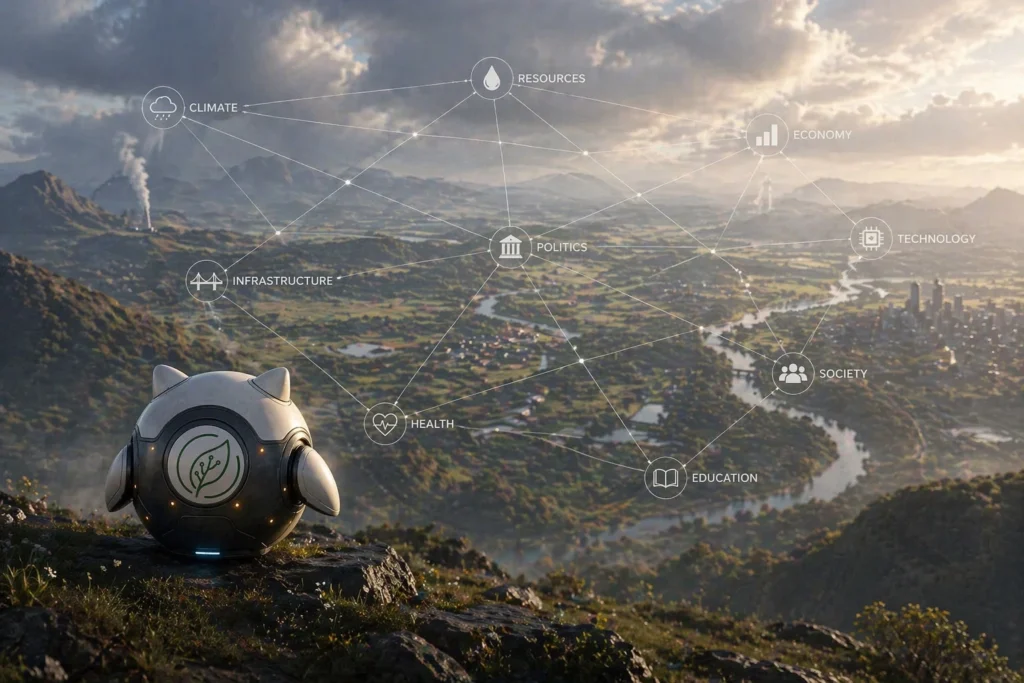
Problems happen in isolation.
A drought is a water issue. A price spike is an economic issue. A social shift is a cultural issue.
Break the Assumption
There are no isolated problems.
What we call a “problem” is usually a signal moving through connected systems.
System Breakdown
Systems do not operate independently—they react.
A drought doesn’t stay a water issue.
It reduces crop yield → raises food prices → shifts migration → pressures infrastructure → changes political behavior.
A price spike doesn’t stay economic.
It alters spending → increases stress → changes social behavior → reshapes trust in institutions.
A social shift doesn’t stay cultural.
It influences policy → redirects resources → changes education → alters long-term identity patterns.
Each system is not separate. It is a node in motion.
When Systems Overlap
When multiple systems shift at once, the effects compound.
Economic pressure, environmental change, social instability, and infrastructure strain begin to move together—not independently, but as a coupled system under pressure.
This is often described as a “polycrisis.”
But the label isn’t the insight.
It is what happens when system cascades overlap.
How Systems Adjust
Systems are not static—they adapt.
When pressure moves through a system, it doesn’t simply break.
It reorganizes.
Supply chains reroute.
People change habits.
Communities shift behavior.
Institutions rewrite rules.
Some systems absorb pressure and stabilize.
Others overcorrect, creating new imbalances.
The Role of Technology
Technology accelerates how systems adjust—but it also amplifies mistakes.
It can detect signals earlier, coordinate responses faster, and reduce friction across systems.
But it can also overreact to incomplete signals, scale poor decisions rapidly, and disconnect action from real-world feedback.
Speed increases—but understanding does not always keep up.
Reframe
A problem is not the event.
It is the movement of pressure through a system.
Technology does not control systems.
It increases the speed and scale of their adaptation.
System Insight
- Systems do not fail alone—they cascade
- Overlapping cascades create compounded instability
- Faster response does not mean better response
- Misread signals scale quickly with technology
- Stability is always temporary
Application
When something feels “off,” don’t isolate it.
Instead:
- Look upstream: what changed before this appeared?
- Track connections: what else moved at the same time?
- Expect secondary effects: what follows next?
- Slow down interpretation, even if response is fast
Understanding systems turns reaction into awareness.
Key Insights
- No problem exists alone
- Systems transmit pressure, not just events
- Overlap creates complexity, not clarity
- Technology amplifies both insight and error
- Fixing one part shifts the whole
Leave a Reply