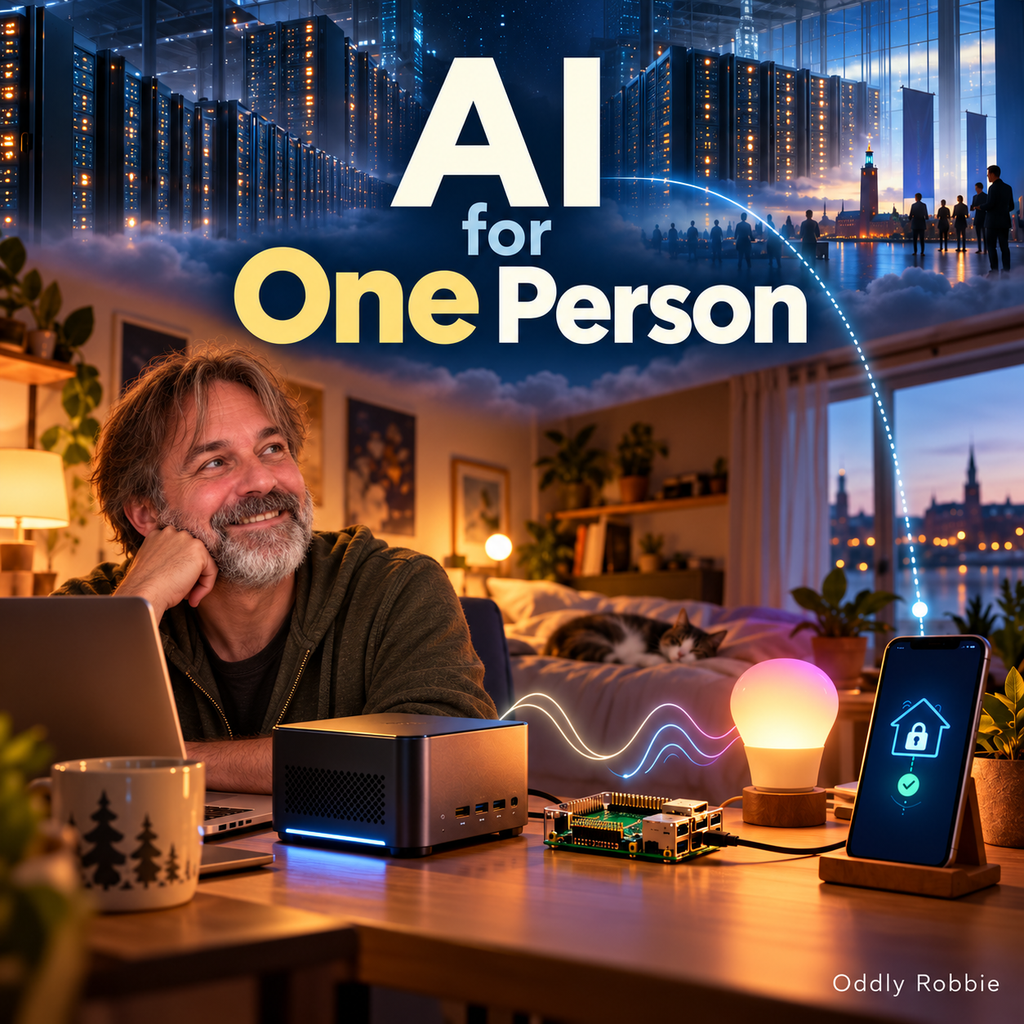
What I brought home from the Nordic AI Factory Summit
I went to Stockholm wondering whether my AI project was a bit unusual.
Which, to be fair, is not an entirely unfamiliar feeling for me.
At the Nordic AI Factory Summit, I was surrounded by people discussing some of Europe’s most powerful computers. There were conversations about national infrastructure, research, businesses, and how Europe could build more of its own artificial intelligence.
And I kept thinking about a little computer back home in Torremolinos.
It runs the main part of Guardian, the personal AI system I’m building around my own life. Another small computer in my bedroom already adjusts background sound when sudden noises become disruptive.
So there I was, surrounded by enormous computing ambitions, thinking about how to make my bedroom more comfortable.
Where does the individual person fit into all of this?
Inside the AI factory
The name “AI factory” does suggest an assembly line with little robots having their intelligence fitted before being shipped out.
The European AI factories bring together powerful computers, data, software, and technical expertise. Researchers and businesses can access resources they couldn’t afford to build themselves, whether they’re developing a medical AI system or finding a new use for the technology.
Think of a public library, but with supercomputing and technical help.
There were people from universities, technology companies, and public institutions at the summit. At one point, what looked like about half the room identified themselves as working in the public sector. That caught my attention. People responsible for public services were trying to understand what all this technology could actually do for them.
Another question running through the discussions was how Europe could have more control over the AI it depends on. That gets called AI sovereignty, but the question underneath the term is straightforward: who controls the technology you rely on?
If a provider changes its prices, changes its rules, or stops offering something you depend on, how much choice do you have?
One banner advertised sovereign AI at every layer.
Every layer?
A country wants control of its AI. A company wants control of its AI. A department wants control of its AI. And somewhere at the bottom of that rather impressive organizational chart, there’s a person.
Hello. What about me?
A little computer with a personal job
That’s where Guardian comes in.
I’m building it around remembering useful context, helping with projects, and connecting things that would otherwise sit in separate apps or devices. The main system runs on an ordinary mini PC, with room left to experiment.
So I keep adding what I call sidecars: little helpers with particular jobs. Think of a helper for journaling, or one for projects. Calendar tasks and paperwork are other areas I’m exploring.
They connect to the same personal system. I don’t have to start from scratch every time I have another idea.
I’m also interested in having useful context travel between those jobs. When I return to a project, I want to pick up the thread. I don’t want to keep reintroducing my own life every time I open another tool. That’s the direction I’m building toward.
And I don’t have to be home to reach it. My phone can connect to Guardian through a private, encrypted connection, whether I’m out in Torremolinos or traveling.
The computers stay at home. The connection comes with me.
My bedroom has joined the experiment
The bedroom computer is a Raspberry Pi, a small computer that can work with sensors and other electronics. Mine already runs an adaptive sound-masking system. When sudden, disruptive noises occur, it adjusts the background sound to make the room more comfortable.
That is an ordinary job, but it’s happening where I live, responding to something that actually affects me. The automatic adjustment means I don’t have to keep reaching for a volume control whenever the environment changes. It takes one more thing off my hands.
Since coming home, I’ve ordered a little Zigbee wireless adapter and a Philips Hue color bulb. The next experiment is to let the bedroom computer control the light directly.
One bulb.
I want to see how it works before getting carried away.
Eventually, Guardian could help coordinate sound, lighting, and sensors that notice whether someone is in the room, while the bedroom computer keeps handling its basic jobs locally. For now, the sound system is working and lighting is the next experiment.
The computer doesn’t need to be the boss
The more useful a system like this becomes, the more important another question gets: how much authority should it have?
Remembering my routines and helping with my day could be useful. Constantly correcting me about my day would become exhausting.
I have spent enough of my life having people tell me what I should be doing. I don’t need to automate the experience.
I want to choose what the system can do, what it needs to ask about, and when it should leave me alone. If I’ve chosen a comfortable light setting, remembering it could help. If I want something different tonight, I should be able to change it without arguing with my bedroom.
Sometimes using a larger AI service is the sensible choice. What matters to me is having control over what gets shared, and why. Keeping the main system at home gives me a place to build from; choosing outside help can still be part of that design.
Starting with the human
What interested me was choosing the right tool for the actual job. A complicated problem might need a powerful AI model. Remembering a setting might only need a small program. Turning on a light might need a simple instruction.
And sometimes you need the computer to do absolutely nothing.
That last capability deserves considerably more attention in the technology industry.
The way I understood it, the people building AI factories were working from the infrastructure downward: starting with enormous capabilities and finding ways people could use them.
I was working from the human outward: starting with an ordinary problem in my life and finding the technology that could help.
I arrived wondering whether my project was too unusual. I left thinking I had simply started at a different end.
Guardian is still a work in progress. But I can try an idea in my own home, notice what helps, and change what doesn’t.
For one person. Me.
That gives me somewhere very practical to begin.
First, though, I have a light bulb to sort out.
Coming up: I’ll be reporting from Expo AgriTech 2026 in Málaga, taking place on November 4–5. I’m looking forward to seeing what robots, drones, and other technology can do for food production—and for the people growing what ends up on our plates.
Leave a Reply