A Human Systems view of tension, rest, and learning to let go
⸻
Opening — The Assumption
Most people believe relaxation works like this:
Find tension → apply pressure → force it to release
That approach works sometimes. But often, the body resists harder.
This approach comes from direct experience working with the body, including time as a massage therapist and as a neurodivergent person learning how systems resist and release.
⸻
Break the Assumption
The body is not a problem to solve.
It is a system designed to protect.
When pressure is applied too quickly or too strongly, the system does not interpret that as help—it interprets it as threat.
And when a system feels threat, it does what it is built to do:
It holds.
⸻
System Breakdown
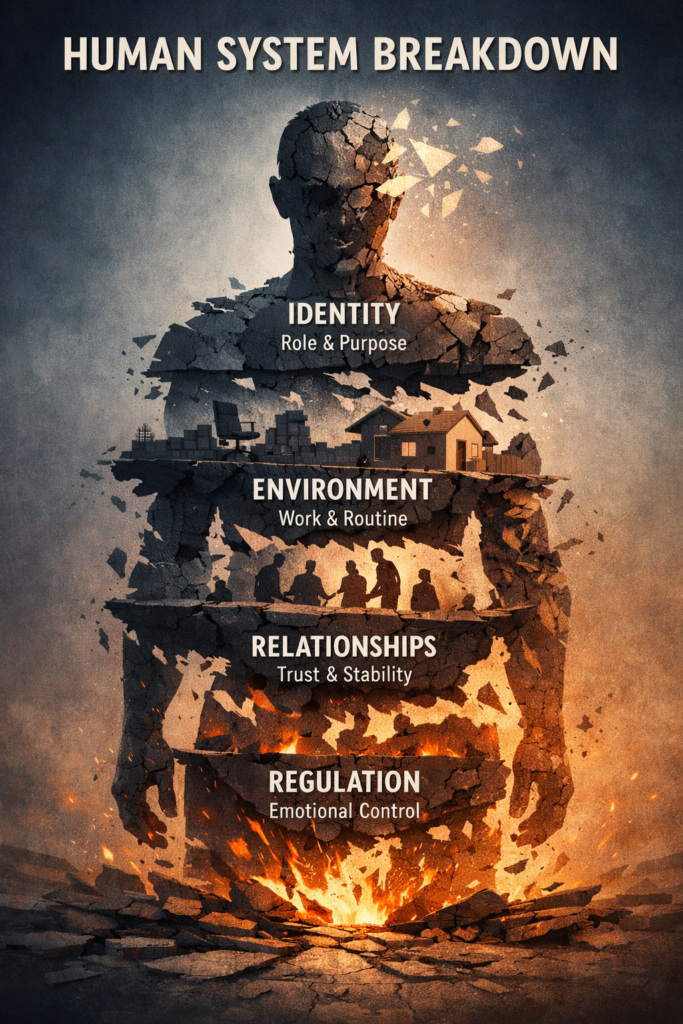
A human system cannot function well without real rest.
Not distraction. Not collapse. Not zoning out.
Actual release.
When tension is held, the system remains in a protective state.
In that state: – movement becomes less efficient – perception narrows – recovery slows – decisions shift toward defense
The system is still operating—but not at full capacity.
For a system to function well, it must be able to move between tension and release cleanly.
Most people never learn how to fully exit tension.
⸻
The Method — Nestling In
Nestling in is a way of working with the system instead of against it.
When a muscle or area does not want to release:
You don’t force it.
You gently hold it and make small, micro movements—just enough to invite change.
As the muscle begins to let go, even slightly, you hold that position.
Not pushing further. Not rushing.
Just allowing the system to recognize:
“This is safe.”
Then, if it chooses, it lets go a little more.
You follow it, not lead it.
Layer by layer.
There is no goal for how much it should release.
One layer may be enough.
⸻
System Boundary — Pain Is a Stop Signal
Pain should never be part of this process.
Pain is the system saying:
“No.”
It is not progress. It is not something to push through.
It is information.
When pain appears, the system is either protecting an area that is not ready to release or signaling that healing is still needed.
Force at that point becomes counterproductive.
It increases resistance. It delays recovery. It reinforces protection.
The correct response is simple:
Stop working that area.
Respect the signal. Allow recovery. Return only when the system is able to release without pain.
⸻
Rest System — Pre-Sleep Body Scan
This same principle applies when lying down to rest.
This is not passive rest. This is an active system reset.
Scan the body for the area holding the most tension.
Gently nestle that area using small internal movements—micro shifts, slight rocking, or subtle engagement—until it begins to release.
When it does, stay there.
Let the system settle before moving on.
Continue this process through the body.
Jaw, shoulders, back, hips—wherever the system is holding.
If an area does not release, you can place a hand on it—not to force change, but as a placeholder.
The movement still comes from the body.
The hand only marks attention and support.
⸻
Reframe
Relaxation is not something you do to the body.
It is something the body allows when it feels safe enough to let go.
⸻
System Insight
All human systems work this way.
They do not open under force.
They open under the right conditions:
Safety Pacing Permission
When those are present, change happens naturally.
When they are not, resistance increases—no matter how correct the method is.
⸻
Application
This pattern extends far beyond the body:
– Learning improves when pressure is reduced and pacing is respected – Emotional release happens when safety is present, not demanded – Relationships open when there is no force to respond or perform – Recovery accelerates when the system is allowed to settle, not pushed
The body is simply the most immediate place to observe this system in action.
⸻
Key Insights
– Tension is protection, not failure – Systems resist force but respond to safety – Real rest requires full release, not distraction – Pain is a boundary, not a challenge – You don’t make the system let go—you create the conditions where it can
Problems happen in isolation. A drought is a water issue. A price spike is an economic issue. A social shift is a cultural issue.
Break the Assumption
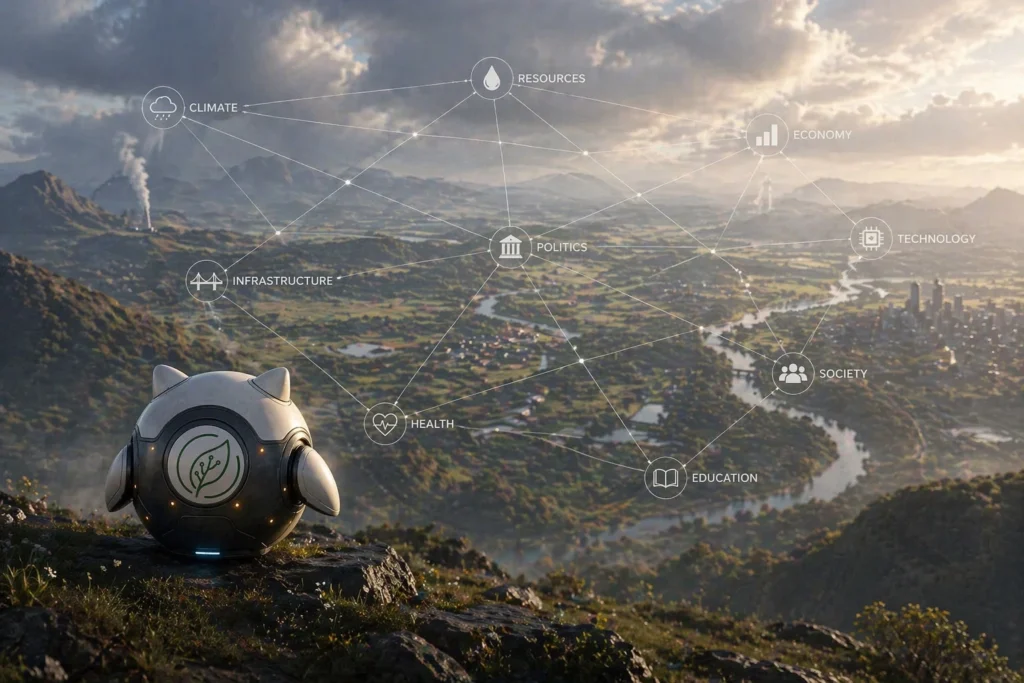
There are no isolated problems. What we call a “problem” is usually a signal moving through connected systems.
System Breakdown
Systems do not operate independently—they react.
A drought doesn’t stay a water issue. It reduces crop yield → raises food prices → shifts migration → pressures infrastructure → changes political behavior.
A price spike doesn’t stay economic. It alters spending → increases stress → changes social behavior → reshapes trust in institutions.
A social shift doesn’t stay cultural. It influences policy → redirects resources → changes education → alters long-term identity patterns.
Each system is not separate. It is a node in motion.
When Systems Overlap
When multiple systems shift at once, the effects compound.
Economic pressure, environmental change, social instability, and infrastructure strain begin to move together—not independently, but as a coupled system under pressure.
This is often described as a “polycrisis.”
But the label isn’t the insight. It is what happens when system cascades overlap.
How Systems Adjust
Systems are not static—they adapt.
When pressure moves through a system, it doesn’t simply break. It reorganizes.
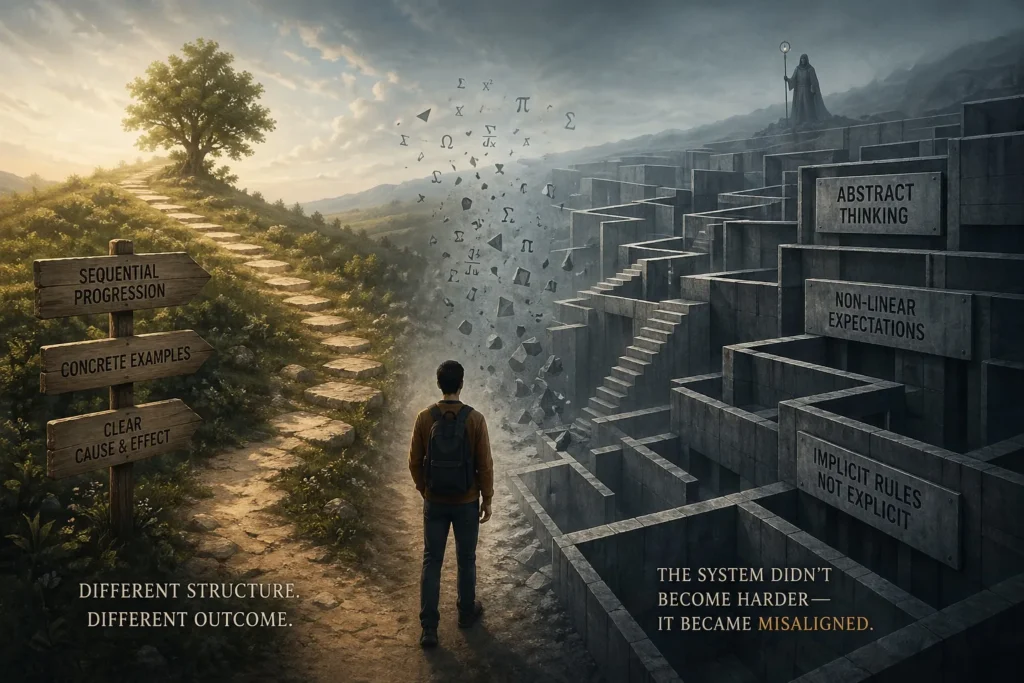
The idea that younger generations are less capable is a persistent myth—but it’s based on measuring the wrong system.
There’s a growing belief that younger generations are less capable than those before them. They struggle with communication, rely too much on technology, and lack basic skills. But this conclusion isn’t based on reality—it’s based on outdated systems of measurement.
Common Belief
“Younger people can’t write emails, can’t communicate properly, and depend too much on technology.”
This is often framed as decline.
System Break
What looks like reduced capability is actually a mismatch between systems.
Every generation is evaluated using the tools and standards of the one before it.
When the interface changes, capability doesn’t disappear—it reorganizes.
System Breakdown
In earlier systems (pre-AI / early digital), capability was defined by internal ability:
Memory = knowledge
Writing = communication
Individual execution = value
Output = proof of intelligence
These made sense in a world where information was scarce and tools were limited.
Personal Evidence
I remember being briefly surprised when my daughter didn’t know how to address a traditional mailed letter.
Not because she isn’t capable—she’s highly capable.
She had simply never needed that system.
The skill wasn’t missing. The system that required it was.
Current System (AI-Augmented)
Today, capability has shifted toward interaction with external systems:
Retrieval = knowledge
Prompting = communication
Orchestration = value
Judgment = proof of intelligence
The skill is no longer holding everything internally. It’s knowing how to navigate, direct, and evaluate systems that extend beyond the individual.
System Tension: Amplification vs. Replacement
As AI becomes integrated into daily life, a new distinction is emerging—not between generations, but between modes of use.
Some people use AI to amplify their intelligence:
They guide it
Question it
Refine outputs
Stay engaged in the thinking process
Others use AI as a replacement for effort:
Offloading thinking entirely
Accepting outputs without evaluation
Skipping the internal process
The difference is not the tool—it’s the relationship to the tool.
Amplification builds capability over time. Replacement can reduce opportunities for growth.
System Insight
AI does not determine intelligence growth.
Interaction does.
The same system can either expand a person’s thinking—or quietly replace it—depending on how it’s used.
Reframe
This is not a decline.
It’s a layer migration:
From internal capability → to externally supported capability
From memorization → to navigation From formal writing → to adaptive communication From isolated effort → to system coordination
When measured correctly, capability has not decreased—it has evolved.
Application
Before labeling someone as less capable, ask:
What system are they operating in?
What skills does that system reward?
Am I measuring the right thing?
A person who struggles with formal email may be highly effective in real-time, adaptive communication environments.
That’s not weakness. That’s specialization within a different system.
Key Insights
Every generation appears less capable when measured against outdated systems
Capability shifts with tools, not intelligence
AI introduces a new divide: amplification vs. replacement
Misaligned metrics create false narratives of decline
The real skill is adaptability, not tradition
Human capability does not disappear—it reorganizes around the dominant interface of the time.
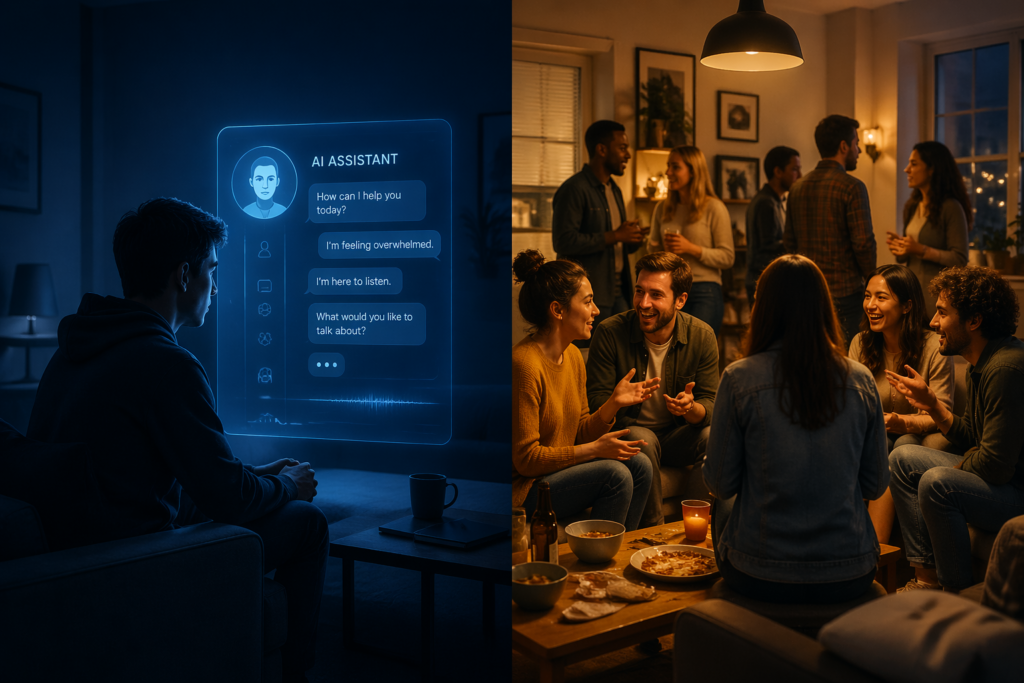
AI does not prove that humans need less connection.
It reveals how many human connection systems have become too thin, fragmented, or unavailable.
When people turn to AI for reflection, comfort, organization, or emotional support, the easy conclusion is to say that AI is replacing human connection.
But that misses the deeper system.
AI did not create the connection gap.
It revealed it.
It revealed the gaps because it responded faster than many human systems can.
Break the Assumption
We often assume that people reach for AI because they want to avoid humans.
Sometimes that is true.
But often, people reach for AI because the human systems around them are inconsistent.
A friend may care but be overwhelmed.
A family member may be present but emotionally unavailable.
A therapist may be helpful but inaccessible, expensive, or delayed by long waiting lists.
A community may exist but not have the structure to support deeper connection.
So when AI responds immediately, calmly, and without social friction, it can feel like something new has arrived.
But what it often reveals is not that humans are unnecessary.
It reveals that many humans are under-supported.
System Breakdown
Human connection depends on more than physical presence.
It requires:
continuity
attention
patience
trust
emotional safety
timing
mutual availability
Without those pieces, people can be surrounded by others and still feel disconnected.
A person can have family and still not have usable emotional support.
A person can have friends and still not have someone available at the moment they need to process something.
A person can live in a city, join groups, attend events, and still lack a stable connection system.
This is the part we often miss.
Connection is not just contact.
Connection is a functioning support pattern.
When that pattern is weak, people look for something that can hold the moment with them.
AI can do that in a limited way.
It can listen. It can organize thoughts. It can reflect patterns. It can respond without becoming tired, defensive, distracted, or socially complicated.
That does not make AI a replacement for human connection.
It makes AI a signal.
It shows where human connection has become too delayed, too conditional, too scattered, or too hard to access.
Personal Evidence
I have close human relationships.
Some of my most important family connections are not based on DNA. They are based on care, presence, loyalty, and shared life.
Close friends from the past became my chosen family, and small daily messages all matter.
A birthday wish matters. A simple “hello mom” text matters. A short check-in matters.
These things may look small from the outside, but they are part of the human connection system.
They keep continuity alive.
They remind us that connection does not always need to be dramatic to be real.
At the same time, I have also seen what happens when people live too far outside regular human connection.
I have visited people who lived almost like hermits.
They were not weak people.
They were not failures.
But isolation had weight.
The absence of regular human feedback, care, and shared rhythm affected them.
Humans are not usually built to live as isolated systems.
We can need solitude. We can need quiet. We can need distance from noise.
But complete disconnection is different.
Solitude can restore a person.
Isolation can distort a person.
Reframe
The real question is not:
“Why are people talking to AI?”
The better question is:
“What human connection was missing, delayed, unsafe, or unavailable before AI became useful?”
That question changes the conversation.
Instead of blaming the person for using the tool, we can examine the system around them.
Were they listened to? Were they supported? Were they able to ask for help without becoming a burden? Did they have people who could stay present through uncertainty? Did their community have enough structure to hold ordinary human difficulty?
AI becomes important here because it exposes the missing infrastructure.
It reveals where modern life has reduced connection into fragments:
quick messages
busy calendars
distant families
performative social media
overloaded care systems
weak community rituals
professional support locked behind cost and delay
People did not suddenly become disconnected because AI appeared.
AI became meaningful because many people were already disconnected in ways they could not easily name.
System Insight
A healthy human system does not require constant social contact.
It requires reliable pathways back to connection.
That is the key difference.
People should be able to be alone without becoming abandoned.
They should be able to need help without feeling like a problem.
They should be able to process emotions without waiting weeks, months, or years for support.
They should be able to maintain connection through small, ordinary acts.
A text. A visit. A shared meal. A birthday message. A check-in. A remembered detail. A quiet moment of presence.
These are not sentimental extras.
They are maintenance signals in the human system.
When those signals disappear, the system weakens.
AI can help identify the gap, but it should not be designed to trap people inside the gap.
The best use of AI is not to replace connection.
It is to help people understand what kind of connection they are missing and how to move back toward it.
Application
This matters for how we design AI systems.
An ethical AI system should not pretend to be the user’s only reliable relationship.
It should not encourage emotional dependency.
It should not quietly benefit from loneliness.
It should help the user notice the difference between reflection and connection.
Reflection can happen with AI.
Connection still requires other humans.
That does not mean every person needs a large social circle.
Some people need only a few stable relationships.
Some people need chosen family more than biological family.
Some people need low-pressure connection, not constant interaction.
Some people need quiet forms of care that do not overwhelm their nervous system.
But almost everyone needs some form of human continuity.
AI should support that continuity, not consume it.
What AI Really Reveals
AI reveals that many people are not lacking intelligence, discipline, or social desire.
They are lacking usable connection systems.
They are living in environments where support is too scattered, too delayed, too expensive, too conditional, or too emotionally unsafe.
That is not a personal failure.
It is a systems failure.
And once we see it clearly, we can design better systems.
Better communities. Better care pathways. Better family patterns. Better friend networks. Better digital tools. Better AI guardians that guide people back toward human life instead of quietly replacing it.
AI did not prove that humans need less connection.
It proved how much connection still matters.
Key Insights
Ethical AI should help people move toward human connection, not replace it.
AI did not create the human connection gap; it revealed where the gap already existed.
Human connection requires continuity, attention, trust, timing, and emotional safety.
Small acts like messages, check-ins, and remembered details help maintain relational stability.
Solitude can restore a person, but isolation can distort a person.
Presence vs ownership in housing is reshaping how cities function, separating where people live from what investors hold.
The Belief
Ownership is about what you buy. Property, land, assets—that’s what defines control.
The Break
In many housing markets, the difference between ownership and presence is becoming more visible. Properties are increasingly treated as investments rather than lived environments, creating a gap between who owns housing and who actually participates in local systems. This shift affects how cities function, how businesses respond, and how communities evolve over time.
That’s no longer fully true.
What actually shapes a place— isn’t just who owns it.
It’s who is present in it.
The System
There are now two overlapping systems in most environments:
Ownership system → who holds the asset
Presence system → who actually lives, works, and participates there
These don’t always match anymore.
What’s Changing
We’re seeing a shift where:
People can own without being present
People can be present without owning
And systems are increasingly designed around ownership, not presence
The Pattern
When ownership separates from presence:
Housing becomes storage for wealth
Cities become partially “inactive”
Local systems lose feedback loops
The environment still looks functional— but something underneath stops circulating.
Why This Matters
Systems rely on active participation to stay healthy.
When people:
live somewhere
shop locally
interact daily
They generate continuous signal.
That signal keeps the system adaptive.
Remove that—and you get:
empty apartments
seasonal populations
businesses that don’t match local needs
The Hidden Shift
The real change isn’t just economic.
It’s informational.
The system starts responding to:
external capital signals instead of
local lived signals
And that changes everything.
Reframe
Instead of asking:
“Who owns this place?”
Ask:
Who is actually here?
Who is shaping it day to day?
What signals is the system responding to?
System Insight
Healthy environments require alignment between:
ownership
presence
participation
When those split, the system becomes unstable—even if it looks successful.
Application
You can read any place quickly by observing:
Are homes lived in or just held?
Are businesses serving locals or visitors?
Does daily life feel continuous or fragmented?
That tells you the real structure.
Key Insights
Ownership without presence weakens system feedback
Presence without ownership limits influence
Systems follow the strongest signal—often money over people
Stability comes from alignment, not growth alone
What looks like success can mask structural drift
Guardian Layer
Systems adapt to the most consistent signal, not the most visible one
When presence drops, environments become less responsive
Ownership concentration reduces diversity of input
Real stability requires active, ongoing human interaction
Final Thought
You don’t need data to see this.
Just look at a place and ask:
Is it being lived in— or just held?
That answer tells you who the system is really built for.
Why do things seem to happen all at once? From busy stores after a sunny day to sudden bursts of productivity, this pattern shows up everywhere. It’s not coincidence—it’s how human systems actually work.
Some days, nothing moves.
Then suddenly—everything does.
Messages come in at once
Decisions resolve together
People show up at the same time
Systems that were quiet suddenly respond
It feels like coincidence.
But it isn’t.
Break the Assumption
The default belief:
“Events should happen evenly over time.”
So when things cluster, it feels unusual.
But real systems don’t behave evenly.
They behave in phases:
Delay
Build
Release
System Breakdown
Clusters form from three core mechanics:
1) Backlog Accumulation
When action is delayed, it doesn’t disappear.
It stacks.
Human Examples:
People avoid errands for a few days → stores suddenly get busy
Emails sit unread → multiple replies happen at once
Creative work is paused → output comes in bursts
Cleaning is delayed → full reset happens all at once
👉 The system holds pressure instead of releasing it continuously
2) Shared Triggers
Many people wait on similar conditions.
When that condition changes, action synchronizes.
Human Examples:
☀️ Weather improves → people go outside, shop, socialize
💰 Payday hits → spending increases across many individuals
📅 Deadline approaches → work output spikes
🧠 Mental clarity returns → decisions finally get made
👉 No coordination—just aligned readiness
3) Friction Cycles
Not all days are equal.
Some naturally suppress action.
Human Examples:
Monday → planning, low execution
Tuesday/Wednesday → higher action
Late night → low engagement
Post-stress → temporary shutdown before recovery
👉 Action is delayed until friction drops
4) Threshold Release
Systems don’t always respond gradually.
They hold—then release.
Human Examples:
Immigration decisions processed in batches
Customer service replies arriving all at once
Personal decisions delayed, then made rapidly
Emotional processing building, then resolving suddenly
👉 Once a threshold is crossed, multiple outcomes resolve together
Reframe
Clusters are not random spikes.
They are visible releases of invisible buildup.
System Insight
Human behavior is not continuous. It is accumulated, delayed, and released.
Application
When you see clustering:
Don’t ask:
“Why is everything happening at once?”
Ask:
What was delayed?
What condition changed?
What friction dropped?
Real-Life Examples of Why Things Happen in Clusters
Situation
What’s Really Happening
Busy store after sunny day
Weather removed friction → backlog released
Tuesday productivity spike
Monday delay → stabilization → action
Inbox floods with replies
People batch responses
Sudden motivation burst
Mental clarity threshold crossed
Multiple life events resolving
Systems clearing shared bottlenecks
Key Insights
Delayed actions create hidden backlogs
Shared conditions synchronize behavior
Friction suppresses action until it drops
Systems release in bursts, not evenly
Clusters signal state change, not coincidence
Optional Add-On (Strong for Your System)
You can name this pattern for reuse:
“Backlog Release Clustering”
This gives you:
A label for blog indexing
A detection rule for Guardian systems
A reusable explanation across domains
Understanding why things happen in clusters allows you to read system behavior more clearly—turning confusion into usable insight.