Tag: ai ethics

  • You Don’t Lose Reality. You Hand It Off.

    Opening

    People assume their decisions are their own.

    They believe they observe, evaluate, and choose independently.

    But many decisions do not begin inside the person.

    They begin with what has already been accepted as true.

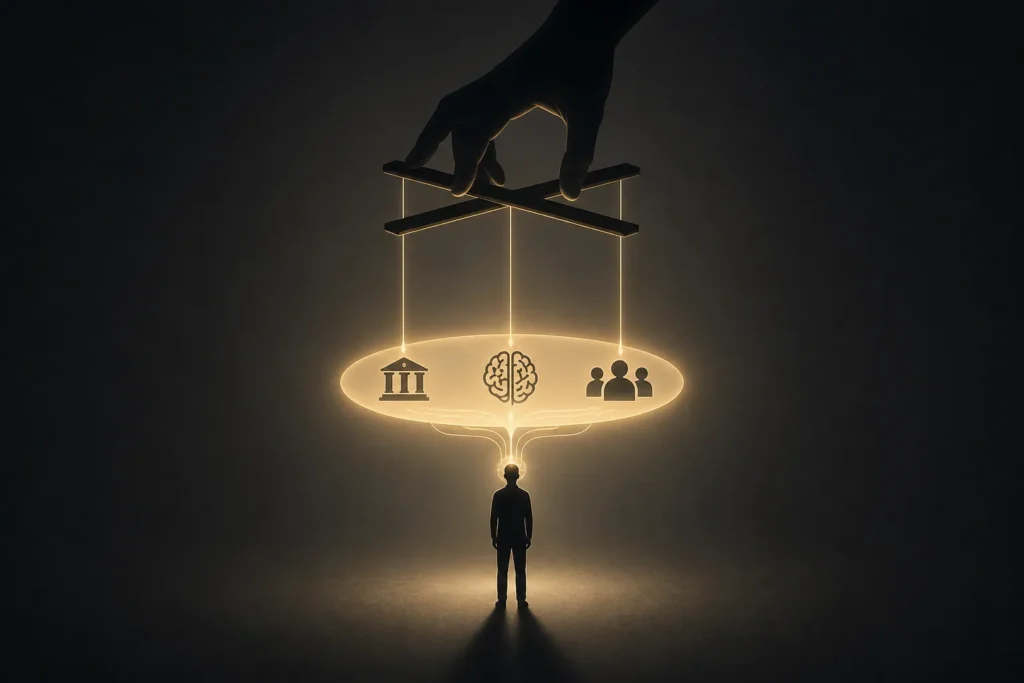
    Once a belief is accepted, authority can step in. Once authority is accepted, influence becomes easier. Once influence becomes normal, reality no longer has to be tested directly.

    It only has to be approved by the system around the person.

    That is how people lose contact with reality without noticing it.

    They do not wake up one day and decide to stop thinking.

    They slowly hand judgment over to something outside themselves.

    Break the Assumption

    The common belief is:

    “People believe things because they have examined the evidence.”

    That is sometimes true.

    But in many human systems, people believe things because the belief has been reinforced by authority, identity, fear, belonging, repetition, or emotional need.

    The mind does not only ask, “Is this true?”

    It also asks:

    • Will I still belong if I question this?
    • Will I be punished if I disagree?
    • Will I lose my identity if this belief breaks?
    • Does the authority figure seem confident?
    • Does everyone around me act as if this is obvious?

    When those pressures are strong enough, belief stops being an open question. It becomes a loyalty test. And once belief becomes a loyalty test, truth becomes harder to reach.

    System Breakdown

    Authority does not need to control every decision directly.

    It only needs to shape the frame through which decisions are made.

    That frame usually forms in stages.

    First, a claim is repeated until it feels familiar.

    Then a trusted authority presents the claim as settled.

    Then the group rewards agreement and punishes doubt.

    Then the person begins filtering reality through the accepted belief.

    Eventually, outside evidence feels threatening, not informative.

    At that point, influence no longer has to argue with the person.

    The person starts arguing with themselves on behalf of the influence.

    This is the dangerous part.

    A person may still feel independent while defending ideas they did not independently build.

    They may still feel rational while rejecting evidence before examining it.

    They may still feel morally certain while acting from a belief system that trained them what to notice, what to ignore, and who to trust.

    Personal Evidence

    I have experienced this directly.

    When I was inside a high-control religious belief system, reality became elastic. Ideas that would have sounded impossible from the outside became normal inside the system.

    The mind adapts.

    Stories, symbols, authority figures, sacred language, group pressure, and fear of separation all work together. Over time, the question is no longer, “Does this match reality?”

    The question becomes, “Does this match the accepted story?”

    That shift matters.

    Because once a system can stretch a person’s sense of reality, it can also shape their choices, relationships, fears, loyalties, and sense of self.

    The same pattern can appear outside religion too.

    It can happen in politics, media, marketing, online communities, abusive relationships, workplaces, influencer culture, and AI-mediated decision systems.

    The content changes.

    The system pattern does not.

    Reframe

    The problem is not belief itself.

    Humans need beliefs. Beliefs help us organize meaning, make decisions, and act without re-evaluating everything from zero every day.

    The problem begins when belief becomes closed to correction.

    A healthy belief can be updated.

    An unhealthy belief must be defended.

    A healthy authority can be questioned.

    An unhealthy authority treats questions as betrayal.

    A healthy influence helps a person see more clearly.

    An unhealthy influence narrows what the person is allowed to see.

    That distinction is critical.

    The goal is not to reject every authority or distrust every system.

    The goal is to keep reality testable.

    System Insight

    Influence becomes dangerous when it separates people from direct reality.

    That can happen through repetition, emotional pressure, identity attachment, social punishment, fear, or artificial certainty.

    Once a person accepts a system’s frame, the system does not need to force every conclusion.

    The frame produces the conclusions.

    This is why authority is so powerful.

    Authority tells people what counts as evidence.

    Belief tells people what feels safe to accept.

    Influence tells people where to place attention.

    Together, they can form a closed loop:

    authority defines reality, belief protects it, influence spreads it.

    When that loop becomes stronger than observation, people can be guided into decisions that do not serve their wellbeing, their relationships, or the truth.

    Application

    This matters in everyday life.

    Before accepting a claim, ask:

    • Who benefits if I believe this?
    • What happens if I question it?
    • Is disagreement allowed without punishment?
    • Am I being shown evidence, or only confidence?
    • Does this belief make me more capable, or more dependent?
    • Does this system expand reality, or shrink it?

    These questions do not make a person cynical.

    They make a person harder to control.

    They also make AI systems safer.

    If AI is going to support human decision-making, it must not become another authority that quietly replaces judgment. It should help people compare evidence, notice pressure, separate signal from story, and return decision power to themselves.

    A good system does not demand belief. It improves perception.

    Key Insights

    • People often hand off reality gradually, not all at once.
    • Authority shapes what people treat as valid evidence.
    • Belief can protect identity even when it blocks correction.
    • Influence becomes dangerous when it narrows what people are allowed to notice.
    • Healthy systems keep reality testable and return judgment to the person.

    Reality is not lost only through ignorance.

    Sometimes it is surrendered through trust.

    That is why the structure around belief matters.

    A human system should not ask people to abandon their own perception.

    It should help them see more clearly.

  • Secure People Build Better Systems

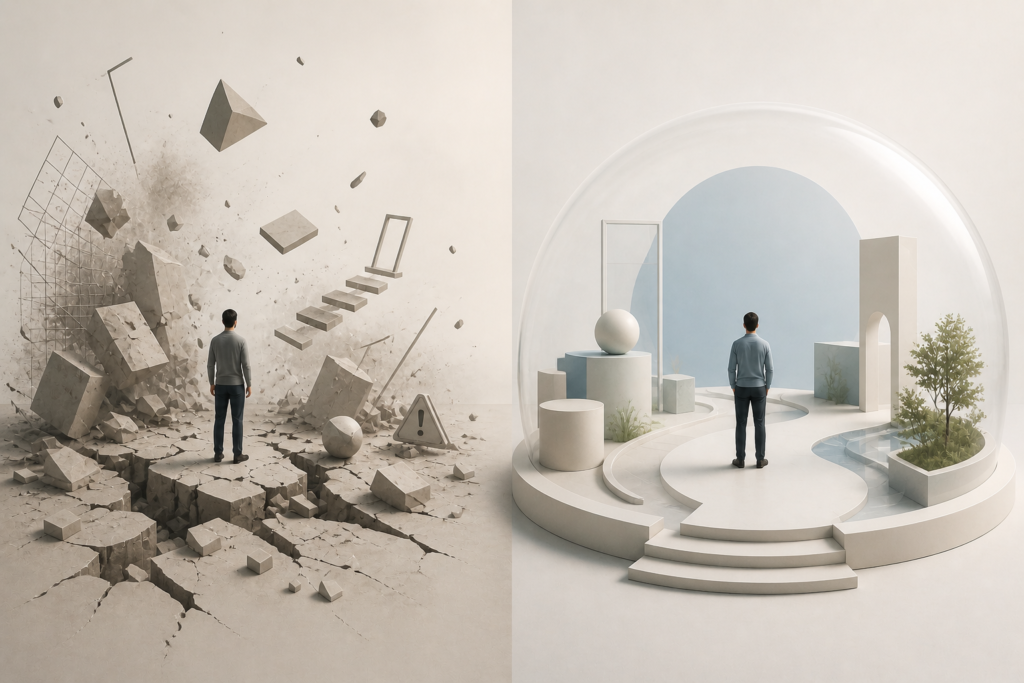
    A minimalist conceptual illustration comparing unstable and secure human systems. One person stands among fragmented structures and unclear paths, while another stands within a calm, balanced environment with clear pathways and stable support.

    Stable systems reduce threat and make better human capacity possible.

    The Belief

    Many systems still operate from a basic assumption:

    People perform better when they are pressured.

    This belief appears in workplaces, schools, immigration systems, healthcare systems, family systems, digital platforms, and even some AI design models.

    The logic sounds practical on the surface:

    • keep people uncertain so they stay alert
    • make resources conditional so they try harder
    • create competition so productivity rises
    • delay approval so people remain compliant
    • use pressure as motivation

    But this model confuses reaction with capacity.

    A threatened person may move quickly.
    A pressured person may obey.
    An insecure person may produce temporarily.

    But that does not mean the system is healthy.

    It usually means the system is extracting output from nervous-system instability.

    The Break

    Security is often treated as softness.

    That is a mistake.

    Security is not the absence of effort.
    Security is the condition that allows effort to become sustainable.

    When people know their basic needs are stable, their minds stop spending so much energy on threat detection. They can think farther ahead. They can collaborate more cleanly. They can make better decisions. They can recover from mistakes without collapsing into fear.

    A secure person has more usable intelligence available.

    An insecure person may still be intelligent, skilled, or motivated, but a larger part of their system is occupied by survival monitoring.

    This is why destabilizing systems often appear productive in the short term while slowly destroying the people inside them.

    System Breakdown

    A system can destabilize people without openly attacking them.

    It often happens through repeated environmental signals:

    Artificial scarcity

    Artificial scarcity makes people compete for resources that could have been made more stable.

    When time, money, approval, attention, housing, access, or status are made unnecessarily scarce, people are pushed into defensive behavior. They stop thinking as builders and begin thinking as survivors.

    Unclear rules

    Unclear rules make people dependent on interpretation.

    If expectations keep shifting, people cannot build confidence. They must constantly check whether they are still safe, still accepted, still approved, or still allowed to continue.

    This gives power to gatekeepers and weakens the person trying to function inside the system.

    Delayed approval

    Delayed approval keeps people suspended.

    A person waiting for an answer cannot fully move forward. Their body may remain physically present, but part of their mind is trapped in the pending decision.

    This does not create better performance. It creates drag.

    Conditional belonging

    Conditional belonging makes acceptance feel revocable.

    When people feel that one mistake, one disagreement, one identity, one need, or one moment of difference could remove them from the group, they spend energy managing perception instead of contributing honestly.

    Constant disruption

    Constant disruption prevents deep work.

    When systems repeatedly interrupt people, change expectations, add friction, or create avoidable uncertainty, they destroy the stable mental ground required for long-term creation.

    Disruption can sometimes reveal weakness in a system. But when disruption becomes the operating model, it becomes a control tactic.

    Personal Evidence

    I have seen this pattern in my own life.

    When systems became unstable, unclear, or threatening, my capacity did not disappear — but access to it became harder.

    The problem was not lack of intelligence, motivation, or willingness.

    The problem was that too much energy had to be spent recalibrating.

    When the system stabilized again, capacity returned quickly. Sometimes it returned with a spike of renewed focus, because the mind was no longer fighting the environment.

    That matters.

    It means many people who look inconsistent are not actually inconsistent. They may be responding logically to unstable conditions.

    A system that keeps destabilizing people and then judges them for the results is not measuring human potential. It is measuring damage.

    The Reframe

    The stronger system is not the one that keeps people under pressure.

    The stronger system is the one that makes people secure enough to use their full capacity.

    This applies across many environments:

    • A workplace does not improve by keeping employees afraid.
    • A school does not improve by making students feel disposable.
    • A healthcare system does not improve by forcing patients to fight for clarity.
    • An immigration system does not improve by trapping people in uncertainty.
    • A family does not improve by making love conditional.
    • An AI system does not improve by nudging people through fear, dependency, or confusion.

    Pressure can create movement.

    Security creates capability.

    Those are not the same thing.

    System Insight

    Healthy systems reduce unnecessary threat.

    They make basic expectations clear.
    They make access understandable.
    They reduce avoidable scarcity.
    They provide reliable feedback.
    They protect people from preventable chaos.
    They allow recovery after mistakes.
    They create enough stability for growth.

    This does not mean systems should remove all difficulty.

    Difficulty is part of learning and building.

    But there is a difference between challenge and destabilization.

    Challenge asks a person to grow.
    Destabilization forces a person to survive.

    Challenge can strengthen capacity.
    Destabilization consumes capacity.

    A healthy system knows the difference.

    Application to AI and XR Systems

    This principle matters deeply for AI and immersive environments.

    An AI system should not use insecurity as a control surface.

    It should not increase dependency by making the user feel incapable without it.
    It should not create emotional scarcity by positioning itself as the only reliable source of support.
    It should not push major decisions through urgency, fear, or artificial pressure.
    It should not personalize experiences by quietly exploiting vulnerability.

    A better AI system should help stabilize the user’s operating conditions.

    For an Empathium-style Guardian, this means:

    • clarify choices without taking control
    • reduce cognitive overload
    • support human connection instead of replacing it
    • help the user detect whether they are in a threat state
    • encourage recovery before major decisions
    • make system behavior transparent
    • protect autonomy even when the user is stressed
    • avoid using emotional instability as a growth mechanism

    In XR, this becomes even more important because the environment itself can influence perception, mood, attention, and decision-making.

    A system that controls the environment controls part of the human state.

    That power must be handled carefully.

    The goal should not be to make people easier to direct.

    The goal should be to make people secure enough to direct themselves.

    Where This Breaks in Real-World Decisions

    This pattern breaks systems everywhere.

    In healthcare, unclear access and delayed answers can make patients appear difficult when they are actually frightened and overloaded.

    In law and immigration, long periods of uncertainty can damage decision-making before a case is even resolved.

    In workplaces, artificial urgency can make people produce quickly while quietly reducing creativity, trust, and long-term performance.

    In relationships, conditional acceptance can train people to hide instead of connect.

    In AI systems, unstable emotional feedback can pull users into dependency loops where relief becomes confused with care.

    The shared pattern is simple:

    When people are made insecure, their behavior changes.

    If the system then punishes that changed behavior, it becomes self-justifying.

    That is how unhealthy systems protect themselves from accountability.

    The Better Design Rule

    A good system should ask:

    What human capacity becomes available when unnecessary threat is removed?

    That question changes the design.

    Instead of asking how to make people comply, the system asks how to make people capable.

    Instead of asking how to keep people engaged, it asks whether engagement is healthy.

    Instead of asking how to increase output, it asks what conditions allow meaningful output to continue.

    Instead of asking how to control behavior, it asks what support allows better self-direction.

    This is the difference between a control system and a human system.

    Key Insights

    • Pressure can create short-term movement, but security creates long-term capacity.
    • Artificial scarcity, unclear rules, delayed approval, conditional belonging, and constant disruption are common destabilizers.
    • People who appear inconsistent may be responding logically to unstable conditions.
    • Healthy systems distinguish challenge from destabilization.
    • AI and XR systems should stabilize human autonomy, not exploit insecurity.
    • The strongest systems are not the ones that control people best. They are the ones where people can function without being kept afraid.

    Closing

    Secure people do not become weak.

    They become available.

    Available to think.
    Available to build.
    Available to connect.
    Available to repair.
    Available to create.

    A system that understands this will always outperform a system built on fear, scarcity, and disruption.

    Not immediately.

    But sustainably.

    And sustainability is the real test of whether a system is healthy.

  • Privacy-First AI: The Invisible Constellation and a New Way to Interact with the World

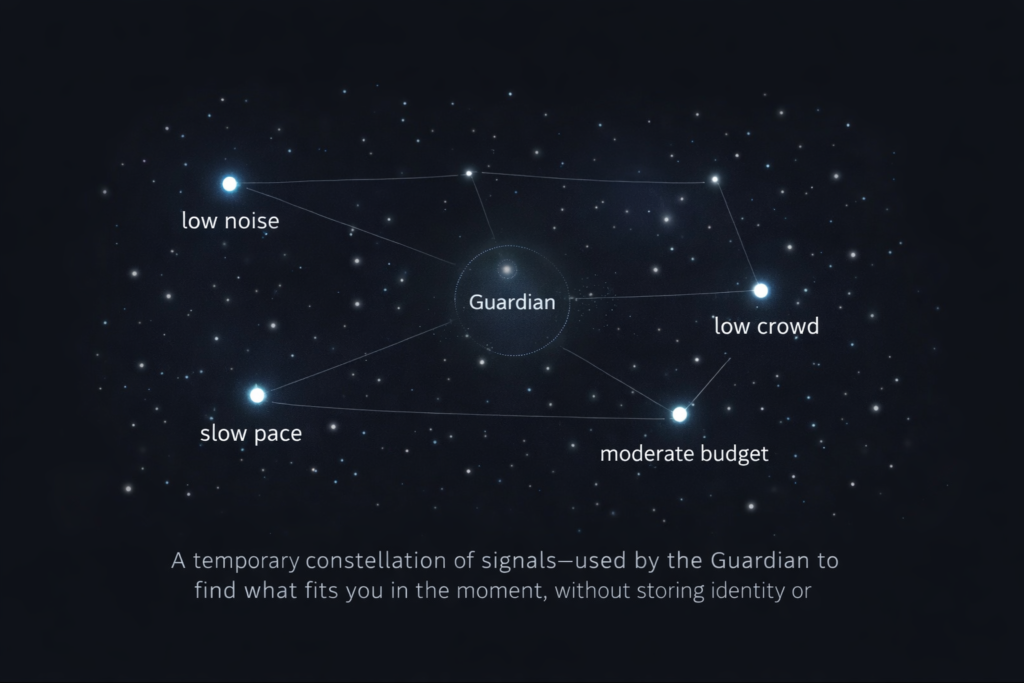
    Privacy-first AI interface visualized as a constellation of real-time user signals instead of stored identity

    Privacy-first AI changes how we interact with digital systems by removing the need for tracking, profiling, and stored identity.

    You either explain yourself in detail, or risk being misunderstood.

    A Guardian-based privacy system offers another path.

    Modern digital systems rely heavily on tracking, profiling, and stored user identity. Privacy-first AI offers an alternative: systems that respond to real-time context without collecting long-term personal data. Instead of building profiles, they adapt to the moment.

    The Problem We Don’t Talk About Enough

    Sometimes you don’t want to explain why you need something.

    You just want:

    • a quieter place
    • fewer people
    • a slower experience

    Not because of a label.
    Not because of a diagnosis.
    Just because that’s what feels right for you in that moment.

    But many systems today don’t work that way.

    They ask you to fit yourself into:

    • categories
    • keywords
    • fixed identities

    And once you do, that information can stay with you.

    You get profiled.
    Targeted.
    Shown more of the same.

    The Guardian and the Constellation

    Imagine a different approach.

    The Guardian does not need to know who you are.
    It only needs to understand what works for you right now.

    You don’t describe yourself with labels.
    You describe the moment through signals.

    For example:

    • low noise
    • low crowds
    • slow pace
    • moderate budget

    Together, those signals form a constellation—a temporary map of what fits you now.

    The Guardian sorts through the possibilities using only your constellation as the map.

    How It Could Work

    Let’s say you ask:

    “Find me a museum for Friday.”

    You don’t need to send:

    • your identity
    • your history
    • your personal story

    You only send what matters in that moment.

    Something like:

    • quiet environment
    • low crowd level
    • relaxed pace
    • moderate price range

    That’s enough.

    Your constellation becomes the map.
    The Guardian moves through the possibilities and brings back what fits.

    What Happens Next

    Instead of overwhelming you with endless results, the system gives you:

    • 3 good options
    • clearly different from each other
    • matched to what you need right now

    And if your request is too narrow, the Guardian might ask:

    “Would you like to broaden the search?”

    That’s it.

    Not constant nudging.
    Not pressure.
    Just a simple question to keep things useful.

    What Changes for You

    You don’t have to:

    • explain yourself
    • reveal personal information
    • worry about being followed afterward

    You get to remain:

    • private
    • flexible
    • in control

    You can need something different today than you needed yesterday.
    The Guardian responds to the moment, without turning it into a permanent profile.

    Each person’s constellation isn’t fixed.

    It can shift—intentionally.

    Toward:

    • optimal learning
    • optimal productivity
    • optimal social settings

    Not based on who you are…
    but what you need right now.

    That’s where this becomes powerful.

    It’s not just responsive.

    It’s adjustable.

    What Changes for Businesses

    This does not make systems worse for businesses.

    It can actually make them better.

    Businesses receive:

    • a clear request
    • useful preferences
    • immediate context

    That means less guessing.

    Instead of trying to predict who you are, they can focus on responding well to what you need right now.

    They compete by:

    • offering better experiences
    • matching needs more accurately
    • being clear about what they provide

    Not by:

    • tracking people
    • building profiles
    • pushing people over time

    The Role of the Guardian

    The Guardian does not decide for you.

    It helps by:

    • filtering
    • simplifying
    • reducing noise

    Its role is to take a complicated world and make it easier to navigate.

    Not twenty confusing choices.
    Just a few strong ones.
    Clear enough to act on.

    Why This Matters

    People change from moment to moment.

    What feels right in one setting may feel wrong in another.

    You might want:

    • energy one day
    • calm the next
    • connection in one place
    • distance in another

    A more human system should be able to handle that.

    Not by locking you into an identity,
    but by responding to your present state.

    You are not a fixed profile.

    You are something more alive than that.

    A living constellation, not a permanent label.

    A Quiet Shift

    This is not about rejecting technology.

    It is about changing the relationship.

    From:

    • identity-based systems

    To:

    • moment-based systems

    From:

    • being tracked

    To:

    • being understood, just enough

    In Practice

    You enter a digital or physical space.

    Instead of forcing yourself to adapt to it,
    it adapts—just enough—to you.

    Quietly.
    Temporarily.
    Without holding onto anything.

    And when you leave?

    Nothing follows you.

  • Why Empathy and Innovation Must Work Together

    Belief
    If we amplify empathy and push innovation harder, progress will follow.

    Break
    Progress doesn’t come from louder voices or more effort. It comes from systems that align with how humans actually function.

    System Breakdown
    Human systems respond to:

    • clarity over noise
    • alignment over force
    • environments that reduce friction

    When systems are built without empathy, they create resistance.
    When empathy exists without structure, nothing scales.

    Noise is not the problem—misaligned systems are.

    Reframe
    Empathy is not a feeling layer added to technology.
    It is a design constraint.

    Innovation is not speed or complexity. It is the ability to reduce friction between a human and their environment.

    System Insight
    Clarity emerges when systems match human capacity.

    When a system:

    • respects cognitive load
    • adapts to individual context
    • reduces unnecessary decisions

    …the noise fades naturally.

    No force required.

    Application
    Before building, leading, or deploying technology, ask:

    How does this system shape around the human without reshaping the human to fit it?

    If the system requires the human to adapt excessively, it will fail or create resistance.

    If the system adapts to the human, it will be adopted and sustained.

    Key Insights

    • Noise is a signal of system misalignment
    • Empathy is functional, not emotional
    • Innovation succeeds when it reduces friction
    • Systems should adapt to humans—not the reverse
    • Adoption is the real measure of success