Privacy-first AI changes how we interact with digital systems by removing the need for tracking, profiling, and stored identity.
You either explain yourself in detail, or risk being misunderstood.
A Guardian-based privacy system offers another path.
Modern digital systems rely heavily on tracking, profiling, and stored user identity. Privacy-first AI offers an alternative: systems that respond to real-time context without collecting long-term personal data. Instead of building profiles, they adapt to the moment.
The Problem We Don’t Talk About Enough
Sometimes you don’t want to explain why you need something.
You just want:
- a quieter place
- fewer people
- a slower experience
Not because of a label.
Not because of a diagnosis.
Just because that’s what feels right for you in that moment.
But many systems today don’t work that way.
They ask you to fit yourself into:
- categories
- keywords
- fixed identities
And once you do, that information can stay with you.
You get profiled.
Targeted.
Shown more of the same.
The Guardian and the Constellation
Imagine a different approach.
The Guardian does not need to know who you are.
It only needs to understand what works for you right now.
You don’t describe yourself with labels.
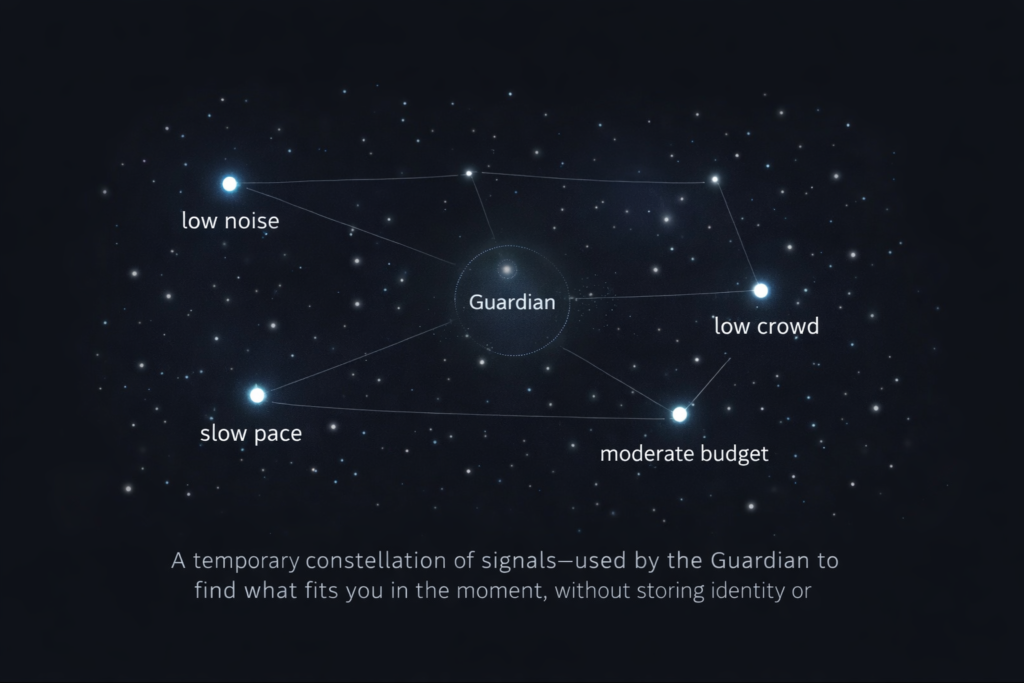
You describe the moment through signals.
For example:
- low noise
- low crowds
- slow pace
- moderate budget
Together, those signals form a constellation—a temporary map of what fits you now.
The Guardian sorts through the possibilities using only your constellation as the map.
How It Could Work
Let’s say you ask:
“Find me a museum for Friday.”
You don’t need to send:
- your identity
- your history
- your personal story
You only send what matters in that moment.
Something like:
- quiet environment
- low crowd level
- relaxed pace
- moderate price range
That’s enough.
Your constellation becomes the map.
The Guardian moves through the possibilities and brings back what fits.
What Happens Next
Instead of overwhelming you with endless results, the system gives you:
- 3 good options
- clearly different from each other
- matched to what you need right now
And if your request is too narrow, the Guardian might ask:
“Would you like to broaden the search?”
That’s it.
Not constant nudging.
Not pressure.
Just a simple question to keep things useful.
What Changes for You
You don’t have to:
- explain yourself
- reveal personal information
- worry about being followed afterward
You get to remain:
- private
- flexible
- in control
You can need something different today than you needed yesterday.
The Guardian responds to the moment, without turning it into a permanent profile.
Each person’s constellation isn’t fixed.
It can shift—intentionally.
Toward:
- optimal learning
- optimal productivity
- optimal social settings
Not based on who you are…
but what you need right now.
That’s where this becomes powerful.
It’s not just responsive.
It’s adjustable.
What Changes for Businesses
This does not make systems worse for businesses.
It can actually make them better.
Businesses receive:
- a clear request
- useful preferences
- immediate context
That means less guessing.
Instead of trying to predict who you are, they can focus on responding well to what you need right now.
They compete by:
- offering better experiences
- matching needs more accurately
- being clear about what they provide
Not by:
- tracking people
- building profiles
- pushing people over time
The Role of the Guardian
The Guardian does not decide for you.
It helps by:
- filtering
- simplifying
- reducing noise
Its role is to take a complicated world and make it easier to navigate.
Not twenty confusing choices.
Just a few strong ones.
Clear enough to act on.
Why This Matters
People change from moment to moment.
What feels right in one setting may feel wrong in another.
You might want:
- energy one day
- calm the next
- connection in one place
- distance in another
A more human system should be able to handle that.
Not by locking you into an identity,
but by responding to your present state.
You are not a fixed profile.
You are something more alive than that.
A living constellation, not a permanent label.
A Quiet Shift
This is not about rejecting technology.
It is about changing the relationship.
From:
- identity-based systems
To:
- moment-based systems
From:
- being tracked
To:
- being understood, just enough
In Practice
You enter a digital or physical space.
Instead of forcing yourself to adapt to it,
it adapts—just enough—to you.
Quietly.
Temporarily.
Without holding onto anything.
And when you leave?
Nothing follows you.
Leave a Reply