Resource boom impact is often misunderstood, especially when economic growth is treated as progress.
Economic growth is often treated as progress. When resources are discovered—oil, minerals, land—the assumption is simple: extraction leads to prosperity.
Break the Assumption
But history shows a different pattern. Resource booms don’t just create wealth—they distort systems. They shift priorities away from stability, community, and long-term sustainability toward short-term gain.
System Breakdown
When a resource becomes the primary driver of value, three things tend to happen:
Local systems are overridden Farming, community rhythms, and long-term land stewardship are replaced by extraction cycles.
External incentives dominate Decisions are no longer made for the land or people living there, but for distant markets and profit timelines.
Collapse follows concentration When the resource declines or demand shifts, the system built around it cannot sustain itself.
This pattern is not unique—it repeats across regions and generations.
Personal Evidence
Growing up connected to farmland in North Dakota, I saw this shift firsthand. Land that once supported families and steady livelihoods became part of an oil-driven economy. Homes changed purpose. Communities changed identity. And when the boom slowed, what remained was not stability—but absence.
Reframe
Resource extraction is not inherently harmful. But when it becomes the dominant system, it replaces balanced ecosystems with fragile ones.
System Insight
The real risk is not the resource—it is system dependency on a single form of value.
Any system that trades long-term resilience for short-term gain becomes unstable, regardless of location or culture.
Application
This pattern is now visible beyond the prairies.
In Norway, discussions around deep-sea mining reflect a similar tension. The opportunity is clear—but so is the uncertainty. The systems being affected are not fully understood, yet decisions are being shaped by potential gain.
A better approach is not rejection, but constraint and awareness:
Evaluate long-term system impact before scaling extraction
Preserve existing ecosystems as primary, not secondary
Avoid building economies dependent on a single resource cycle
Key Insights
Resource booms reshape systems—not just economies
Short-term gain often replaces long-term stability
Dependency is the real vulnerability, not the resource itself
Patterns repeat across geography when systems are ignored
Sustainable systems prioritize balance over extraction
The choices being made today are not new. But the ability to recognize the pattern—and respond differently—is.
Technology for Earth’s Revival Is Not the System—Human Response Is
We often talk about the damage done to our planet—but far less about what is already working to repair it.
Across the world, technologies are actively cleaning oceans, producing fresh water, and building more sustainable environments. These are not future ideas. They exist now.
But the real question is not what exists.
It’s how humans respond to what exists.
The Assumption
We assume that if solutions exist, progress will follow.
History shows that isn’t true.
Solutions do not create change on their own. Human systems determine whether solutions are adopted, ignored, or resisted.
The System
Every environmental solution moves through the same human pattern:
1. Exposure
People encounter the solution. Example: Ocean-cleaning systems like Mr. Trash Wheel or large-scale ocean collectors.
2. Interpretation
The mind assigns meaning:
“This is impressive”
“This is too small to matter”
“This isn’t my responsibility”
3. Decision
A choice is made:
Engage (support, share, adopt)
Ignore
Dismiss
4. Behavior
Action follows:
Support initiatives
Change habits
Or continue as before
5. Reinforcement
The system stabilizes:
Small actions create agency → continued engagement
Overwhelm creates inaction → continued detachment
Where Most Systems Fail
Not at innovation.
At interpretation.
When a solution feels:
Too complex
Too distant
Too small
The human system defaults to disengagement.
This is why powerful technologies can exist—and still have limited impact.
What Actually Works
Solutions that succeed align with human systems:
Visible impact → people see results
Local relevance → people feel connected
Low friction → easy to support or adopt
Clear role → people understand what they can do
Technologies like beach-cleaning robots or river interceptors work not just because they function—but because they are understandable.
They fit the human system.
Reframe
The future of environmental recovery is not just technological.
It is behavioral.
The question shifts from:
“What can technology do?”
to:
“How does this system help humans engage instead of disengage?”
Application
When evaluating any solution, ask:
Can people see the impact clearly?
Does it reduce overwhelm or increase it?
Does it give the individual a role?
Does it fit naturally into human behavior?
If not, the system will struggle—no matter how advanced the technology is.
Key Insight
Technology can repair the planet.
But only if it aligns with the systems that drive human behavior.
We often talk about the damage done to our planet—but far less about what is already working to repair it.
Across the world, technologies are actively cleaning oceans, producing fresh water, and building more sustainable environments. These are not future ideas. They exist now.
But the real question is not what exists.
It’s how humans respond to what exists.
The Assumption
We assume that if solutions exist, progress will follow.
History shows that isn’t true.
Solutions do not create change on their own. Human systems determine whether solutions are adopted, ignored, or resisted.
The System
Every environmental solution moves through the same human pattern:
1. Exposure
People encounter the solution. Example: Ocean-cleaning systems like Mr. Trash Wheel or large-scale ocean collectors.
2. Interpretation
The mind assigns meaning:
“This is impressive”
“This is too small to matter”
“This isn’t my responsibility”
3. Decision
A choice is made:
Engage (support, share, adopt)
Ignore
Dismiss
4. Behavior
Action follows:
Support initiatives
Change habits
Or continue as before
5. Reinforcement
The system stabilizes:
Small actions create agency → continued engagement
Overwhelm creates inaction → continued detachment
Where Most Systems Fail
Not at innovation.
At interpretation.
When a solution feels:
Too complex
Too distant
Too small
The human system defaults to disengagement.
This is why powerful technologies can exist—and still have limited impact.
What Actually Works
Solutions that succeed align with human systems:
Visible impact → people see results
Local relevance → people feel connected
Low friction → easy to support or adopt
Clear role → people understand what they can do
Technologies like beach-cleaning robots or river interceptors work not just because they function—but because they are understandable.
They fit the human system.
Reframe
The future of environmental recovery is not just technological.
It is behavioral.
The question shifts from:
“What can technology do?”
to:
“How does this system help humans engage instead of disengage?”
Application
When evaluating any solution, ask:
Can people see the impact clearly?
Does it reduce overwhelm or increase it?
Does it give the individual a role?
Does it fit naturally into human behavior?
If not, the system will struggle—no matter how advanced the technology is.
Key Insight
Technology can repair the planet.
But only if it aligns with the systems that drive human behavior.
People often believe the platform is what matters.
VR, AR, MR—each new wave promises to define the future. The focus stays on tools, features, and which company is leading.
But platforms change. They always have.
What doesn’t change is how humans experience environments.
The Real System
The value was never in the platform.
It’s in understanding how people:
perceive space
regulate emotion
engage with environments
decide whether to stay or leave
A platform is just a container. The human response inside it is the system.
Where Most Builders Get It Wrong
When builders focus on platforms, they optimize for:
features
performance
novelty
But humans don’t return for features.
They return for how a space feels.
Calm. Clear. Meaningful. Navigable.
If those are missing, the platform doesn’t matter.
Reframe
The question is not:
“What can this platform do?”
The question is:
“How does this environment influence the human inside it?”
That shift changes everything.
What Actually Lasts
Systems that last are:
adaptable to different human states
responsive to cognitive load
aligned with emotional regulation
capable of evolving without breaking the experience
A system that cannot adapt will eventually misalign with the human using it.
Individual Fit Matters
Not every system works for every person.
Immersive environments can be powerful—but they can also overwhelm. For some, immersion creates clarity. For others, it increases cognitive load.
For some individuals, simply being placed in an unfamiliar environment—virtual or physical—can be disorienting. New spatial rules, unfamiliar cues, and constant interpretation can quickly exceed what the brain can comfortably process.
Technology should align with the user’s comfort level.
When systems push beyond what a person can comfortably process, they don’t accelerate adoption—they create resistance.
Familiarity often matters more than capability.
Sometimes the most effective environment isn’t advanced at all.
It’s something simple and known— like sitting with a cousin, having coffee in a place that feels familiar, even if that place no longer exists.
The system works because the human already understands it.
System Reality
More immersive does not mean better
More advanced does not mean usable
More features do not mean more effective
Systems that push users create resistance
What matters is fit.
Application
This applies beyond XR:
AI interfaces
websites
physical environments
communication systems
If it interacts with a human, it is part of a human system.
Systems should reduce friction so the human can function well.
And they succeed based on that interaction.
Key Insights
Platforms are temporary. Human response patterns are not.
Experience determines value, not technology.
Environments influence human state, not control it.
Adaptability is more important than capability.
The best system is the one the individual can use without friction.
Builders who follow systems outlast those who follow platforms.
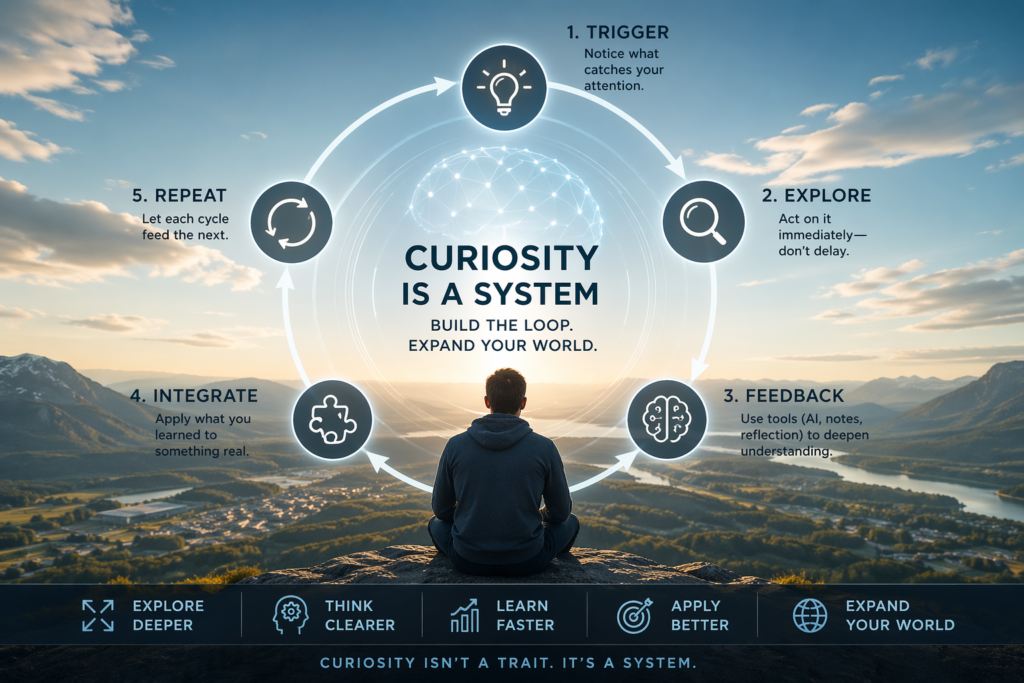
Most people think curiosity is something you either have or don’t. In reality, it’s a structured process that determines how you explore, learn, and grow.
But that framing misses what actually drives growth.
Curiosity isn’t a trait. It’s a system.
Break the Assumption
We assume curiosity is passive:
something we feel
something that shows up naturally
something tied to personality
In reality, most people stop exploring not because they lack curiosity—
but because they lack a structure to act on it.
System Breakdown
Curiosity only becomes useful when it moves through a system:
Trigger → Exploration → Feedback → Integration
Without this loop:
curiosity fades into distraction
learning stays surface-level
insights don’t stick
With the loop:
questions turn into understanding
exploration compounds over time
learning becomes self-sustaining
Technology—especially AI—can accelerate this loop.
But it doesn’t create it.
It amplifies what’s already there.
Personal Evidence (Controlled)
Growing up in Montana, my curiosity started with a simple computer from RadioShack—paid for by sweeping sidewalks at JC Penneys.
That early experience wasn’t about the machine.
It was about the loop: question → explore → learn → repeat.
Recently, AI has allowed me to refine that loop further.
By aligning tools with how I naturally process information—sequentially and visually—learning shifted from effort to flow.
Not because AI is intelligent—
but because it supports the system.
Reframe
Curiosity isn’t something you wait for.
It’s something you build.
And once structured, it becomes a reliable way to expand your world.
System Insight
Across human systems:
People don’t fail to grow because they lack interest.
They fail because:
exploration isn’t structured
feedback isn’t clear
integration never happens
So curiosity gets misdiagnosed as a personality trait—
instead of recognized as a repeatable process.
Application
To turn curiosity into a working system:
Step 1 — Trigger
Notice what catches your attention
Step 2 — Explore
Act on it immediately—don’t delay
Step 3 — Feedback
Use tools (AI, notes, reflection) to deepen understanding
Step 4 — Integrate
Apply what you learned to something real
Step 5 — Repeat
Let each cycle feed the next
The goal isn’t more information.
It’s a functioning loop.
Autism Perspective (System Advantage)
For me, being on the autism spectrum made this clearer.
When information is structured correctly:
patterns become visible
systems become predictable
learning becomes efficient
AI didn’t “fix” anything.
It aligned with how my system already works.
That alignment is where the advantage comes from.
Why This Matters
In a rapidly changing world, curiosity isn’t optional.
Modern work often feels normal because we inherited it, not because it was designed around the human body.
A person sits upright. A desk holds the tools. A screen faces forward. The spine stays compressed. The neck holds position. The eyes stay fixed. Movement becomes interruption.
This is not just a work habit. It is a human system.
For centuries, tools shaped posture. Factories, schools, offices, vehicles, and computer work trained people into repeated body geometry. Sit here. Face forward. Keep still. Pay attention. Use the desk. Look at the screen. Stay in position until the task is done.
Over time, this became “normal.”
But normal does not always mean natural. Many modern work postures are better understood as industrial compatibility postures. They exist because the tools required them.
The Chair Became Infrastructure
A chair is not only furniture. It is part of a built environment that trains the body.
Homes, classrooms, offices, restaurants, waiting rooms, airports, buses, cars, and meeting rooms are organized around sitting. Once a space is designed around chairs, the body has limited choices. Standing becomes temporary. Stretching becomes awkward. Reclining becomes inappropriate. Floor-based posture becomes unusual. Movement becomes something separate from work.
That matters because the body is not only carrying the mind. The body is part of how attention, calm, fatigue, discomfort, and thought are regulated.
When work forces one posture for too long, the body has to spend energy managing that posture. The spine, neck, shoulders, hips, circulation, and nervous system all participate. Physical compression can become background stress.
And background stress affects the mind.
Digital Work Does Not Have to Stay Attached to Furniture
This is where XR becomes interesting.
XR may not simply create new behaviors. It may allow humans to recover older body patterns that industrial systems suppressed.
Before industrial standardization, people often shifted posture more naturally. They rested while working. They worked closer to the ground. They alternated movement. They adapted environments fluidly. The body had more permission to change shape.
XR changes that equation because the workspace no longer has to be physically attached to a desk.
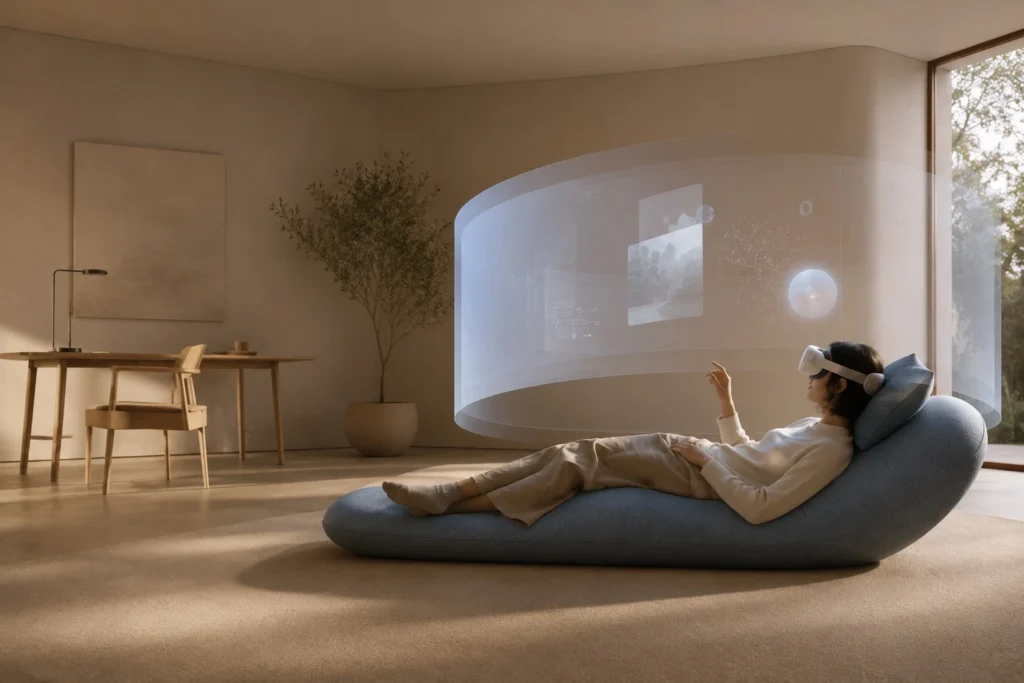
A screen can float. It can follow gaze. It can resize. It can move with the body. It can remain visible while reclined. It can exist in a low-stimulation room. It can support focus without demanding one fixed posture.
That breaks centuries of workstation assumptions.
Body-First Computing
I notice this in my own work. I am often supine, with a large wraparound screen in VR and my Mac resting on my chest. I do not need to see the keys, so the old desk-and-chair geometry becomes optional.
The screen can move with the body instead of forcing the body to stay fixed around the screen.
That changes the question.
The issue is not whether everyone should work lying down, standing up, or sitting on the floor. The larger point is that digital work no longer has to obey one inherited posture. XR can let the workspace adapt to the nervous system, the body, and the moment.
This is body-first computing instead of furniture-first computing.
Calm Attention Needs a Supported Body
A relaxed body can change the quality of attention.
When work is built around an upright chair, a desk, and a fixed screen, the body is often asked to hold one shape for too long. For some people, that creates unnecessary strain. The person may still be productive, but part of their attention is quietly spent managing discomfort.
If digital work can happen in a more comfortable, supported, and less spine-compressed posture, the body may not need to spend as much energy managing tension.
That can make work feel calmer.
Not easier in a lazy sense. Calmer in a systems sense. Less energy wasted on fighting the workstation. More energy available for thought, creativity, regulation, and sustained attention.
For autistic people, chronic pain users, fatigue-sensitive workers, mobility-limited people, and anyone with a sensitive nervous system, this distinction matters even more.
The future of computing should not only ask:
What can the machine do?
It should also ask:
What does the machine require from the body?
The Human Systems Reframe
Industrial systems standardized posture because tools demanded it.
XR may be the first major computing shift that lets posture become human again.
That does not mean abandoning chairs. It means questioning why so much of modern life assumes the chair is the default container for attention.
The future of smart cities is often misunderstood.
Most people imagine something sleek, efficient, and fully optimized—dense networks of sensors, autonomous systems, and perfectly managed infrastructure.
The assumption is simple: the more advanced the technology, the more advanced the city.
Break the Assumption
This assumption is incomplete.
Cities are not machines. They are lived environments shaped by culture, behavior, and time. When cities are designed primarily through abstraction—models, simulations, and efficiency metrics—they often lose the qualities that make them meaningful.
The result is a familiar pattern: cities that function better on paper, but feel less human in reality.
System Breakdown
Modern smart cities systems are built on three layers:
Sensing — data from sensors, cameras, and infrastructure
Modeling — digital twins and real-time representations
Optimization — AI-driven decisions to improve efficiency
This creates cities that are increasingly aware of themselves.
But awareness alone is not intelligence.
What’s missing is a fourth layer:
Cultural Continuity — the preservation and evolution of what people value
This includes how people gather, how streets are used, what is preserved, and what is allowed to change.
Without this layer, cities become technically advanced but culturally interchangeable.
Reframe
A city is only “smart” if smart cities culture reflects what matters to the people who live in it.
Technology can measure movement, energy, and flow. But these are not the things that give a place meaning. Culture lives in patterns that are harder to quantify but easy to feel.
The goal is not to make cities more efficient.
The goal is to make them more aware—of both their systems and their identity.
System Insight
Some cities already demonstrate this balance.
In places like Kyoto, infrastructure evolves without erasing the past. Streets remain human in scale. Architecture reflects history. Nature is integrated into daily life rather than added as decoration.
Technology exists, but it is quiet. It adapts to the city instead of redefining it.
This reveals a broader pattern:
Cities that prioritize identity first can integrate technology without losing themselves. Cities that prioritize optimization first often erase what made them unique.
Application
This changes how we design urban systems:
Sensors should enhance awareness, not enforce control
Digital models should reflect lived experience, not just infrastructure
AI systems should adapt to cultural patterns, not override them
Development should preserve identity before improving efficiency
The question is no longer how to build smarter cities.
It is how to build cities that can evolve without losing who they are.
Key Insights
A city is a cultural system, not just an infrastructure system
Efficiency is not neutral—it can erase identity
Smart systems must learn what people value, not just what can be measured
Technology should adapt to cities, not redefine them
The future of cities is not built from scratch—it is grown from what already exists
Sustainable systems don’t give everything at once—they continue providing over time.
The Common Belief
Self-care vs helping others is often misunderstood. Many believe giving more always creates more good.
Break the Assumption
This belief overlooks a critical flaw.
If giving has no boundaries, it does not create more good—it creates depletion.
The idea is familiar. In The Giving Tree, the tree gives everything it has until it becomes a stump. The story is often interpreted as generosity, but from a systems perspective, it represents total resource collapse.
If the tree had maintained its capacity, it could have provided apples for a lifetime.
System Breakdown
Every person operates within a finite energy system:
Input → rest, nutrition, emotional recovery
Output → helping, working, supporting others
Recovery → restoring system stability
When output exceeds input over time, the system enters delayed depletion.
This is why burnout doesn’t feel immediate. It builds quietly while the person continues to give.
Reframe
Helping others is not about giving everything.
It is about managing capacity so giving can continue.
Boundaries are not a limitation of compassion—they are what make compassion sustainable.
System Insight
Unbounded giving is not generosity. It is resource exhaustion disguised as virtue.
Sustainable support comes from preserving the system that produces it.
The most effective people are not those who give the most once, but those who can continue giving over time.
Application
Shift how you evaluate your actions:
Set boundaries before exhaustion appears
Treat rest as required system maintenance
Monitor your energy like a limited resource
Reduce output when recovery is insufficient
Instead of asking: “Am I giving enough?”
Ask: “Can I keep giving at this level without breaking the system?”