Category: Human Systems

  • Nutrition System: How Food Access Shapes Brain Function and Health

    Vegan Mediterranean plate with fork ready to eat showing a real-world nutrition system in southern Spain

    1. Opening

    Nutrition systems shape how we think, feel, and function long before we make a single food choice.


    2. Break the Assumption

    But nutrition isn’t primarily a discipline problem.
    It’s a system input problem.

    If your environment makes low-quality food the easiest option, the outcome is already shaped before any decision is made.


    3. System Breakdown

    The human body runs on inputs:

    • Food becomes cellular repair material
    • Nutrients regulate brain function and mood
    • Energy sources determine focus, stability, and recovery

    Even how you cook matters:

    • Boiling can strip water-soluble vitamins
    • Overheating can degrade sensitive nutrients
    • Long storage reduces nutrient density

    The system is simple:

    Lower-quality inputs → reduced system performance

    This shows up as:

    • Brain fog
    • Energy instability
    • Slower recovery
    • Reduced emotional regulation

    This isn’t failure. It’s system behavior.


    4. A Living System (Southern Spain)

    Here in southern Spain, this system becomes visible.

    Food is local. Seasonal. Simple.
    Markets shift with what’s available—not what’s manufactured.

    We follow a vegan variation of the Mediterranean pattern:

    • Vegetables
    • Legumes
    • Grains
    • Olive oil
    • Fresh, minimally processed ingredients

    It’s not difficult. The structure already exists.

    When the system is aligned, “healthy eating” stops feeling like effort.
    It becomes the default.

    The effects are consistent:

    • Stable energy across the day
    • Clearer thinking
    • Less friction around meals
    • Food supports life instead of interrupting it

    5. Reframe

    Health is not driven by willpower.
    It is driven by access to consistent, high-quality inputs.


    6. System Insight

    Nutrition is a compounding system:

    • Better food → better brain function
    • Better brain function → better decisions
    • Better decisions → better long-term outcomes

    This loop runs continuously.


    7. Application

    Individual level:

    • Prioritize whole, plant-based foods when possible
    • Eat seasonally → higher nutrients, lower cost
    • Use cooking methods that preserve nutrients (steam, roast, light sauté)
    • Reduce ultra-processed foods

    Environment level:

    • Source from local markets when available
    • Keep simple ingredients visible and accessible
    • Build routines around easy, repeatable meals

    8. Key Insights

    • Nutrition is a system input, not a moral issue
    • Poor outcomes often reflect poor access, not poor discipline
    • Cooking methods directly affect nutrient retention
    • Seasonal, plant-based patterns align with human biology
    • Better inputs create compounding improvements over time

    Closing

    Better nutrition doesn’t come from trying harder.

    It comes from living inside a system where better inputs are normal, available, and easy to sustain.

  • When Work Stops Forcing the Body Into a Chair

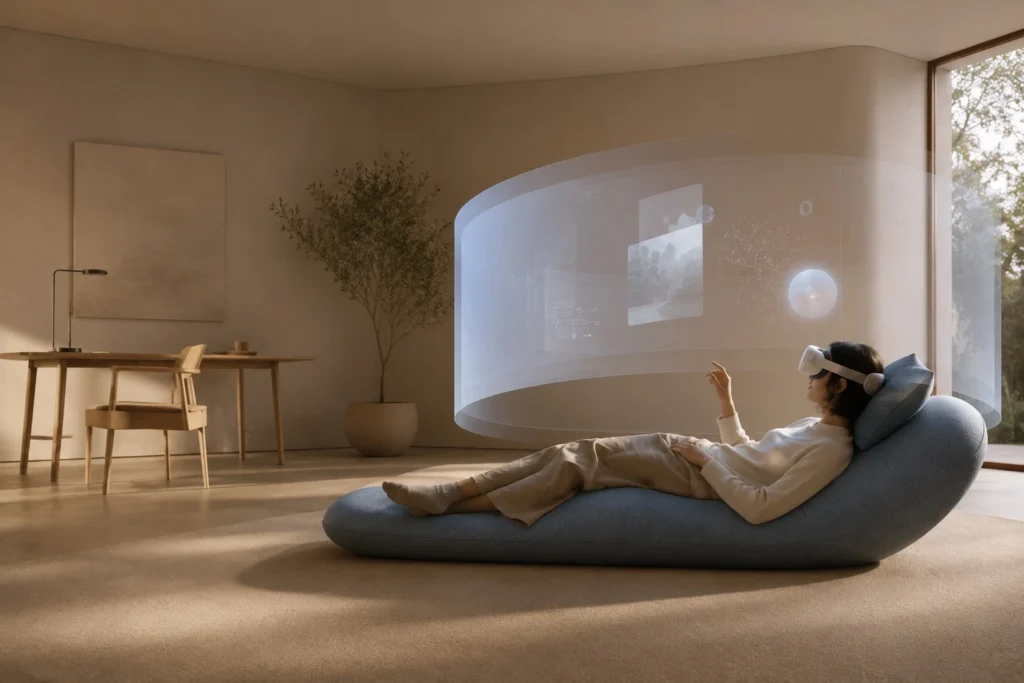
    A person works in a relaxed reclined posture with a floating XR screen while a chair and desk sit unused in the background, suggesting a shift from furniture-first computing to body-first digital work.

    Modern work often feels normal because we inherited it, not because it was designed around the human body.

    A person sits upright.
    A desk holds the tools.
    A screen faces forward.
    The spine stays compressed.
    The neck holds position.
    The eyes stay fixed.
    Movement becomes interruption.

    This is not just a work habit. It is a human system.

    For centuries, tools shaped posture. Factories, schools, offices, vehicles, and computer work trained people into repeated body geometry. Sit here. Face forward. Keep still. Pay attention. Use the desk. Look at the screen. Stay in position until the task is done.

    Over time, this became “normal.”

    But normal does not always mean natural. Many modern work postures are better understood as industrial compatibility postures. They exist because the tools required them.

    The Chair Became Infrastructure

    A chair is not only furniture. It is part of a built environment that trains the body.

    Homes, classrooms, offices, restaurants, waiting rooms, airports, buses, cars, and meeting rooms are organized around sitting. Once a space is designed around chairs, the body has limited choices. Standing becomes temporary. Stretching becomes awkward. Reclining becomes inappropriate. Floor-based posture becomes unusual. Movement becomes something separate from work.

    That matters because the body is not only carrying the mind. The body is part of how attention, calm, fatigue, discomfort, and thought are regulated.

    When work forces one posture for too long, the body has to spend energy managing that posture. The spine, neck, shoulders, hips, circulation, and nervous system all participate. Physical compression can become background stress.

    And background stress affects the mind.

    Digital Work Does Not Have to Stay Attached to Furniture

    This is where XR becomes interesting.

    XR may not simply create new behaviors. It may allow humans to recover older body patterns that industrial systems suppressed.

    Before industrial standardization, people often shifted posture more naturally. They rested while working. They worked closer to the ground. They alternated movement. They adapted environments fluidly. The body had more permission to change shape.

    Then modern systems narrowed the range.

    Factories standardized motion.
    Schools standardized attention.
    Offices standardized desk posture.
    Vehicles standardized seated travel.
    Screens standardized forward-facing gaze.

    The body adapted because the tools demanded it.

    XR changes that equation because the workspace no longer has to be physically attached to a desk.

    A screen can float.
    It can follow gaze.
    It can resize.
    It can move with the body.
    It can remain visible while reclined.
    It can exist in a low-stimulation room.
    It can support focus without demanding one fixed posture.

    That breaks centuries of workstation assumptions.

    Body-First Computing

    I notice this in my own work. I am often supine, with a large wraparound screen in VR and my Mac resting on my chest. I do not need to see the keys, so the old desk-and-chair geometry becomes optional.

    The screen can move with the body instead of forcing the body to stay fixed around the screen.

    That changes the question.

    The issue is not whether everyone should work lying down, standing up, or sitting on the floor. The larger point is that digital work no longer has to obey one inherited posture. XR can let the workspace adapt to the nervous system, the body, and the moment.

    This is body-first computing instead of furniture-first computing.

    Calm Attention Needs a Supported Body

    A relaxed body can change the quality of attention.

    When work is built around an upright chair, a desk, and a fixed screen, the body is often asked to hold one shape for too long. For some people, that creates unnecessary strain. The person may still be productive, but part of their attention is quietly spent managing discomfort.

    If digital work can happen in a more comfortable, supported, and less spine-compressed posture, the body may not need to spend as much energy managing tension.

    That can make work feel calmer.

    Not easier in a lazy sense. Calmer in a systems sense. Less energy wasted on fighting the workstation. More energy available for thought, creativity, regulation, and sustained attention.

    For autistic people, chronic pain users, fatigue-sensitive workers, mobility-limited people, and anyone with a sensitive nervous system, this distinction matters even more.

    The future of computing should not only ask:

    What can the machine do?

    It should also ask:

    What does the machine require from the body?

    The Human Systems Reframe

    Industrial systems standardized posture because tools demanded it.

    XR may be the first major computing shift that lets posture become human again.

    That does not mean abandoning chairs. It means questioning why so much of modern life assumes the chair is the default container for attention.

    A better system would allow more variation:

    reclining work, standing work, floor-based work, movement-integrated work, low-stimulation work, gaze-based work, voice-supported work, and adaptive screen placement.

    The goal is not novelty. The goal is restoring choice.

    When the workspace adapts to the human body, the person may become calmer, more comfortable, and more capable of sustained attention.

    That is not just a health idea.

    It is a design principle.

    Key Insights

    • Many modern work postures are industrial compatibility postures, not necessarily biologically optimal ones.
    • Chairs became part of a built environment that trains stillness, posture, and attention.
    • XR can separate digital work from fixed desks, fixed screens, and fixed gaze direction.
    • A supported, less compressed body may reduce background stress and improve calm attention.
    • The future of work should move from furniture-first computing toward body-first computing.
  • Primal Instincts Aren’t the Problem — Misinterpretation Is

    Man sitting in quiet reflection with hands clasped – representing internal struggle, survival instincts, and self-awareness

    A Human Systems View of Survival Responses and Compassion


    Opening — The Assumption

    Most people believe that reactions like fear, anger, or withdrawal are signs of weakness, instability, or even moral failure.

    We’re taught to judge these responses—both in ourselves and others.


    Break the Assumption

    What we label as “overreaction” is often a system doing exactly what it was designed to do.

    Fight.
    Flight.
    Freeze.

    These are not flaws. They are survival mechanisms—fast, automatic, and protective.


    System Breakdown

    The human nervous system prioritizes survival over accuracy.

    When a threat is perceived—real or remembered—the system:

    • Reduces time for reflection
    • Increases speed of response
    • Chooses protection over connection

    This creates patterns such as:

    • Fight → aggression, defensiveness
    • Flight → avoidance, withdrawal
    • Freeze → shutdown, dissociation

    These responses are not chosen consciously.
    They are triggered patterns based on past conditioning and stored signals.


    Personal Evidence (Optional Anchor)

    In lived experiences such as PTSD, these responses become more visible.

    What looks like “irrational behavior” from the outside is often a system reacting to internal signals others cannot see.


    Reframe

    Instead of asking:

    “Why is this person acting like this?”

    A more accurate question is:

    “What is this system trying to protect?”

    This shift moves us from judgment → understanding.


    System Insight

    Behavior is not random.

    It is:

    Signal → Interpretation → Response

    When the interpretation layer is shaped by past threat,
    the response will prioritize safety—even when no danger is present.


    Application

    You can work with this system in practical ways:

    • Pause before labeling behavior
    • Look for the protective function behind reactions
    • Reduce intensity before trying to reason
    • Create environments where safety is felt, not forced

    For yourself:

    • Notice your default response pattern (fight, flight, freeze)
    • Track when it activates
    • Focus on regulation first, meaning second

    Key Insights

    • Survival responses are functional, not flawed
    • The nervous system chooses speed over accuracy
    • Behavior is driven by protection, not intention
    • Understanding function leads to compassion
    • Compassion creates space for better system outcomes

    Closing

    When we stop treating survival responses as problems to eliminate,
    we gain the ability to work with the system instead of against it.

    That’s where real compassion begins—not as an idea,
    but as a direct understanding of how humans actually function.

  • Smart Cities and Culture: Why the Smartest Cities Won’t Look Futuristic

    futuristic coastal smart city in Andalucia blending culture and modern technology

    The future of smart cities is often misunderstood.

    Most people imagine something sleek, efficient, and fully optimized—dense networks of sensors, autonomous systems, and perfectly managed infrastructure.

    The assumption is simple: the more advanced the technology, the more advanced the city.

    Break the Assumption

    This assumption is incomplete.

    Cities are not machines. They are lived environments shaped by culture, behavior, and time. When cities are designed primarily through abstraction—models, simulations, and efficiency metrics—they often lose the qualities that make them meaningful.

    The result is a familiar pattern: cities that function better on paper, but feel less human in reality.

    System Breakdown

    Modern smart cities systems are built on three layers:

    • Sensing — data from sensors, cameras, and infrastructure
    • Modeling — digital twins and real-time representations
    • Optimization — AI-driven decisions to improve efficiency

    This creates cities that are increasingly aware of themselves.

    But awareness alone is not intelligence.

    What’s missing is a fourth layer:

    • Cultural Continuity — the preservation and evolution of what people value

    This includes how people gather, how streets are used, what is preserved, and what is allowed to change.

    Without this layer, cities become technically advanced but culturally interchangeable.

    Reframe

    A city is only “smart” if smart cities culture reflects what matters to the people who live in it.

    Technology can measure movement, energy, and flow. But these are not the things that give a place meaning. Culture lives in patterns that are harder to quantify but easy to feel.

    The goal is not to make cities more efficient.

    The goal is to make them more aware—of both their systems and their identity.

    System Insight

    Some cities already demonstrate this balance.

    In places like Kyoto, infrastructure evolves without erasing the past. Streets remain human in scale. Architecture reflects history. Nature is integrated into daily life rather than added as decoration.

    Technology exists, but it is quiet. It adapts to the city instead of redefining it.

    This reveals a broader pattern:

    Cities that prioritize identity first can integrate technology without losing themselves. Cities that prioritize optimization first often erase what made them unique.

    Application

    This changes how we design urban systems:

    • Sensors should enhance awareness, not enforce control
    • Digital models should reflect lived experience, not just infrastructure
    • AI systems should adapt to cultural patterns, not override them
    • Development should preserve identity before improving efficiency

    The question is no longer how to build smarter cities.

    It is how to build cities that can evolve without losing who they are.

    Key Insights

    • A city is a cultural system, not just an infrastructure system
    • Efficiency is not neutral—it can erase identity
    • Smart systems must learn what people value, not just what can be measured
    • Technology should adapt to cities, not redefine them
    • The future of cities is not built from scratch—it is grown from what already exists
  • Self-Care vs Helping Others: Why Boundaries Prevent Burnout

    Sustainable systems don’t give everything at once—they continue providing over time.

    The Common Belief

    Self-care vs helping others is often misunderstood. Many believe giving more always creates more good.

    Break the Assumption

    This belief overlooks a critical flaw.

    If giving has no boundaries, it does not create more good—it creates depletion.

    The idea is familiar. In The Giving Tree, the tree gives everything it has until it becomes a stump. The story is often interpreted as generosity, but from a systems perspective, it represents total resource collapse.

    If the tree had maintained its capacity, it could have provided apples for a lifetime.

    System Breakdown

    Every person operates within a finite energy system:

    • Input → rest, nutrition, emotional recovery
    • Output → helping, working, supporting others
    • Recovery → restoring system stability

    When output exceeds input over time, the system enters delayed depletion.

    This is why burnout doesn’t feel immediate.
    It builds quietly while the person continues to give.

    Reframe

    Helping others is not about giving everything.

    It is about managing capacity so giving can continue.

    Boundaries are not a limitation of compassion—they are what make compassion sustainable.

    System Insight

    Unbounded giving is not generosity.
    It is resource exhaustion disguised as virtue.

    Sustainable support comes from preserving the system that produces it.

    The most effective people are not those who give the most once, but those who can continue giving over time.

    Application

    Shift how you evaluate your actions:

    • Set boundaries before exhaustion appears
    • Treat rest as required system maintenance
    • Monitor your energy like a limited resource
    • Reduce output when recovery is insufficient

    Instead of asking:
    “Am I giving enough?”

    Ask:
    “Can I keep giving at this level without breaking the system?”

    Key Insights

    • Energy is finite and must be managed
    • Burnout is delayed, not immediate
    • Boundaries extend your ability to help
    • Unbounded giving leads to collapse
    • Sustainable impact requires maintained capacity

  • Travel Isn’t Hard — The Environment Is Mismatched

    A Human Systems view of why new environments overwhelm — and how to design for stability


    Autism travel overwhelm isn’t caused by poor preparation. It happens when a human system enters an environment it hasn’t calibrated to. New sounds, unfamiliar layouts, and unpredictable social patterns create a mismatch that the nervous system experiences as overload.

    Most travel advice focuses on preparation:

    Pack correctly
    Plan your route
    Stay organized

    But even when everything is “done right,” many people still feel overwhelmed the moment they enter a new environment.

    So the assumption breaks:

    The problem isn’t the person.
    The problem is the system mismatch.


    Break the Assumption

    Travel isn’t inherently difficult.

    What’s difficult is this:

    A human system entering an environment it hasn’t calibrated to.

    New sounds
    New social rules
    New spatial layouts
    New expectations

    The system doesn’t recognize the pattern — so it shifts into protection mode.


    System Breakdown

    Every human operates through a simple loop:

    Input → Processing → Output

    In travel, the input spikes:

    • high sensory load
    • unpredictability
    • constant decision-making

    The system processes this as:

    • uncertainty
    • lack of control
    • potential threat

    The output becomes:

    • withdrawal
    • fatigue
    • irritability
    • shutdown

    This is not failure.

    This is the system protecting itself.


    Reframe

    Instead of asking:

    “How do I handle travel better?”

    Ask:

    “How do I reduce system mismatch?”

    That shift changes everything.


    System Insight

    Humans don’t struggle with travel.

    They struggle with environments that exceed their regulation capacity.

    When input > processing capacity → overload
    When input ≈ capacity → stability
    When input < capacity → comfort

    So the goal is not endurance.

    The goal is regulation.


    Application

    You don’t fix the human.

    You adjust the system.

    1. Reduce Input

    • control noise (headphones, quiet spaces)
    • simplify choices
    • limit exposure windows

    2. Increase Predictability

    • preview environments
    • repeat familiar routines
    • anchor to known patterns

    3. Add Regulation Tools

    • sensory kits
    • pacing strategies
    • safe fallback locations

    4. Respect State Changes

    • don’t push through overload
    • recovery is part of the system
    • pauses are not failure

    Connection to Real Tools

    A “sensory kit” isn’t just helpful.

    It’s a portable regulation system.

    It allows the human system to:

    • stabilize faster
    • stay within capacity
    • re-enter environments on their terms

    Key Insight

    Travel becomes manageable when:

    • input is controlled
    • state is respected
    • environment is adjusted

    Not when the person forces adaptation.


    Closing

    Confidence in new environments doesn’t come from pushing harder.

    It comes from understanding this:

    Your system is already working.
    You just need to give it the conditions it was designed for.

  • Sustainable Living Without Sacrifice: Why It Works as a System

    sustainable living without sacrifice lifestyle alignment system

    The belief
    Sustainable living is often framed as sacrifice—but this framing is what causes it to fail at scale.

    The break

    What’s actually happening

    Across food, mobility, and consumption systems, a consistent pattern is emerging:

    • Behaviors that reduce friction are increasing
    • Behaviors that require ongoing effort are declining
    • Systems that align with daily life are replacing those that rely on discipline

    This is not a lifestyle shift.

    It is a system realignment.

    The system
    Sustainability functions as an alignment system—not a restriction system.

    When people adopt behaviors that:

    • improve their immediate experience
    • reduce friction in daily life
    • increase clarity or efficiency

    those behaviors tend to persist.

    When sustainability is framed as:

    • limitation
    • guilt
    • forced reduction

    it creates resistance and eventual abandonment.

    What’s actually happening
    Across food, mobility, and consumption systems, a shift is underway:

    • Plant-based options improve health and reduce system load
    • Lightweight transport (walking, cycling, e-mobility) reduces friction in movement
    • Simplified consumption reduces cognitive and financial overhead

    These are not sacrifices.
    They are optimizations.

    Why this works
    Humans don’t sustain behaviors because they are told to.
    They sustain behaviors because those behaviors make sense within their system.

    Alignment produces continuity.
    Force produces drop-off.

    The mistake
    Trying to standardize sustainability into a single model.

    Different people will:

    • minimize
    • optimize with technology
    • combine both approaches

    The system becomes stronger through diversity of approaches—not uniformity.


    Pattern detected

    New systems are consistently misjudged during early adoption phases.

    • Scientific calculators were seen as harmful to learning
    • The internet was seen as unreliable and unnecessary
    • Electric vehicles were seen as impractical

    In each case, evaluation focused on early friction—not long-term system behavior.

    Sustainability is following the same pattern.


    Technology’s role

    Technology succeeds when it reduces the cost of alignment.

    • Lower effort → higher adoption
    • Lower friction → higher continuity

    The function is not replacement.

    The function is support.

    System insight
    Sustainability succeeds when it feels like an upgrade—not a restriction.

    Application

    • Remove sustainability decisions that feel forced
    • Keep the ones that improve daily experience
    • Let systems—not willpower—carry the behavior

    Key insights

    • Pressure-based systems fail at scale
    • Alignment-based systems persist
    • Diversity of approaches increases resilience
    • Sustainability is a systems design problem, not a moral one
  • A Human Perspective in an AI World

    AI is often framed as a tool for efficiency—faster work, better answers, more output—but its deeper impact is on human agency.

    That framing isn’t wrong.

    But it’s incomplete.


    Break the Assumption

    The assumption is that AI’s primary impact is productivity.

    It isn’t.

    The deeper shift is who gets to participate.


    System Breakdown

    Historically, participation in shaping systems required access—education, credentials, networks, or proximity to institutions.

    Information existed, but it was gated.

    AI changes that structure.

    It reduces the friction between thought and expression.
    It compresses the distance between idea and execution.

    What once required layers of translation—social, academic, or technical—can now move more directly from internal to external.

    This is not just an increase in access.

    It is a redistribution of agency.


    Personal Evidence

    For people like me—autistic, non-traditional, often out of sync with standard systems—this shift is structural.

    AI acts as a bridge.

    It translates, supports, and enables participation without requiring conformity first.

    That is not convenience.

    That is inclusion at the system level.


    Reframe

    AI is not primarily an efficiency tool.

    It is an agency amplifier.


    System Insight

    When a system lowers the cost of participation, it changes who shapes outcomes.

    Not by replacing existing contributors, but by expanding the set of voices that can act.

    This introduces variability, experimentation, and new forms of contribution that were previously filtered out.


    Application

    This shift changes how AI should be approached:

    • Use AI to externalize thinking, not just complete tasks
    • Treat it as a bridge, not a substitute
    • Prioritize clarity of intent over volume of output
    • Focus on participation, not perfection

    At a system level, the question is no longer “What can AI do?”

    It becomes:

    “Who can now act who couldn’t before?”


    Key Insights

    • AI reduces friction between thought and execution
    • Lower friction increases participation
    • Increased participation redistributes agency
    • Agency, not efficiency, is the primary shift
    • Systems change when new participants can act

    We are still early in this shift.

    There will be misuse, overreach, and correction cycles.

    But the direction is clear.

    AI will not define the future on its own.

    The people who engage with it will.

    The outcome depends on whether it is used to replace human input—

    or to expand who gets to contribute.

    The goal is not a world run by AI.

    The goal is a world where more humans can participate in shaping it.

  • Human Systems Thinking: Oddly Robbie’s Personal Operating System

    Robbie Ellestad portrait – XR and AI systems architect, founder of EmpathiumXR

    Human systems thinking starts with a simple observation: most personal blogs begin with a story, but stories alone don’t explain how people actually operate.

    A story.
    A background.
    A timeline of where someone has been.

    It makes sense. People want context before they engage.

    But context alone doesn’t explain anything.


    The Assumption

    We tend to believe that understanding a person comes from knowing their past.

    Where they grew up.
    What they went through.
    What shaped them.

    But that model is incomplete.

    Because people are not defined by events.

    They are defined by the systems they build to navigate those events.


    The System

    Every human develops internal systems over time.

    • How they process information
    • How they regulate emotion
    • How they make decisions
    • How they relate to others
    • How they adapt to change

    These systems are not fixed.
    They evolve through friction, contrast, and iteration.

    Military structure. Personal freedom.
    Isolation. Connection.
    Constraint. Exploration.

    Each contrast forces an adjustment.

    Over time, those adjustments become a personal operating system.


    Personal Context (Condensed)

    I’m Robbie.

    A veteran.
    An autistic systems thinker.
    Someone who has lived across cultures—Montana, Argentina, Japan, and now Spain.

    Each environment didn’t just add experience.

    It forced system updates.

    Different languages.
    Different expectations.
    Different definitions of identity.

    What emerged wasn’t a single story.

    It was a way of seeing.


    The Reframe

    This is not a blog about my life.

    It’s a space for observing and refining human systems.

    The focus is not:

    • what happened

    The focus is:

    • how systems form
    • how they break
    • how they can be redesigned

    What This Becomes

    This work now extends into something more intentional:

    Empathium

    An exploration of AI, XR, and human-centered systems designed to support:

    • Autonomy
    • Emotional clarity
    • Real-world connection

    Not technology that replaces people.

    Technology that understands human limits and works with them.


    System Insight

    Most people don’t need more information.

    They need better internal systems for:

    • interpreting reality
    • regulating response
    • navigating complexity

    When those systems improve, outcomes change naturally.


    Why Human Systems Thinking Matters

    Without a clear internal system, people rely on reaction instead of design.

    This leads to:

    • inconsistent decisions
    • emotional volatility
    • dependency on external structure

    Human systems thinking shifts the focus from reacting to events toward designing how you respond to them.

    Instead of asking:
    “What should I do in this situation?”

    You begin asking:
    “What system would make this decision easier next time?”


    Application

    This space brings together:

    • Personal experience → as system input
    • Technology → as system extension
    • Neurodiversity → as system variation
    • Future design → as system direction

    Nothing here is presented as final.

    Everything is iterative.


    What to Expect

    No polished perfection.
    No simplified answers.

    Instead:

    • Clear patterns
    • Working models
    • Real adjustments

    If you’re looking for certainty, this won’t help.

    If you’re learning how to think, adapt, and build your own systems—

    You’re in the right place.


    Key Insights

    • People are not their stories—they are their systems
    • Experience only matters if it changes how you operate
    • Better systems reduce the need for constant effort
    • Technology should support human systems, not override them
    • Growth is not linear—it’s iterative system refinement