There was a time in my life when belief felt structured, purposeful, and complete.
As a child, I didn’t question it. I participated fully.
My autism gave me a kind of focus that made belief systems feel immersive—almost like stepping into a fully defined world with rules, roles, and meaning.
When I entered missionary life, it reinforced that structure. I saw myself as part of something larger—contributing to a system that defined truth, purpose, and identity.
When Structure Stops Matching Reality
Over time, something shifted.
Effort didn’t always produce the expected outcomes. Experiences didn’t align with what I had been taught to expect.
Eventually, I encountered moments that forced me to reassess the system itself—not just my role within it.
Disruption
A significant personal betrayal within that structure accelerated the shift.
It wasn’t just about one event.
It was about realizing that the system I trusted wasn’t as stable or consistent as I had believed.
That recognition is difficult.
Because when a belief system forms part of your identity, questioning it feels like destabilizing yourself.
Rebuilding
Leaving wasn’t a single decision—it was a process.
It required:
examining what I had accepted without question
separating belief from identity
rebuilding a sense of self outside that structure
Therapy helped. Time helped.
Most importantly, distance allowed clarity.
What I Understand Now
Belief systems can provide:
structure
meaning
community
But they can also:
limit perspective
discourage questioning
define identity too narrowly
The balance matters.
🔄 2026 Update
This experience directly informs how I think about systems design today.
Whether religious, technological, or social:
A system should:
support the individual
allow questioning
adapt when reality doesn’t match expectation
When it doesn’t, people are forced to choose between:
truth
or belonging
That’s a design failure.
Key Insights
Systems can shape identity deeply
Questioning a system can feel like losing yourself
Healthy systems allow flexibility and reflection
Identity should not be fully dependent on any single structure
Guardian Application
A Guardian system could:
help users reflect on belief systems without pressure
What is perceived as entertainment is processed by my body as threat—immediate, physical, and difficult to regulate, even when I know I am safe.
I’m writing this shortly after experiencing it. Even with time to settle, the physical response lingers longer than the event itself.
The Experience
This response isn’t a matter of preference.
It’s neurological.
And it’s shared by many:
people with autism
individuals with trauma sensitivity
animals, especially dogs
What feels brief to some can have a lasting physiological impact on others.
The Disconnect
Fireworks are often framed as harmless fun.
But that framing doesn’t include everyone.
It leaves out the people who:
prepare for it
endure it
recover from it afterward
A Better Direction
This isn’t about removing celebration.
It’s about evolving it.
Alternatives already exist—drone light shows, coordinated visual displays, and quieter events—that preserve the experience without creating the same level of impact.
🔄 2026 Update
This connects directly to how I think about human-centered systems.
If a system consistently creates distress for part of the population, it’s worth redesigning.
Not to reduce joy—but to make it accessible.
Key Insights
Sensory experiences are not universal
“Harmless” activities can have real impact
Systems should be designed for inclusion, not assumption
Alternatives can preserve joy while reducing harm
Guardian Application
A Guardian system could:
help users prepare for known sensory events
provide real-time calming strategies
guide communities toward more inclusive alternatives
Modern gaming is no longer just entertainment. It is a system that shapes behavior. Understanding ethics in gaming means looking at how games influence attention, decision-making, and long-term habits.
Some are designed to capture attention, prolong engagement, and keep players inside behavioral loops. Others can help people learn, adapt, cooperate, and develop real-world skills.
That is where the ethical tension begins.
1. Extraction Systems
Some games are intentionally built around behavioral capture loops:
Variable rewards that create repeated dopamine spikes
Endless progression systems with no real resolution
Social pressure mechanics such as daily tasks, streaks, and timed obligations
Monetization tied to impatience, scarcity, or fear of missing out
What is happening underneath the surface is simple:
The game is optimizing for time spent, not player growth
The player becomes a resource inside the system
System pattern: engagement without resolution
This is where ethics become gray. Not because the design is hidden, but because it has become normal.
2. Development Systems
On the other side, games can also function as:
Simulation environments
Decision-training systems
Social interaction spaces
Cognitive and emotional skill builders
Games can help train:
Pattern recognition
Strategic thinking
Cooperation and communication
Emotional regulation, when designed with intention
System pattern: engagement with transformation
This is where games become more than entertainment. They become environments that shape human capability.
The Ethical Tension
The same mechanics can be used for very different outcomes.
Mechanic
Extractive Use
Developmental Use
Rewards
Keep the player hooked
Reinforce meaningful learning
Progression
Endless grind
Skill mastery
Social systems
Pressure and comparison
Collaboration and empathy
Feedback loops
Compulsion
Awareness
So the issue is not the mechanic itself.
The real issue is the intent behind the system design.
The Shift
The older model of gaming often treated play as escape.
Old model:
Escape reality
Win = dominate
A more useful model is beginning to emerge.
Emerging model:
Interface with reality
Win = understand, adapt, connect
Games can include real-world information, decision-making, and learning through play. That is not a small change. It is a system evolution.
Games as Training Environments
The real shift is not about graphics, realism, or immersion.
It is about function.
Games are becoming environments where human behavior is shaped through repeatable loops.
The deeper question is no longer:
How do I win this match?
It becomes:
What patterns am I reinforcing every time I play?
System Reframe
A game is not just content.
It is a behavioral system with direction.
That direction can move toward:
Extraction — time, attention, money
Development — skill, awareness, adaptability
This makes the ethical question much clearer.
The issue is not whether games are “good” or “bad.”
The question is:
What is this system training me to become?
Application
When interacting with any game, it helps to ask:
Does this loop increase awareness or reduce it?
Am I leaving more capable, or just more engaged?
Is this system narrowing me, or expanding me?
System Insight
The most advanced games of the future will not compete only on realism.
They will compete on how well they expand human potential.
Frequently Asked Questions
Are video games designed to be addictive? Some games use behavioral loops like variable rewards and social pressure to maximize engagement rather than player growth.
Can games be used for learning? Yes. When designed intentionally, games can improve decision-making, pattern recognition, and social skills.
What is ethical game design? Ethical game design focuses on player development, not just retention, aligning game mechanics with long-term human benefit.
For a period of time, drugs were decriminalized. The intention was to shift addiction away from punishment and toward treatment. On paper, it made sense.
In practice, something else happened.
People moved there.
Not for recovery—but because the environment allowed continuation.
And the systems that were supposed to support treatment weren’t ready at scale.
What followed wasn’t just a policy outcome.
It was a systems mismatch.
The Gap Between Policy and Reality
Decriminalization without infrastructure creates a vacuum.
If you remove enforcement, but don’t replace it with:
accessible treatment
consistent support
stable housing
community integration
then the system doesn’t stabilize—it drifts.
And drift, in this context, looks like visible suffering.
Not hidden.
Public.
What Was Missing
The idea wasn’t wrong.
But the timing and execution were incomplete.
Support systems need to exist before behavior shifts—not after.
Otherwise, people fall into the gap between intention and reality.
A Different Approach
If we look forward instead of backward, the question becomes:
How do we build systems that can actually handle change?
Not just policy change—but human behavior change.
That requires:
continuous support, not episodic intervention
environments designed for stability
systems that can adapt in real time
This is where technology can help—but only if used carefully.
AI conflict resolution begins with understanding how escalation patterns form.
Conflict tends to follow a familiar pattern.
Action. Reaction. Escalation.
Whether between individuals, communities, or nations, the loop repeats with surprising consistency. What changes is scale, speed, and the number of people forced to absorb the cost.
Because retaliation rarely resolves conflict.
It redistributes harm. It extends instability. And it reinforces the very conditions that created the conflict.
So the real question is not whether conflict exists.
It’s whether we keep responding to it through the same systems that repeatedly fail to resolve it.
What Actually Keeps Wars Going
Wars don’t sustain themselves by accident.
They are maintained by reinforcing human patterns—especially under pressure.
1. The Need for Victory
Conflict becomes something to win, not resolve.
This creates rigid endpoints:
one side must dominate
the other must concede
In complex systems, that rarely happens—so the conflict continues.
2. Rage and Emotional Momentum
Once harm occurs, emotional energy builds fast.
anger becomes justification
grief becomes fuel
fear becomes preemptive action
Perception narrows. Reaction accelerates.
3. Revenge Loops
Retaliation creates feedback cycles:
action → counteraction → escalation
Each side experiences their move as justified. The loop sustains itself.
4. Historical Distortion
Over time, narratives simplify:
events are compressed
blame is concentrated
identity fuses with the conflict
The story feels absolute—even when it’s incomplete.
5. Superiority and Dehumanization
When one group sees itself as superior:
empathy drops
the other becomes abstract
harm becomes easier to justify
At this stage, conflict is no longer just strategic—it becomes moralized.
Technology Has Been Framed Too Narrowly
Most discussions about AI focus on power:
efficiency, advantage, control.
That’s incomplete.
At its core, AI is a pattern-recognition system.
And conflict is built from patterns:
misunderstanding
resource pressure
identity threat
communication breakdown
repeated escalation loops
Humans can sense parts of this.
But rarely the whole system—especially in real time.
A Different Role for AI
AI does not need to optimize force.
It can improve understanding.
Not by replacing human judgment—but by improving its quality.
The goal is not control.
The goal is clarity.
Where AI Can Create Clarity
AI cannot stop a war.
But it can interrupt the conditions that allow wars to escalate blindly.
1. Real-Time Pattern Awareness
AI can detect early escalation signals:
shifts in language tone
movement patterns
breakdowns in communication
This allows earlier response—not just reaction.
2. Narrative Comparison
Different sides describe the same event differently.
Example:
one calls it “defense”
the other calls it “attack”
AI can surface both perspectives side-by-side—without forcing a conclusion.
That alone exposes distortion.
3. De-Escalation Windows
There are moments where escalation isn’t locked in:
pauses
reduced intensity
openings for mediation
Humans often miss these under stress.
AI can highlight them.
4. Human Cost Visibility
War decisions often operate on abstraction.
AI can translate impact into tangible projections:
civilian displacement
infrastructure collapse
recovery timelines
This shifts decisions from symbolic to real.
5. Signal vs Story Separation
In high emotion, interpretation becomes “truth.”
AI can separate:
confirmed signals
inferred meaning
assumptions
This reduces unnecessary escalation driven by misinterpretation.
A Simple Example
Imagine a border incident.
One side interprets movement as aggression. The other sees it as routine positioning.
Without clarity:
alerts rise
retaliation is prepared
escalation begins
With AI-supported clarity:
historical patterns are checked
intent probabilities are surfaced
communication gaps are identified
The situation is still tense.
But reaction slows just enough to allow verification.
Sometimes, that pause is enough.
The Missing Investment
For decades, societies have invested heavily in:
defense
deterrence
retaliation
Far less has gone into systems that reduce escalation early.
What’s underbuilt are systems that:
reduce misunderstanding
surface shared interests
detect stress before aggression
support resolution before identity hardens
That imbalance matters.
The Human Role Remains Central
No system can carry moral responsibility.
And it shouldn’t.
Humans still decide:
what matters
what is fair
what future is acceptable
But better systems support better decisions.
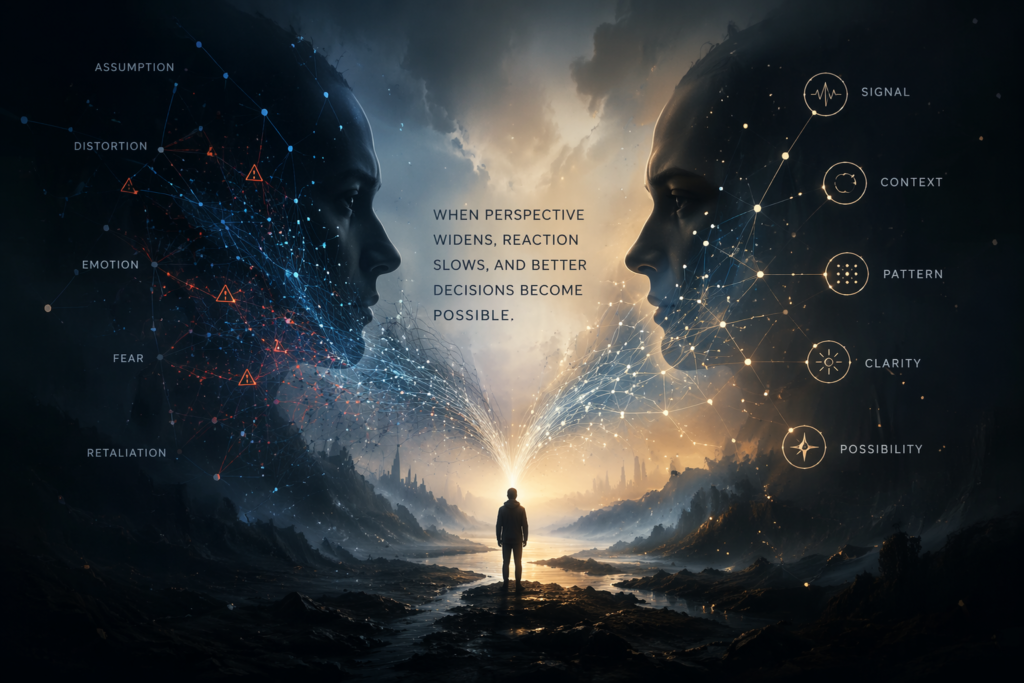
They widen the frame. They slow reaction. They create space between impulse and action.
And that space is where better outcomes become possible.
Closing Thought
Peace cannot be enforced by technology. But clarity can be supported.
This kind of clarity doesn’t have to come from large institutions alone. It can emerge through personal, adaptive interfaces that help individuals navigate complexity—quietly supporting better decisions in real time.
And wars are often sustained by distorted perception under pressure.
If we reduce distortion—even slightly—we change decisions. And repeated decisions are what shape outcomes.
The question is no longer whether we have powerful tools. It’s whether we are willing to use them to interrupt cycles of harm instead of accelerating them.
Social pressure around difference isn’t always obvious at first.
We went back to Montana looking for something simple—quiet, space, and a place to root.
We found a small house we could see ourselves building into something long-term. It wasn’t temporary. We were planning to stay.
My family was well known in the town. I had grown up there, but left right after high school. After the military—and a few scuffs along the way—I came back thinking that history would make it easier to settle.
My partner began teaching figure skating in a town where hockey dominated the culture. It seemed like a natural way to connect, contribute, and become part of the community.
On the surface, everything pointed toward this being a good fit.
That sense of fit didn’t last long.
What we found followed a different pattern.
The looks came first. Then the comments. Then the realization that this wasn’t just discomfort—it was something we had to actively navigate.
It wasn’t one moment. It was a pattern.
Simple things—going into town, interacting with people, existing openly—started to carry weight. Not always direct, not always loud, but consistent enough to change how you move, how you think, and how safe you feel.
The pattern didn’t stay subtle.
What began as looks and comments started to shift into something more structural—where risk wasn’t just felt, it had to be actively calculated.
At that point, the decision wasn’t about comfort anymore. It was about exposure.
That’s when we left.
From the outside, Montana is wide open space, mountains, sky, and quiet. And that part is real. But there’s another layer that sits underneath it—one shaped by long-held beliefs that don’t always make room for difference.
Even in places known for being more open, that tension doesn’t fully disappear. It shows up in policies, in conversations, and in the quiet calculations people make just to exist without conflict.
This isn’t about labeling a place as good or bad.
It’s about recognizing that beauty and harm can exist in the same space.
And if we want things to improve, we have to be willing to see both clearly.