Opening
Curiosity is a system—not a personality trait.
Most people think curiosity is something you either have or don’t. In reality, it’s a structured process that determines how you explore, learn, and grow.
But that framing misses what actually drives growth.
Curiosity isn’t a trait. It’s a system.
Break the Assumption
We assume curiosity is passive:
- something we feel
- something that shows up naturally
- something tied to personality
In reality, most people stop exploring not because they lack curiosity—
but because they lack a structure to act on it.
System Breakdown
Curiosity only becomes useful when it moves through a system:
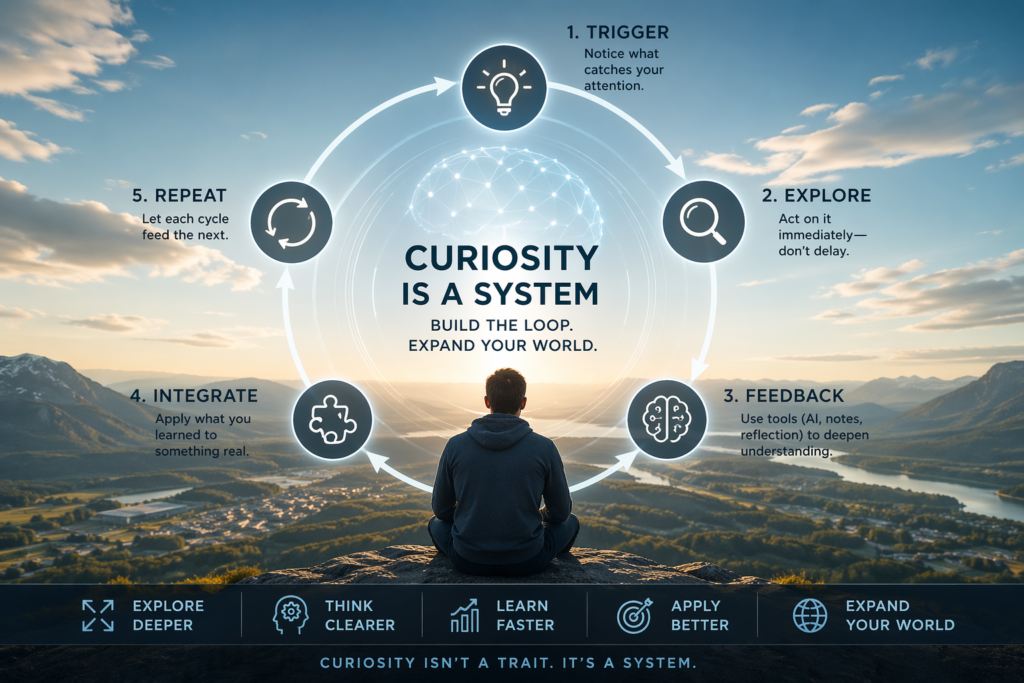
Trigger → Exploration → Feedback → Integration
Without this loop:
- curiosity fades into distraction
- learning stays surface-level
- insights don’t stick
With the loop:
- questions turn into understanding
- exploration compounds over time
- learning becomes self-sustaining
Technology—especially AI—can accelerate this loop.
But it doesn’t create it.
It amplifies what’s already there.
Personal Evidence (Controlled)
Growing up in Montana, my curiosity started with a simple computer from RadioShack—paid for by sweeping sidewalks at JC Penneys.
That early experience wasn’t about the machine.
It was about the loop:
question → explore → learn → repeat.
Recently, AI has allowed me to refine that loop further.
By aligning tools with how I naturally process information—sequentially and visually—learning shifted from effort to flow.
Not because AI is intelligent—
but because it supports the system.
Reframe
Curiosity isn’t something you wait for.
It’s something you build.
And once structured, it becomes a reliable way to expand your world.
System Insight
Across human systems:
People don’t fail to grow because they lack interest.
They fail because:
- exploration isn’t structured
- feedback isn’t clear
- integration never happens
So curiosity gets misdiagnosed as a personality trait—
instead of recognized as a repeatable process.
Application
To turn curiosity into a working system:
Step 1 — Trigger
Notice what catches your attention
Step 2 — Explore
Act on it immediately—don’t delay
Step 3 — Feedback
Use tools (AI, notes, reflection) to deepen understanding
Step 4 — Integrate
Apply what you learned to something real
Step 5 — Repeat
Let each cycle feed the next
The goal isn’t more information.
It’s a functioning loop.
Autism Perspective (System Advantage)
For me, being on the autism spectrum made this clearer.
When information is structured correctly:
- patterns become visible
- systems become predictable
- learning becomes efficient
AI didn’t “fix” anything.
It aligned with how my system already works.
That alignment is where the advantage comes from.
Why This Matters
In a rapidly changing world, curiosity isn’t optional.
But without structure, it collapses into noise.
With a system, it becomes:
- adaptation
- growth
- connection
Key Insights
- Curiosity is not a trait—it’s a system
- Growth depends on loops, not interest
- AI amplifies structure, not intelligence
- Learning sticks when it is applied
- Systems outperform personality over time
Closing
Curiosity doesn’t expand your world on its own.
The system behind it does.
Build the loop— and your world expands with it.
Leave a Reply