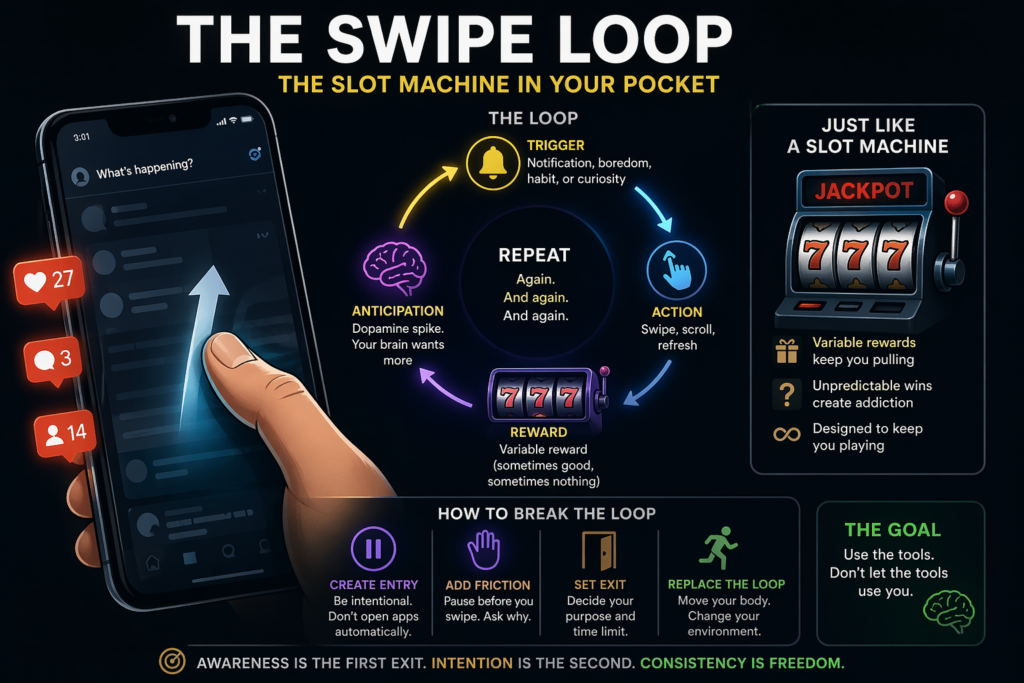
The Swipe Loop Visual Model
The Swipe Loop starts the same way every time.
The bells ring first—sharp, bright, demanding.
Then the reward.
That pattern isn’t limited to casinos.
It’s in your pocket.
The Anchor
Every time you:
- refresh a feed
- check a notification
- scroll “just one more time”
you’re pulling a lever.
Sometimes you get something:
- a message
- a like
- something interesting
Most of the time, you don’t.
That unpredictability is the key.
This pattern has a name:
The Swipe Loop
The Break
This isn’t accidental.
Digital platforms are built around a pattern called intermittent reinforcement:
- rewards come randomly
- not every time
- just often enough to keep you engaged
This is the same mechanism used in slot machines.
And it’s one of the most powerful behavioral hooks humans have.
System Breakdown
1. Variable Reward
You don’t know when something good will appear.
That uncertainty keeps you checking.
2. Low Effort Loop
- flick
- refresh
- repeat
No friction. Easy to continue.
3. Social Signal Layer
- likes
- views
- responses
Your brain reads this as attention and approval.
4. Endless Design
There’s no natural stopping point.
So the loop continues unless you interrupt it.
Personal Evidence (Loop Resistance in Practice)
I’ve tried to break the loop in simple ways:
- hide the app
- move it off the screen
- reduce visibility
When that doesn’t work, I delete it.
And it works—for a while.
But then something interesting happens:
The app comes back.
Not because I need it.
Because the loop isn’t finished.
So I delete it again.
What this reveals is simple:
Removing access doesn’t remove the system.
The urge is not about the app.
It’s about the loop continuing without closure.
What This Reveals
The behavior isn’t a personal flaw.
It’s a system interacting with your nervous system.
You’re not weak.
You’re responding exactly as designed.
Reframe
This isn’t about discipline.
It’s about unfinished loops.
Deleting the app interrupts access.
But it doesn’t complete the cycle your brain is trying to resolve.
Until the loop is closed, it will keep trying to reopen.
Application (Healthy Use)
The goal isn’t to quit technology.
The goal is to stop interacting with it unconsciously.
1. Create Entry Points
- open apps intentionally
- not automatically
2. Add Friction
- pause before refreshing
- ask: “why am I opening this?”
3. Set Exit Conditions
Decide before you start:
- time limit
- purpose
4. Replace the Loop
When the urge hits:
- stand up
- move
- shift your environment
Break the pattern physically.
Result
You still use the tools.
But they stop using you.
System Insight
The Swipe Loop works because it removes closure.
- no defined start
- no defined end
- no completion signal
Your brain keeps searching for resolution that never arrives.
When you reintroduce:
- clear entry
- defined exit
- intentional purpose
the loop weakens.
Closing
The machine is designed to keep you pulling.
But you still decide when to stop.
And that’s where your control begins.
— Oddly Robbie
Leave a Reply