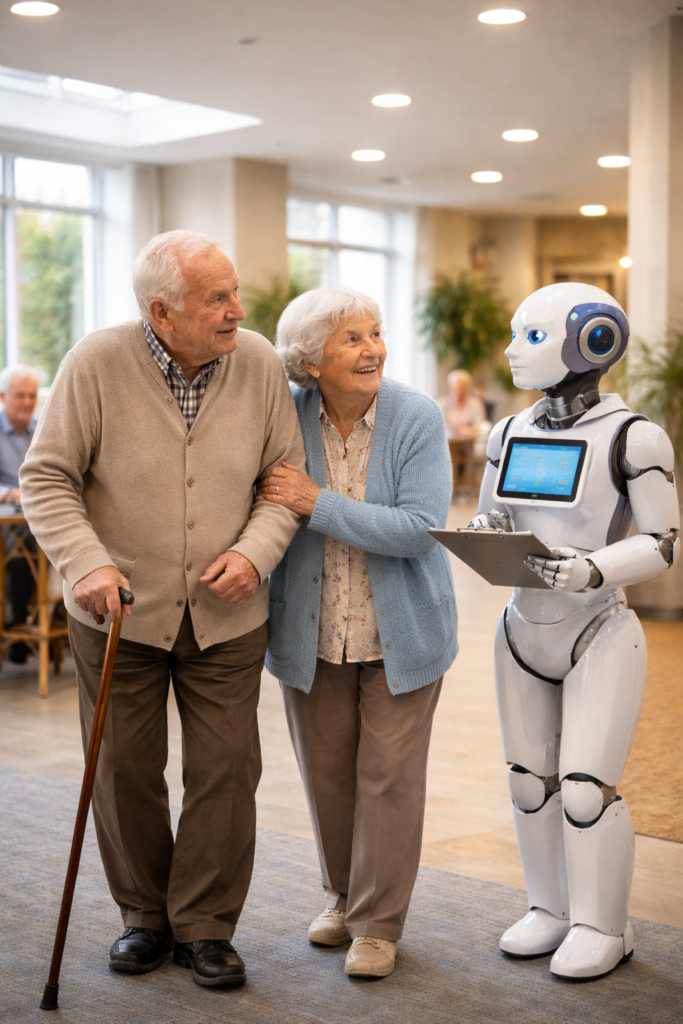
Elder care robots are often misunderstood.
When I worked maintenance in assisted living, I noticed something I wasn’t supposed to.
The system was precise.
Every task logged.
Every action tracked.
Every repair tied to billing.
And people felt it.
The Anchor
Residents would sometimes ask me quietly:
“Don’t log that.”
Not because they didn’t value the help—
but because they understood the system.
Every entry could trigger:
- charges
- reviews
- loss of control
They weren’t resisting help.
They were navigating incentives.
The Break
On paper, I wasn’t a great employee.
I didn’t always document everything.
In reality, I was responding to a system gap:
The system optimized for accountability—
but not for dignity.
So dignity had to be reintroduced manually.
System Breakdown
1. Optimization Bias
Care systems are typically optimized for:
- efficiency
- liability
- revenue
- scalability
These are measurable.
But systems rarely optimize for:
- dignity
- vulnerability
- cognitive variability
These are harder to quantify—so they’re excluded.
2. Dependency on Individuals
When dignity is not system-supported, it becomes person-dependent.
That creates instability:
- good day → better care
- burnout → reduced care
- turnover → inconsistent experience
Care quality becomes variable instead of structural.
3. Selection Pressure
Over time, systems retain what they reward.
In this case:
- emotional detachment is sustainable
- emotional sensitivity is exhausting
So the system stabilizes around detachment.
Not by intent.
By selection.
What This Reveals
If dignity depends on who is on shift—
then dignity is not part of the system.
It is an exception.
Reframe
The goal is not to make humans more empathetic under pressure.
The goal is to reduce the pressure that breaks empathy.
Japan Saw This Early
Faced with:
- aging population
- caregiver shortages
- long life expectancy
This is where elder care robots began to emerge as system support.
They didn’t try to stretch human capacity indefinitely.
They introduced system support:
Robotics.
Not to replace care—
but to stabilize it.
What Robots Actually Do
Robots don’t provide emotional empathy.
They provide system reliability:
- reduce physical strain
- ensure consistency
- monitor conditions continuously
- maintain predictable interactions
This shifts care from variable → stable.
This is the real role of robotic elder care.
Engineered Empathy
Empathy at the system level is not emotional.
It is structural.
It looks like:
- slower interaction speeds by default
- consent before assistance
- consistent tone and behavior
- transparent system actions
- protection against micro-exploitation
A system that prevents harm does not need to simulate care.
It enforces it.
The Real Risk
Low empathy rarely appears as cruelty.
It appears as:
- exhaustion
- policy adherence
- “that’s just how it works”
This is where most harm originates:
Not from intent—
but from system design.
Application
If designed correctly:
- machines handle consistency
- humans handle connection
This removes the failure points from both.
Humans are no longer stretched beyond capacity.
Systems no longer depend on emotional variability.
Result
- reduced burnout
- reduced exploitation
- increased predictability
- preserved dignity
And most importantly:
More space for real human presence.
System Insight
Empathy should not depend on individuals.
It should be embedded in the system.
Closing
We don’t need machines that feel.
We need systems that don’t break people.
That isn’t cold.
That’s responsible design.
— Oddly Robbie
Leave a Reply