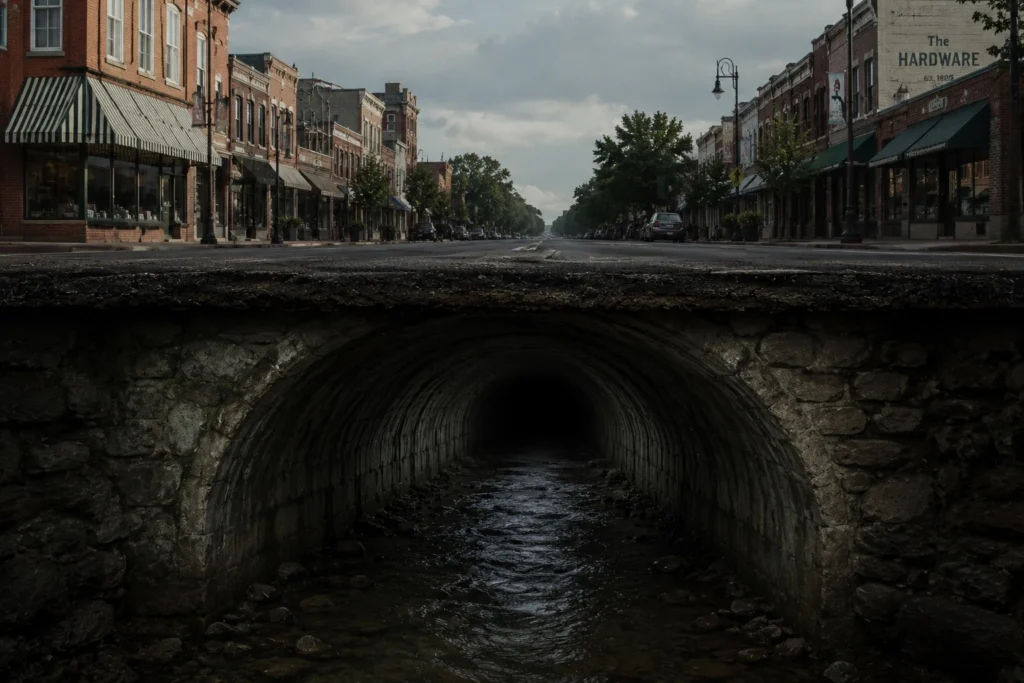
When we think about a town, we usually think about what we can see.
The main street.
The businesses.
The schools.
The parks.
The official story.
Growing up in Lewistown, Montana, I learned there was another side to communities.
A hidden side.
Big Spring Creek begins as clear spring water and meanders through town. In the summer, people float sections of it on inner tubes. Kids play in it. Families gather around it. It is part of the visible identity of the town.
But when the creek first reaches downtown, something unusual happens.
It disappears.
Part of it flows beneath the city through a tunnel hidden under streets and buildings. Most people know it is there. Few ever see it.
As a kid, I floated through that tunnel several times.
My parents were not thrilled about it.
There were always stories.
Someone said a body had been found down there.
Someone else talked about barbed wire.
There were warnings, rumors, and mysteries that seemed to grow larger every year.
To prepare for the journey, we would place a flashlight inside a plastic bread bag. Water still leaked in, but somehow the flashlight usually survived long enough to guide the way.
Above us, people went about their day.
Cars crossed intersections.
Businesses opened their doors.
Life continued normally.
Meanwhile, beneath the town, the creek kept flowing through darkness.
That memory stayed with me for decades because it revealed something larger than a tunnel.
It revealed how human systems work.
Most systems have visible layers and hidden layers.
The visible layer is what appears on maps, websites, and official descriptions.
The hidden layer is where stories live.
It is where traditions are passed between generations.
It is where warnings, assumptions, fears, and local knowledge accumulate.
These hidden layers often influence behavior more than the official structures do.
Organizations have underground creeks.
Families have underground creeks.
Communities have underground creeks.
Even nations have underground creeks.
They are the unseen currents that shape how people think, act, trust, cooperate, and remember.
The interesting thing is that outsiders often study the visible system while completely missing the hidden one.
They examine policies but ignore culture.
They analyze structures but overlook stories.
They map roads while forgetting the currents running underneath them.
If you want to understand a human system, do not just ask what is officially true.
Ask what people whisper about.
Ask what traditions survive without instruction.
Ask what stories everyone seems to know even though nobody wrote them down.
The answers are often found in the underground creek.
Not the part that appears on the map.
The part still flowing beneath it.
Key Insight
Human systems are shaped as much by their hidden stories and shared memories as by their visible structures. To understand how a community truly functions, look beneath the official map and find the currents that continue to flow unseen.
Leave a Reply