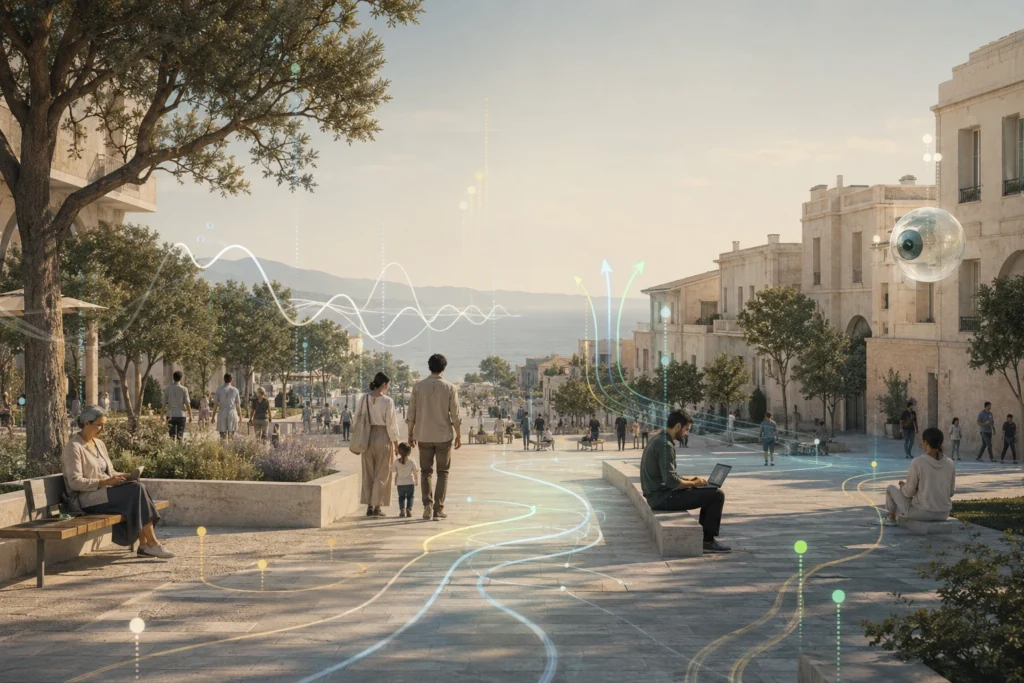
Nations, cities, and regions will not only compete by GDP, climate, or infrastructure. They will compete by how safe people feel inside their bodies while living there. Emotional livability is not a luxury signal. It is becoming a survival, migration, tourism, and governance signal.
A quiet global pattern is becoming easier to see.
People are not only traveling toward beaches, food, history, or cheaper vacations. More people are choosing places where their nervous system can relax.
You can see it on the Costa del Sol: younger visitors, young families, strollers, multilingual conversations, remote workers, and people who seem to be testing whether a place feels livable, not just enjoyable.
At first, it looks like tourism.
But underneath, it may be a larger human-systems shift.
The old assumption
Countries used to compete mainly through obvious systems:
jobs, wages, taxes, military strength, universities, airports, and national prestige.
Those still matter.
But they are no longer enough.
A country can be wealthy and still feel socially hostile.
A city can have opportunity and still feel unsafe.
A destination can be exciting and still keep the body in alert mode.
That changes how people choose where to go.
The global signal
Tourism is growing strongly again. Eurostat reported that 2025 was another record year for EU tourism, with nearly 3.1 billion nights spent in tourist accommodation across the EU, up 2.2% from 2024. Spain alone accounted for 513.6 million of those nights, the highest in the EU.
Costa del Sol also had a record 2025, with about 14.65 million tourists and more than €21.8 billion in tourism impact.
That is not just a vacation statistic.
It shows that certain places are becoming emotional landing zones.
What people may really be selecting for
Many people are not saying:
“I am choosing a nervous-system-friendly country.”
They say simpler things:
“I feel safer there.”
“The kids can be outside.”
“People seem calmer.”
“I can walk.”
“I don’t feel on guard all the time.”
“It feels easier to exist there.”
That is the signal.
People are choosing environments where daily life requires less defensive posture.
Global examples
This pattern shows up in places like:
- Portugal
- Spain
- Slovenia
- Austria
- Denmark
- New Zealand
- Japan
- Costa Rica
They are not identical. They do not all offer the same culture, cost, climate, or visa pathway.
But they often share a few emotional-livability traits:
- lower visible aggression
- safer public spaces
- stronger social trust
- walkable daily life
- reliable healthcare or infrastructure
- calmer family environments
- less constant threat signaling
The 2025 Global Peace Index supports part of this pattern: Portugal ranked 7th, Denmark 8th, Slovenia 9th, Japan 12th, Spain 25th, and New Zealand 3rd among 163 countries and territories. The index measures peacefulness across safety/security, ongoing conflict, and militarization.
The United States comparison
For some travelers and families, the United States now feels less emotionally predictable than it once did.
Not everywhere. Not for everyone.
But enough people notice the public tension: political hostility, gun anxiety, healthcare uncertainty, social fragmentation, high costs, and the feeling that daily life requires constant vigilance.
That creates a different kind of travel and migration pressure.
People may not only leave for cheaper rent or better weather.
They may leave because they are tired of living braced.
Conflict avoidance is now part of destination choice
Families also calculate risk differently.
They ask:
Can my children be safe here?
Can we walk here?
Can we sleep here?
Can we get medical care here?
Can we relax here?
Can we live without emergency mode?
That is not luxury thinking.
That is survival intelligence.
In a world where conflict, instability, and social stress feel more visible, emotionally calmer places become more attractive.
The hard truth
This pattern also creates pressure.
Costa del Sol is not perfect. Málaga is already seeing serious housing strain, with tourist apartment blocks increasing and concern that tourism is displacing residential life. Recent reporting described Málaga’s tourist apartment blocks rising by 15% in two years, passing 10,000 places, while housing remains a major local concern.
So emotional livability can become self-consuming.
A place becomes attractive because it feels calm.
More people arrive.
Housing tightens.
Locals feel pressure.
The calm system starts to strain.
That is the warning.
Reframe
Tourism may be the surface signal.
Emotional migration may be the deeper pattern.
People are quietly testing places with their bodies.
They arrive, walk, eat, listen, sleep, watch their children, feel the social temperature, and ask one basic question:
Can we live here without becoming smaller?
That question may shape the next generation of tourism, migration, and national competitiveness.
Key insight
The future competition between nations may not only be about who is richest, strongest, or most famous.
It may be about who can create environments where ordinary people feel safe enough to think clearly, raise children, stay regulated, and build good lives.
That is emotional livability.
And it may become one of the most important forms of infrastructure in the world.
The Central Tension of Modernity
Modern civilization has become extremely advanced at scaling systems, automating systems, and optimizing systems.
But it remains comparatively weak at aligning systems with human flourishing.
We have built powerful infrastructure for movement, commerce, entertainment, communication, and productivity. Yet many people still feel cognitively overloaded, socially fragmented, and emotionally unsafe inside the systems meant to serve them.
That gap may become one of the defining problems of the next era.
The future competition between nations may not be only about GDP, military strength, tax policy, or technological capacity. It may also be about emotional livability.
Can people rest there?
Can families walk there?
Can children grow there?
Can older people feel included there?
Can neurodiverse people function there without constantly masking?
Can visitors imagine becoming residents because their bodies feel less guarded?
These questions are not soft. They are system-level questions.
A place that feels safe, coherent, walkable, socially functional, and emotionally breathable becomes more than a destination. It becomes a nervous system refuge.
Why This Matters
People do not only move toward opportunity. They move toward regulation.
They move toward places where daily life feels less hostile, less chaotic, and less cognitively expensive. They move toward environments where the body does not have to stay on alert all the time.
That is why emotional livability matters.
It connects tourism, migration, urban design, public safety, healthcare, family life, and social trust into one human systems signal.
A country can have strong infrastructure and still feel difficult to live in. A city can be beautiful and still feel exhausting. A destination can be popular and still fail to become emotionally livable.
The deeper question is not only whether people want to visit.
The deeper question is whether people can imagine staying.
The Human Systems Signal
Costa del Sol, Portugal, and other calmer destinations may be showing an early pattern.
People are not simply looking for beaches, cheaper prices, or better weather. Many are looking for places where the human system feels less threatening.
This does not mean these places are perfect. No society is. Spain has bureaucracy, housing pressure, regional inequality, tourism strain, and real social challenges.
But perfection is not the signal.
The signal is comparative relief.
When people arrive somewhere and their nervous system softens, that matters. When young families, remote workers, older residents, and tired visitors all begin choosing places that feel safer and more breathable, that becomes a systems trend.
The next global advantage may belong to places that understand this clearly:
Human beings are not only economic actors.
They are nervous systems living inside social environments.
And when a place helps those nervous systems settle, people notice.
Leave a Reply