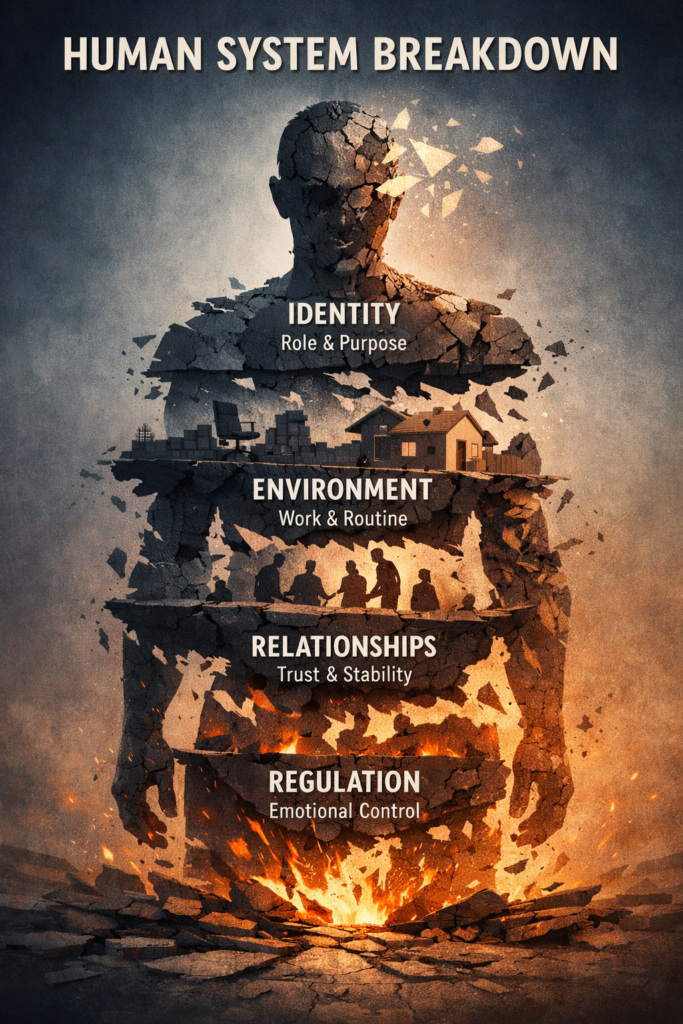
A human system breakdown occurs when identity, environment, relationships, and regulation collapse, leading to loss of self-regulation.
The belief
If someone is struggling, you step in, help, and things stabilize.
The break
That only works when the person is still self-regulating.
When regulation is gone, help doesn’t stabilize the system—
it gets absorbed, distorted, or burned.
This is what a human system breakdown looks like in real conditions.
The system breakdown
A person is not just an individual.
They are a stack of systems:
- Identity system — role, purpose, skill
- Environment system — work, space, routines
- Relationship system — trust, social stability
- Regulation system — emotional control, decision boundaries
When these layers hold, the person adjusts to pressure.
When they collapse—one by one—the person stops self-correcting.
The pattern
The shift usually follows a sequence:
1. Stable structure
Clear role, income, rhythm
→ System runs without intervention
2. External disruption
Loss of work, industry shifts, instability
→ Identity destabilizes
3. Personal fracture
Conflict, loss, breakdown of trust
→ Emotional anchors weaken
4. Coping substitution
Addiction, volatility, unstable behavior
→ Regulation degrades
5. System failure
Distorted reality, unsafe actions
→ No internal correction remains
At this stage, the person is no longer operating as a stable system.
What changes at failure
This is where most people misread the situation.
They continue using support strategies
for what has become a containment problem.
Support assumes:
- Help can be integrated
- Behavior will adjust
- Stability can return
But in a failed system:
- Help is redirected or rejected
- Behavior becomes unpredictable
- Stability does not hold
The system consumes input but does not convert it into change.
The pressure point
When a person can’t regulate themselves, regulation shifts outward:
- Family becomes the stabilizer
- Friends absorb risk
- Institutions intervene when limits are crossed
If no system holds →
the burden falls on whoever is closest
The common mistake
People stay engaged too long because of:
- Memory of who the person was
- Hope that one more effort will work
- Social pressure to not step back
But they are interacting with a different system state—
not the earlier version of the person.
The reframe
Not all systems can be stabilized from the outside.
Some systems:
- Lack internal structure
- Reject correction
- Escalate under intervention
In these cases, stepping in does not help.
It feeds instability.
Application
Before engaging, check for self-regulation signals:
- Can they maintain agreements?
- Do they adjust after consequences?
- Is their perception of reality consistent?
If the answer trends no across these:
You are not entering a support role.
You are entering a containment role.
Choose position deliberately
There are only three viable positions:
1. Support
When self-regulation exists
2. Structured containment
Legal systems, institutions, enforced boundaries
3. Distance
When neither is possible for you
Most harm happens when people try to operate in position 1
while the system requires position 2 or 3.
System insight
- Systems degrade layer by layer, not all at once
- Without regulation, input does not produce stability
- Proximity determines who absorbs the failure
Distance is not abandonment.
It is refusing to become the system that replaces theirs.
Key takeaways
- A person can shift from self-regulating → externally dependent
- Support only works when internal structure exists
- Misreading system state leads to burnout and risk
- Boundaries are structural decisions, not emotional ones
- Not all systems are recoverable from the outside
Guardian signals
- Systems often hide collapse behind familiar identity
- Late-stage instability spreads to nearby systems
- Intervention without structure accelerates failure
- Distance preserves system integrity when containment is unavailable
Related:
• How Human Systems Actually Work
• When Support Turns Into Instability
• Boundaries as System Design
Leave a Reply