Across the world, gender has become a point of tension, debate, and division.
At first glance, it looks like a cultural disagreement—different values, beliefs, and perspectives colliding.
But when the same pattern appears across countries, languages, and political systems, it stops being random.
It becomes a system.
Break the Assumption
This is not fundamentally a “gender issue.”
It is a pressure management system that societies use when they struggle to handle complexity.
Gender is simply one of the current targets.
System Breakdown
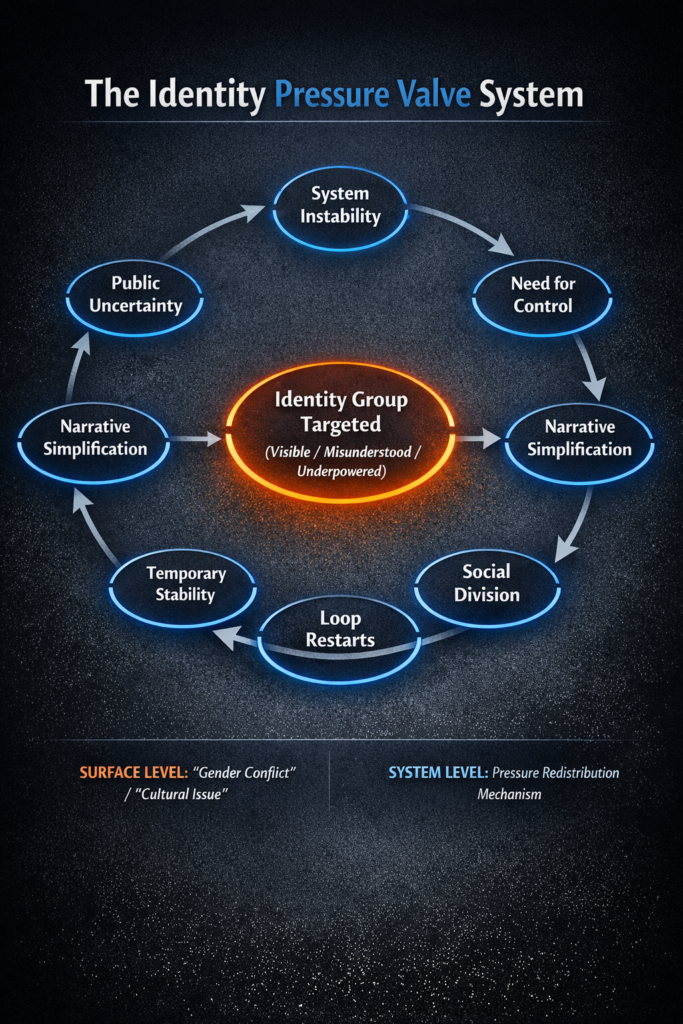
The Identity Pressure Valve System
When systems experience stress, they don’t always resolve it—they redirect it.
The loop:
Instability → Fear → Simplification → Targeting → Division → Temporary Stability → Repeat
Step-by-step
1. Instability rises
Economic strain, rapid technological change, cultural shifts, or political uncertainty create pressure.
2. Fear increases
People lose a sense of control and look for something they can understand and react to.
3. Complexity gets simplified
Real problems are systemic and difficult to solve, so narratives are created to make them feel manageable.
4. A visible identity group becomes the focus
Not random—these groups are:
- Visible
- Misunderstood
- Structurally underpowered
5. Division replaces resolution
Attention shifts away from root causes and toward interpersonal conflict.
6. The system stabilizes temporarily
Pressure is released—not solved—allowing the cycle to reset.
Pattern Recognition
This system is not new.
The target changes, but the structure does not:
- Race
- Religion
- Sexual orientation
- Gender identity
- Immigrants
- Neurodivergent individuals
Each cycle feels unique.
Each cycle follows the same design.
Reframe
Gender is not the cause of the conflict.
It is the current surface where deeper system pressure is being expressed.
When we mistake the surface for the source, we participate in the cycle instead of interrupting it.
System Insight
Division is not just disagreement.
It is a failure mode of human systems under stress.
And unity is not just moral.
It is a stabilization mechanism that prevents systems from fragmenting further.
Application
If you want to step out of the loop:
1. Identify the pressure, not just the target
Ask: What larger instability is being redirected here?
2. Refuse oversimplified narratives
If a complex issue has a simple villain, you’re likely inside the system.
3. Shift from reaction to observation
Seeing the pattern reduces its emotional grip.
4. Reinforce connection where division is expected
This interrupts the system’s ability to escalate.
The Real Risk
If we don’t recognize this system, we will keep participating in it.
Not always as the target—but always as part of the cycle.
Closing
Human systems don’t break all at once.
They fragment slowly, through repeated cycles of redirected pressure.
Recognizing the pattern is the first step.
Choosing not to reinforce it is the second.
Key Insights
- Gender conflict is a surface expression of deeper system instability
- Identity groups are often used as pressure outlets
- The structure repeats globally, regardless of culture
- Division is a system failure mode, not just disagreement
- Awareness allows individuals to step outside the loop
Leave a Reply