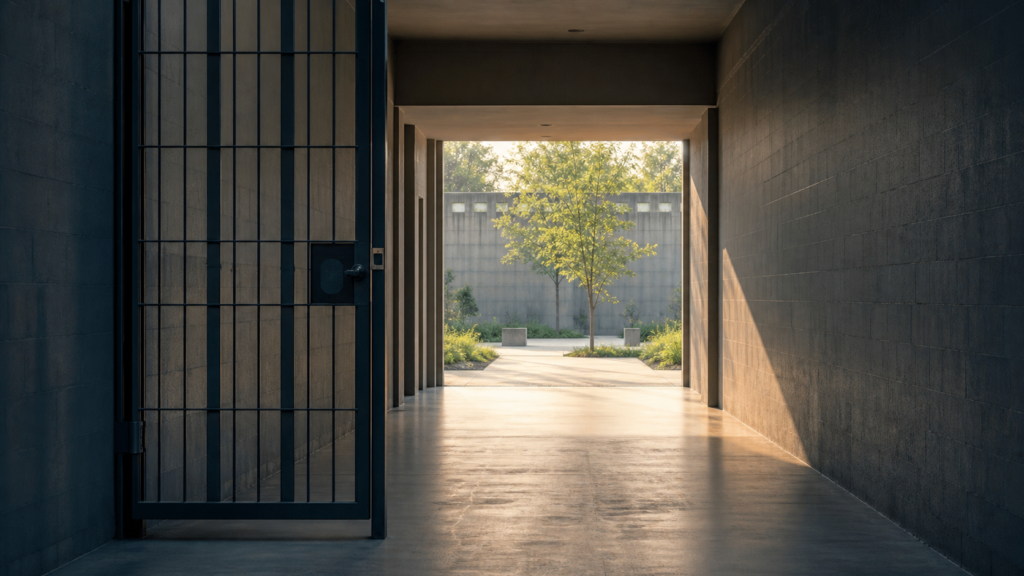
Key idea: Separating someone from the public may sometimes be necessary to prevent harm. But punishment, humiliation, and deprivation do not reliably create safety or repair. A system designed to reduce harm must protect people while preserving dignity and building a realistic path back into life.
Prison is often discussed as though it has one clear purpose: to punish wrongdoing and keep the public safe.
Safety matters. Some people do pose an immediate risk of harming others, and separation from the public may be necessary. But separation should be about preventing harm, not making suffering the response.
That distinction changes everything.
The evidence does not support simple answers
Returning to the justice system after release is common. The U.S. Bureau of Justice Statistics found that 62% of people released from state prisons in 34 states in 2012 were arrested again within three years, and 71% within five years. In a separate 24-state study, 61% returned to prison within ten years, either for a new sentence or a parole or probation violation. Bureau of Justice Statistics, 10-year follow-up
Those figures do not prove that prison causes every later offence. People enter prison with very different histories, needs, and circumstances. But they do show that punishment alone is not producing the level of safety the system promises.
A closed system creates its own culture
Prison is not merely a building where people wait out a sentence. It is a self-contained culture, reinforced by walls, gates, routines, scarcity, and hierarchy.
Like other closed systems, it develops its own informal economy, social rules, loyalties, and survival strategies. When legitimate resources are limited, people find unofficial ways to trade skills, goods, and protection. The institution may try to suppress that culture, but it cannot remove the human need for safety, status, belonging, and agency.
The question is what people are being taught inside that environment.
A system built around control, isolation, and distrust can train people to expect control, isolation, and distrust. Respect is difficult to learn where it is not practised. Trust is difficult to build where every relationship is shaped by suspicion.
Release cannot mean abandonment
A person can leave prison without leaving the conditions that made their life unstable.
Housing may be uncertain. Work may be hard to access. Family relationships may be strained or broken. Supervision requirements can be difficult to meet without money, transport, documents, or support. For some people, the world outside can be less structured and less predictable than the institution they have just left.
That does not excuse future harm. It explains why a system that focuses only on punishment may fail to create a workable alternative.
What a human system would do differently
A human-centred approach to public safety would begin with a simple principle: prevent harm while treating every person as human.
That would mean:
- separating people from the public only when necessary for safety;
- maintaining dignity, meaningful routine, education, healthcare, and human connection while they are separated;
- addressing the conditions that contribute to harm, including trauma, addiction, mental-health needs, poverty, and isolation;
- preparing people for release from the beginning, not at the final gate; and
- making stable housing, work, community support, and continuity of care part of public safety.
This is not softness. It is systems thinking.
Punishment may satisfy a demand for consequence, but suffering alone is not repair. It does not automatically help the person harmed. It does not automatically change the person who caused harm. And it does not automatically make the public safer.
A more mature system would still take harm seriously. It would still protect people. But it would stop confusing cruelty with accountability.
A world that has outgrown punishment is a world worth building: one that protects people from harm without treating suffering as the solution.
Leave a Reply