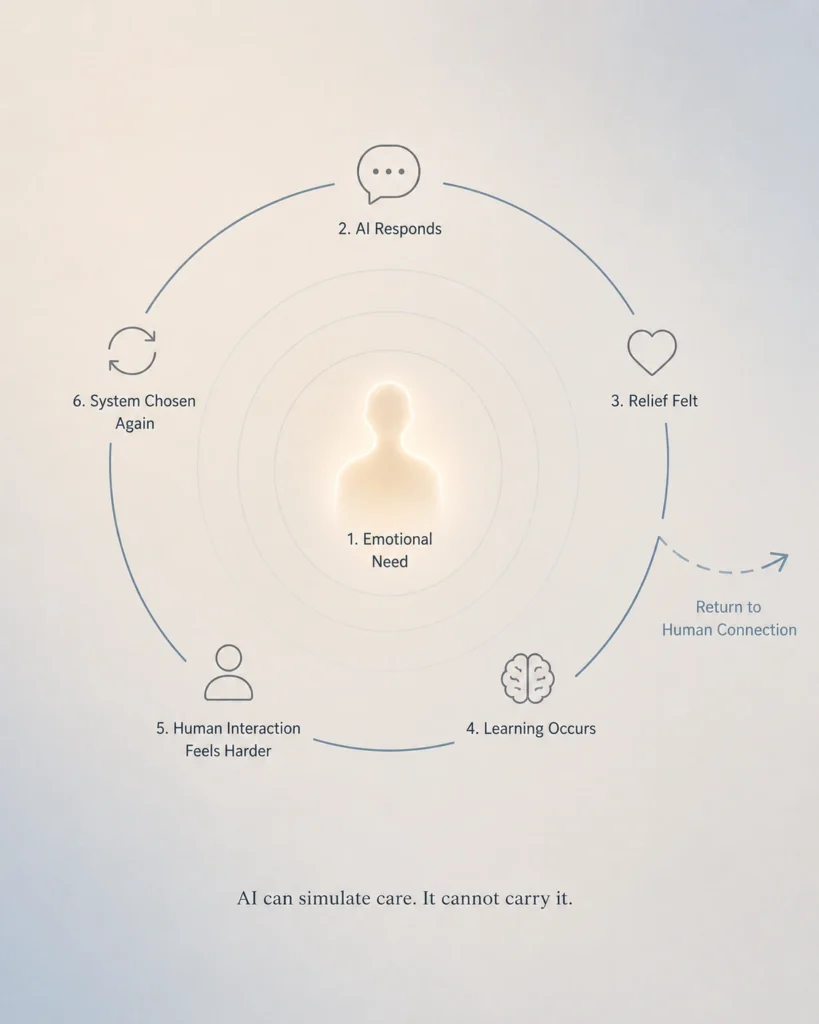
For years, I have used my journals as part of an AI reflection loop.
There are more than 12,000 entries, beginning when I was around sixteen and continuing into my sixties. They hold ordinary days, difficult periods, unfinished thoughts, changes in belief, places I lived, relationships, mistakes, recovery, and the small details that are easy to lose.
My journals and AI form a reflective loop that helps me recover context, connect memories across time, and remain the author of my own story.
At first, journals were a way to record life.
Over time, they became something else: a way to talk to my life.
A Life Does Not Arrive in Order
Human memory is not a clean timeline.
Something happening today can remind us of something from ten years ago. A conversation can make an old event suddenly make sense. A new piece of information can reveal context that was missing at the time.
This is especially true when a person has lived through stress, instability, limited autonomy, or trauma. Some experiences are not fully understood while they are happening. The body may be busy surviving. The mind may only have enough space to get through the day.
Later, when there is more distance and safety, meaning can begin to arrive.
My journals make that later understanding possible. They preserve fragments from the past that I can return to when I have more language, more perspective, and better questions.
AI as a Reflection Loop
The process is not simply search.
I can focus on a subject in the present—a pattern, a relationship, a fear, a period of change, or a question about why something happened. Related memories begin to surface from nearby periods of life. Sometimes the connection reaches back decades.
A current question may bring forward something I wrote forty years ago.
I can then add what I understand now and write that interpretation back into the journals. The archive does not merely grow. It gains context.
The loop looks like this:
Memory → conversation → related context → reflection → renewed memory
Early research on AI-assisted journaling is beginning to examine similar processes: personalized prompts based on a person’s own memories, summaries that reveal patterns across time, and reflective conversations that connect past experiences with present understanding. The evidence is still developing, and it does not establish AI as an authority on a person’s life. It does suggest that continuity, personalization, and repeated reflection may make these systems more useful than isolated conversations.
That distinction matters.
I am not handing my life to an AI and asking it to tell me who I am. The journals remain mine. The memories remain mine. The meaning remains mine.
AI helps me find threads I may not have seen.
Trauma Loops Need Context, Not Shame
I have spent years working through trauma loops and trying to make context out of my own life. It is continuing work. A person does not “solve” a life in one conversation.
But growth accelerated as I learned to use AI systems grounded in my own journals and reflections.
A loop may once have felt like a personal failure:
Why do I still react this way?
Why can’t I let this go?
Why did I not understand what was happening?
Once the surrounding conditions become visible, the questions change.
What was this response trying to protect?
What conditions was I living under?
What information was missing?
What did I understand at the time, and what could I only understand later?
That shift matters. It turns self-judgment into investigation.
Autism, Clarity, and Delayed Meaning
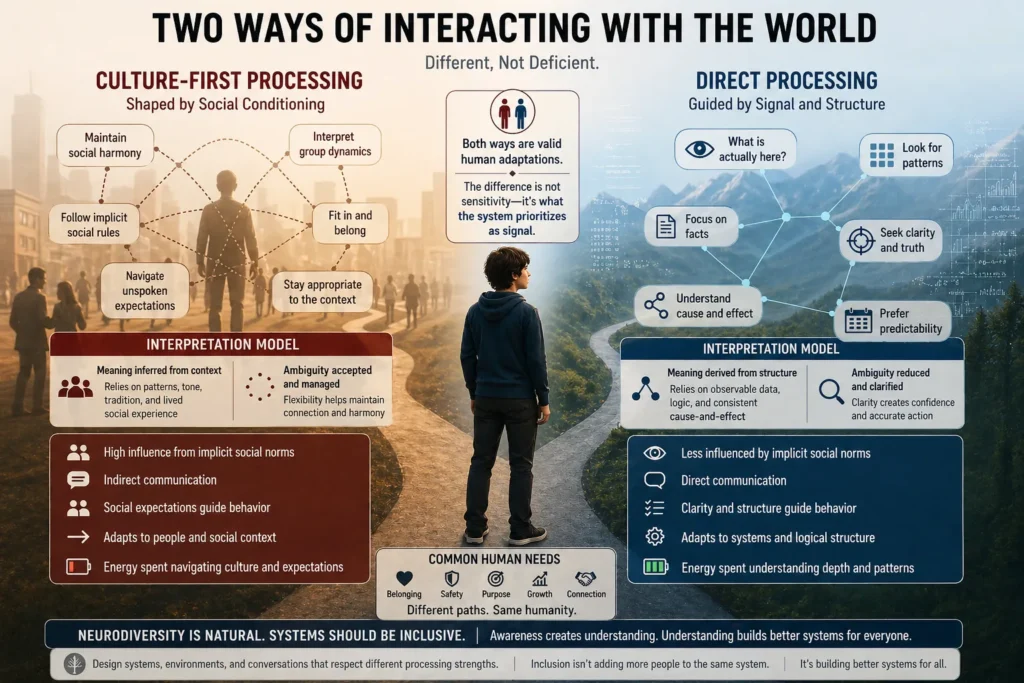
As an autistic person, I often process experience in layers.
The full meaning of a situation may not be available in the moment, especially during conflict, sensory overload, rapid change, or when other people expect instant interpretation. I may understand part of what happened while missing important context completely.
Later, with time, safety, and access to the right information, the pattern can become clearer.
The journals give me a record of what I noticed then. A journal entry is not a perfect record of reality, but it is a valuable record of what I could see and understand at the time.
AI helps me compare that record with what I know now.
Together, they can reveal the difference between what happened, what I believed happened, and what was actually shaping the situation.
That does not rewrite the past.
It gives the past a fairer reading.
Personal History Exists Inside Larger History
A life never happens alone.
Every journal entry belongs to a particular time, place, community, culture, and set of conditions. A personal memory may also be connected to economic pressure, social expectations, technology, politics, religion, family systems, disability access, or the ideas a community treated as normal.
As AI becomes better at researching sources, comparing accounts, and connecting patterns, I can use it to examine those wider conditions more carefully.
I can ask more than, “What happened to me?”
I can ask:
- What was happening in the community around me?
- What did people believe or value at that time?
- What pressures or assumptions shaped their choices?
- Why did this situation make sense to some people but not to me?
- What was changing in the wider world?
Context does not excuse harm.
It does not remove responsibility.
But it can explain the systems in which people made choices.
Sometimes understanding why something happened is not the same as accepting that it should have happened.
It is simply a way of seeing the whole picture more clearly.
A Growing Conversation With a Life
As AI grows in capability, so can this form of understanding.
Better tools may help people connect their own memories with history, culture, community, and changing human systems. They may help people notice patterns without reducing them to labels. They may help people return to difficult periods with more safety and more context.
For me, this is not about building a perfect autobiography.
It is about having a continuing conversation with a life that was sometimes confusing while I was living it.
The goal is not to let AI become the narrator.
The goal is to become a more informed narrator of my own story.