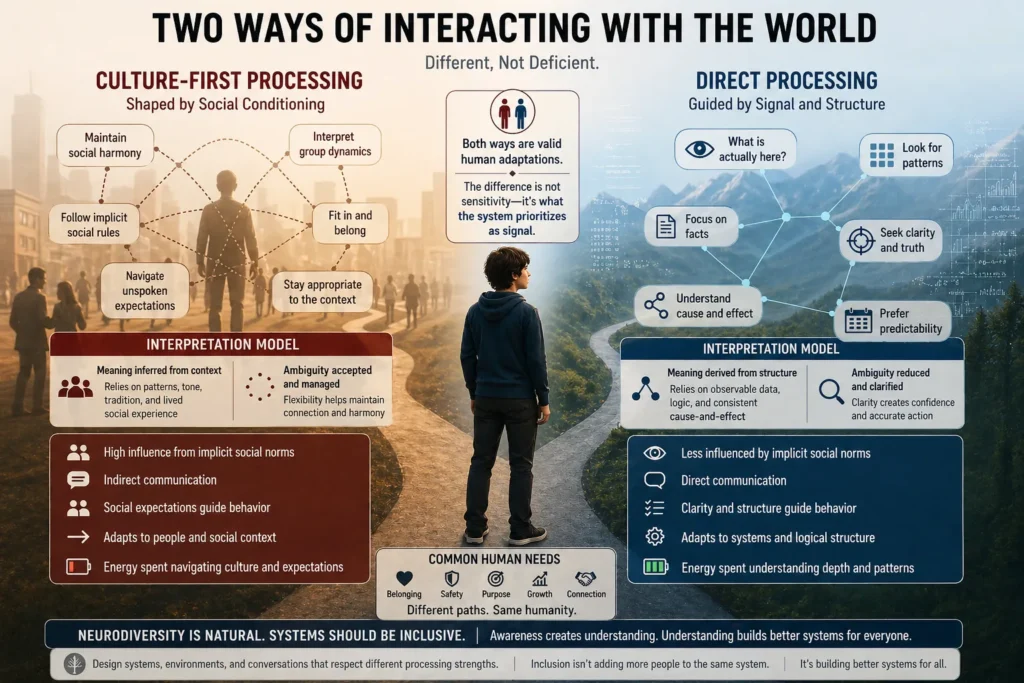
Most conversations about autism begin with a quiet assumption:
That there is a “normal” way to think, behave, and process the world—and anything outside of that needs to be corrected.
That assumption is not neutral.
It is a system decision.
Break the Assumption
“Normal” is not a universal truth.
It reflects what a system has optimized for.
When someone struggles inside that system, the conclusion is usually that something is wrong with the person.
But often, the system itself is narrow.
System Breakdown
Most human environments—schools, workplaces, social structures—are built around:
- fast verbal processing
- indirect communication
- tolerance for unpredictability
- high social bandwidth
These are not baseline human traits.
They are preferences that systems have reinforced over time.
Autistic cognition often operates differently:
- pattern recognition over rapid response
- direct communication over implied meaning
- need for predictability over constant change
- focused attention over distributed attention
When these two patterns meet, friction appears.
That friction is commonly labeled as dysfunction.
In reality, it is system misalignment.
Culture vs Direct Processing
Many people are shaped heavily by cultural conditioning—unspoken rules, social expectations, and indirect signals.
Autistic individuals are not unaffected by environment.
They are affected differently.
- less automatic adoption of implicit social norms
- greater sensitivity to direct environmental signals
- preference for clarity over interpretation
This creates a different relationship with the world.
Where many people are guided primarily by social expectations,
autistic individuals are often guided more by structure, signal, and sensory reality.
This can make cultural systems feel inefficient or unclear—not because the person is disconnected from reality, but because the system depends on shared assumptions that are not explicit.
Reframe
Autism is not simply a condition to be managed.
It is a signal.
It reveals where human systems rely too heavily on implicit agreement, indirect communication, and narrow definitions of “normal.”
Instead of asking:
“How do we make the person fit the system?”
A better question is:
“What does this interaction reveal about the system itself?”
System Insight
Autism does not remove environmental influence.
It shifts which parts of the environment matter most.
- less influence from social conditioning
- more influence from direct input and structure
When systems align with this mode of processing:
- friction decreases
- clarity increases
- capability emerges naturally
What looked like limitation often becomes strength.
Application
This changes how we design systems:
- Education → multiple processing paths, not one correct method
- Workplaces → reduce ambiguity, reward clarity
- Technology → adaptive interfaces instead of fixed expectations
At a personal level:
Stop interpreting difference as failure.
Start interpreting it as data about system fit.
Key Insights
- “Normal” is a system construct, not a universal truth
- Autism reflects a different interaction with environment, not absence of it
- Friction often comes from system mismatch, not individual deficit
- Culture shapes behavior—but not all minds rely on it the same way
- Better systems adapt to cognition instead of forcing conformity
Leave a Reply