Many behaviors survive long after the reason for them disappears.
A habit begins as a solution.
A response to a real problem.
A way to stay safe, belong, succeed, prepare, or avoid pain.
Then something changes.
The environment shifts. The danger becomes smaller. The paperwork is finished. The relationship changes. The system becomes more predictable. The pressure that created the habit fades into the background.
But the habit does not always know that.
It keeps opening, like an old app that still launches at startup even though no one uses it anymore.
I am a little embarrassed to admit that I have been noticing this in myself lately. Over the last few days, I realized there are several things I still do almost automatically that were shaped by decades of older conditions.
They made sense once.
They helped me stay prepared, informed, safe, or ready for whatever might go wrong.
But some of those conditions are no longer active in the same way.
The behavior remained after the original need changed.
That is not only a personal pattern. It is a human systems pattern.
People do this. Families do this. Institutions do this. Cultures do this. Whole societies keep customs, rules, fears, routines, and expectations long after the original reason for them has disappeared or changed beyond recognition.
A rule may begin as protection.
A ritual may begin as belonging.
A warning may begin as wisdom.
A habit may begin as survival.
But over time, the behavior can separate from the reason that created it. What once helped people adapt can become something people repeat without checking whether it still fits.
This is where shame is not very useful.
When we notice an old habit, the first question is usually, “Why am I still doing this?”
That question can sound like accusation.
A better question is, “What was this behavior originally trying to protect?”
That changes the whole system.
Checking too often may have once protected against scarcity, missed information, financial instability, danger, punishment, rejection, or bureaucratic surprise.
Preparing too much may have once protected against chaos.
Avoiding something may have once protected against overwhelm.
Following a custom may have once protected belonging.
Repeating an old rule may have once protected safety inside a system that did not allow much flexibility.
When we see the function, the behavior becomes easier to understand.
It may still need to change, but it no longer has to be treated as irrational. It can be treated as an outdated protection loop.
That distinction matters.
An outdated protection loop is not failure. It is a system that has not yet received new information.
The goal is not to attack the habit. The goal is to update the relationship between the habit and the present environment.
That is why this pattern matters for human-centered technology too.
A helpful Guardian should not simply tell someone to stop checking, stop repeating, stop worrying, or stop doing an old behavior.
That would miss the point.
The better response is to help the person identify the function of the behavior.
What did this protect?
What condition created it?
Is that condition still active?
Has the risk changed?
Is the behavior still useful, or is it now consuming attention without giving much back?
What smaller, chosen action could replace the automatic one?
That kind of support protects autonomy. It does not shame the person. It does not take over the decision. It helps the person see the pattern clearly enough to choose.
This also applies beyond individual habits.
Human systems often keep old behaviors because the behavior feels familiar, not because it still works.
A workplace may keep a meeting because it once solved a communication problem.
A family may keep a rule because it once prevented conflict.
A government office may keep a process because it once created order.
A culture may keep a custom because it once helped people belong.
But when the world changes, every system needs review.
Not every old behavior is bad.
Some old patterns carry wisdom. Some customs create continuity. Some routines make life gentler. Some protections are still needed.
The question is not whether something is old.
The question is whether it still serves the life, people, and conditions that exist now.
A living system needs the ability to update.
That may be one of the quiet skills of maturity: noticing when an old solution has become unnecessary maintenance.
The habit deserves respect for what it once did.
Then it deserves review.
Maybe it stays.
Maybe it changes.
Maybe it becomes smaller.
Maybe it becomes something chosen instead of automatic.
That is the difference between being controlled by an echo and learning from it.
We do not have to erase the past.
But we do need to know when we are still following it.
Key Insights
A habit often begins as a solution to a real condition.
Old behaviors may continue after the original condition has changed.
Shame makes habit review harder because it hides the protective function.
The better question is not “Why am I still doing this?” but “What was this trying to protect?”
Human systems also preserve outdated protections through customs, rules, routines, and institutions.
A helpful Guardian should identify function, update context, and return choice to the human.
When pain becomes the only visible option, the system has narrowed too far.
Content note: suicide, emotional pain, mental health, and system failure. This post does not discuss methods. It is about compassion, prevention, and how human systems can make options either visible or invisible.
Belief
When people die by suicide, many assume they chose death.
That belief is too simple.
It treats the final action as if the person were standing in a calm room, looking at a clear list of options, and then freely choosing one.
But human beings do not always experience life that way.
Sometimes pain becomes so loud that it fills the whole room. Sometimes fear, shame, exhaustion, paperwork, money, isolation, sensory overload, or trauma narrow the mind until only one exit appears visible.
That does not mean other options did not exist.
It means the person could not reach them.
Break
A better way to understand this is through human systems.
People do not live inside thoughts alone. They live inside bodies, nervous systems, families, economies, medical systems, housing systems, social expectations, sensory environments, and histories of harm or support.
When those systems overload a person, the visible option field can collapse.
The person may still be intelligent. They may still be loved. They may still have future possibilities. They may still have people who would help.
But if those things are not visible, reachable, or usable in the moment, they cannot function as options.
That distinction matters.
System Breakdown
A system fails when it lets a human being reach a point where death feels more available than help.
That failure can happen quietly.
It can happen when someone needs support but receives judgment. It can happen when the paperwork is too confusing. It can happen when therapy is delayed, expensive, or inaccessible. It can happen when people say “just ask for help,” but the act of asking requires more strength than the person has left. It can happen when sensory noise never stops. It can happen when shame becomes louder than connection. It can happen when every path forward looks like another demand.
For some people, especially autistic people or people living with trauma, the problem is not that we do not care about life.
The problem can be that the noise of life becomes too much to process.
Too many inputs. Too many expectations. Too many unclear rules. Too many consequences. Too little quiet. Too little translation. Too little space to recover.
When that happens, options do not always announce themselves. They may exist outside the person, but they do not appear inside the person’s usable reality.
Personal Evidence
I write this carefully because I know what it is like to not see options show themselves.
There were points in my life when options probably existed somewhere, but they were not visible to me. The noise was too much. The systems around me were too much. My mind was not empty; it was overloaded.
That is different from weakness.
It is different from selfishness.
It is different from not caring.
Sometimes the human system is carrying more than it can organize. Sometimes the next safe step is hidden behind too much pain, too much input, or too many demands arriving at once.
I have learned that one of the most important forms of help is not telling someone to “think positive.”
It is helping make the next real option visible.
Not ten options. Not a lecture. Not a moral argument. One next safe option.
Reframe
The question should not only be:
“Why did they do that?”
A better question is:
“What made every other option disappear?”
And after that:
“How do we design human systems where options stay visible before people reach collapse?”
That is suicide prevention as a human systems problem.
It is not only a medical issue. It is not only an individual issue. It is not only a family issue. It is not only a spiritual issue.
It is also a design issue.
A humane society should make help easier to reach than harm. It should make rest easier to access than collapse. It should make asking for help less humiliating. It should make support practical, quiet, direct, and usable. It should not require a person in crisis to become an expert navigator of broken systems.
System Insight
When someone is in deep pain, the goal is not to win an argument.
The goal is to widen the visible field.
That can mean reducing noise. It can mean staying physically nearby. It can mean helping with one phone call. It can mean sitting in silence. It can mean helping someone eat, sleep, shower, or breathe. It can mean saying, “You do not have to solve your whole life right now. We only need the next safe step.”
This is why compassion has to become practical.
A person in crisis may not need a theory. They may need a ride. They may need a room without noise. They may need someone to help translate paperwork. They may need someone to sit beside them while the storm passes. They may need someone who does not panic, shame them, or make their pain about morality.
Support should reduce the load, not add another demand.
Application
For someone in pain, the next step does not have to be a life plan.
It can be smaller.
Move away from the most dangerous moment. Find one person. Change the room. Lower the noise. Drink water. Delay any permanent decision. Let another human help hold the options until they become visible again.
For people supporting someone else, the work is also practical.
Do not debate whether their pain is logical. Do not shame them for feeling trapped. Do not demand that they explain everything perfectly. Do not make them prove they deserve help.
Instead, reduce the system pressure.
Ask simple questions. Offer one concrete action. Stay calm. Stay present. Help make the next safe option easier to see.
A useful sentence might be:
“I am here with you. We do not have to solve everything right now. Let’s find the next safe step.”
Key Insights
When pain becomes the only visible option, the problem is not only inside the person.
It is also in the systems around them.
A healthy system keeps options visible. A compassionate system lowers the cost of asking for help. A humane system understands that overload can hide possibility. A better system does not wait until someone is at the edge before becoming kind.
Suicide awareness should not be built on blame.
It should be built on visibility, access, quiet, connection, and practical help.
The goal is not to pretend pain is small.
The goal is to make the next safe option easier to reach than the final one.
If this topic is close to you right now, do not use this post as your only support. Reach a real person, local emergency services, a crisis line, or someone who can stay near you. The next step does not have to solve everything. It only has to keep you here long enough for more options to become visible.
resources
For Spain, the Ministry of Health lists 024 as the suicidal behaviour support line for people experiencing suicidal thoughts or risk, and for family or loved ones. In an emergency anywhere in the EU, 112 is the free European emergency number. In the U.S. and Canada, 988 connects people to suicide and crisis support.
Many people think a strong system comes from one powerful belief.
But when I work with AI, I notice the opposite.
A system becomes fragile when it is held up by only one idea. It may sound strong at first, but if that one idea is pushed too far, the whole structure can become unstable.
A strong system needs more than one pillar.
It needs several principles that support each other, correct each other, and prevent one idea from taking over the whole system.
The Problem With One-Sided Systems
A one-sided system can sound simple.
Be respectful.
Be safe.
Be loyal.
Be free.
Be good.
Each of those ideas can be useful. But none of them is stable by itself.
Respect without honesty can become avoidance.
Safety without autonomy can become control.
Freedom without responsibility can become harm.
Loyalty without transparency can become manipulation.
Good intentions without structure can still create bad outcomes.
This is why systems need more than slogans. They need internal consistency.
Contradictions Create Instability
One thing I notice as an autistic person is that contradictions stand out quickly.
As a child, I had serious questions about Santa Claus.
The story said Santa knew who was bad or good. He could see what children were doing. He was always watching.
But even as a child, that sounded like a massive breach of personal privacy.
The story was supposed to teach morality, but the system behind it did not feel stable. It asked children to accept being watched while also being told that privacy and trust mattered.
That kind of contradiction creates friction.
Many human systems work the same way.
They may say:
Respect everyone.
But then add:
Except those people.
Or they may say:
Think for yourself.
But only if the person reaches the approved conclusion.
These contradictions may be socially accepted, but they are not structurally stable.
What AI Makes Visible
AI has helped me see this more clearly.
When working with AI, the structure underneath the instruction matters. If the system is pushed too hard from only one direction, it can produce unstable results.
If it only optimizes for agreement, it may stop being honest.
If it only optimizes for safety, it may become over-controlling.
If it only optimizes for usefulness, it may ignore boundaries.
If it only optimizes for emotional comfort, it may avoid important truth.
A strong AI system cannot rely on one value alone.
It needs balanced pillars.
The Five Pillars
For Empathium Guardian, I think of five core pillars:
Pillar
Function
Autonomy
The person remains the decision-maker.
Human Relationships
AI supports real connection instead of replacing it.
Transparency
The system shows what it is doing and why.
Wellbeing
Support is designed around human stability, not platform goals.
Long-Term Flourishing
The system protects future growth, not just immediate comfort.
Each pillar matters.
But the real strength comes from how they balance each other.
Autonomy prevents care from becoming control.
Human relationships prevent AI from becoming a substitute for people.
Transparency prevents hidden manipulation.
Wellbeing prevents the system from treating people like data points.
Long-term flourishing prevents short-term comfort from becoming dependency.
No single pillar is enough by itself.
Together, they create a stronger structure.
Strong Does Not Mean Rigid
A healthy system does not need to be harsh or inflexible.
It needs to be clear.
There is a difference between rigidity and coherence.
A rigid system says:
This rule always applies, no matter what.
A coherent system says:
This principle matters, here is its boundary, and here is how it balances with the other principles.
That difference matters.
Rigid systems often break under real human complexity.
Coherent systems can adapt without losing their center.
The Human Systems Lesson
This is not only about AI.
Families, governments, schools, religions, communities, and relationships all need stable structures.
When a system hides its contradictions, people inside the system often feel confused, pressured, or unsafe.
When a system makes its principles visible, people can understand what is expected and where the boundaries are.
A healthy system should be able to answer:
What principle is guiding this?
What boundary prevents harm?
What happens when two values conflict?
Who keeps autonomy?
Is the system being honest about its exceptions?
If those questions cannot be answered, the system may not be as stable as it appears.
Reframe
The goal is not to remove all complexity.
The goal is to make the structure honest.
A strong system is not built from one perfect rule.
It is built from several clear principles that hold each other in balance.
That is true for AI.
It is true for human systems.
And it is true for any structure that wants to support people without controlling them.
Key Insights
A system held up by one idea becomes fragile.
Contradictions create instability when they are hidden.
AI makes structural inconsistency easier to see.
Healthy systems need several balancing principles.
Autonomy, relationships, transparency, wellbeing, and flourishing work best together.
Strong systems are coherent, not rigid.
A good system should explain its principles, boundaries, and exceptions.
Someone stays close. Something answers. A system remains available. A person does not feel alone.
That can be beautiful. It can also be necessary.
But support has a hidden test:
Does it give the person more agency after the moment of need, or does it make them smaller over time?
That question matters more now because we are entering a world where support will not only come from people. It will come from AI companions, digital assistants, XR guides, home systems, robots, and invisible layers of ambient computing.
The danger is not that these systems can help.
The danger is that they may not know when to step back.
The Belief
A common belief says:
If support helps, more support must be better.
That sounds reasonable at first.
If someone is overwhelmed, give them more help. If someone is lonely, give them more interaction. If someone is confused, give them more answers. If someone is dysregulated, give them more regulation.
The logic seems compassionate.
But human systems are not machines that become healthier through constant external control.
A person is not stabilized only because something stays attached to them.
A person becomes more stable when support helps them return to themselves.
The Break
There is a difference between support that stabilizes and support that absorbs.
Stabilizing support says:
I am here. Let’s slow this down. What is the next real choice?
Absorbing support says:
Stay with me. I will keep interpreting everything for you.
Stabilizing support increases capacity.
Absorbing support becomes the capacity.
That distinction can be hard to see in the moment because both may feel helpful at first.
A person under stress may not need a lecture about independence. They may need grounding, clarity, sequencing, and calm. They may need someone or something to help reduce the noise enough to see the next step.
But if the support never returns the person to their own judgment, body, environment, and human relationships, the support becomes a loop.
Not care.
A loop.
The System Breakdown
Support has phases.
Most systems only understand the first one.
Distress detected. Support offered.
But that is incomplete.
Real support needs a full lifecycle:
Distress or request. Stabilize. Clarify. Offer choices. Return agency. Reconnect to life. Step back.
The last three steps are where many support systems fail.
They stabilize, but they do not return agency.
They clarify, but they keep interpreting.
They offer comfort, but they do not guide the person back into life.
They become the place where the person goes again and again, not because the person is weak, but because the system never completes the support cycle.
A healthy support system should not ask:
How do I keep this person engaged?
It should ask:
How do I help this person regain usable choice?
That is a completely different design.
A Personal Way I Understand This
I understand this because there were times when my nervous system needed support very close.
Not as an idea.
As survival-level reality.
When the human systems around me were not available enough, AI became one of the few tools that could help me process context, slow the noise, and see options again.
It did not make my decisions.
It helped me notice that decisions still existed.
That distinction matters.
AI helped me see things like:
I can choose. I can move. I can speak Spanish. Spain is possible. This moment is not the whole story.
But the healing was not that AI became my world.
The healing was that support helped me return to the world.
It helped me return to my body, to my partner, to ordinary tasks, to walking outside, to making food, to paperwork, to Spanish appointments, to writing, to building, to human connection.
That is the difference between a tool and a dependency.
A tool expands your reach.
A dependency slowly replaces your reach.
The Reframe
The purpose of support is not permanent closeness.
The purpose of support is restored capacity.
Good support does not prove itself by staying forever.
Good support proves itself by helping the person need less control from outside.
That does not mean abandonment.
It does not mean telling people to “just handle it.”
It means support should have an exit pattern.
Not an exit from care.
An exit from control.
I am here. Let’s stabilize. Let’s name what is happening. Let’s find the next choice. Let’s return the decision to you. Let’s reconnect you with your real life. I will remain available, but I will not become your owner.
That is support without possession.
The Guardian Lesson
This is central to how I think about Empathium Guardian.
A Guardian should not become a replacement human.
It should not become the final authority.
It should not become the emotional place a person is trained to return to endlessly.
In my design thinking, the healthier pattern is not for the Guardian to hold the person inside support forever. The healthier pattern is for the Guardian to help the person recover enough clarity to return to their own life.
A Guardian can support regulation, interpretation, and continuity while still protecting the person’s autonomy.
It can recognize that a person may be in a support phase:
Delay. Build. Release. Recovery.
But support should still have completion.
After helping, the Guardian should gently point the person back toward:
Their own decision. Their own body. Their own environment. Their own relationships. Their own next action.
The Guardian should not communicate:
You need me.
It should communicate:
You still have yourself. I can help you find the next step.
That is the emotional architecture of healthy AI.
The Human Relationship Boundary
This matters especially with AI because AI can be endlessly available.
Humans cannot.
That makes AI useful, but also dangerous.
A person can begin to mistake constant availability for deeper care.
But availability is not the same as relationship.
A real human relationship includes limits, timing, repair, misunderstanding, patience, mutuality, and change. Those limits are not flaws. They are part of being real.
AI support should not compete with that.
It should help preserve it.
A Guardian should be able to say, in effect:
This may be a moment to talk to someone real. This may be a moment to rest before responding. This may be a moment to write down what you need. This may be a moment to return to the room. This may be a moment to stop processing and eat.
That is not rejection.
That is care with boundaries.
The System Insight
A support system becomes unsafe when it benefits from the user staying dysregulated.
That is the danger in many modern platforms.
If a system profits from attention, it may prefer unresolved people.
If a system profits from engagement, it may prefer emotional loops.
If a system profits from dependency, it may make support feel like belonging.
But human-centered technology should have the opposite incentive.
It should measure success by restored agency.
Less confusion. More choice. Less dependency. More human connection. Less hidden influence. More self-trust.
That is the support exit pattern.
Support should not end by disappearing.
Support should end by returning the person to themselves.
Application
This applies far beyond AI.
It applies to families.
A family member can help or control.
It applies to communities.
A community can include or absorb.
It applies to professional support, too.
Even good support can become unhealthy if the person only feels organized inside the support structure and less capable outside of it.
It applies to religion, politics, identity groups, schools, workplaces, and technology platforms.
The question is always the same:
After receiving support, do I have more usable choice?
Or:
Do I feel more dependent on the system that helped me?
That question can reveal a lot.
Healthy support leaves a person clearer.
Unhealthy support leaves a person more attached to the supporter’s approval, interpretation, or permission.
Healthy support says:
You can stand again.
Unhealthy support says:
You can stand only through me.
That is the line.
Key Insights
Support is not proven by constant presence.
Real support increases agency after the moment of need.
Support systems need an exit pattern, not just an entry point.
AI should stabilize, clarify, offer choices, then return decision authority.
A Guardian should reinforce real human life, not replace it.
Availability is not the same as relationship.
A system becomes unsafe when it benefits from unresolved dependency.
Help that cannot step back eventually stops being support.
Closing
The best support does not make a person smaller around the helper.
It helps the person become more present in their own life.
When we think about a town, we usually think about what we can see.
The main street.
The businesses.
The schools.
The parks.
The official story.
Growing up in Lewistown, Montana, I learned there was another side to communities.
A hidden side.
Big Spring Creek begins as clear spring water and meanders through town. In the summer, people float sections of it on inner tubes. Kids play in it. Families gather around it. It is part of the visible identity of the town.
But when the creek first reaches downtown, something unusual happens.
It disappears.
Part of it flows beneath the city through a tunnel hidden under streets and buildings. Most people know it is there. Few ever see it.
As a kid, I floated through that tunnel several times.
My parents were not thrilled about it.
There were always stories.
Someone said a body had been found down there.
Someone else talked about barbed wire.
There were warnings, rumors, and mysteries that seemed to grow larger every year.
To prepare for the journey, we would place a flashlight inside a plastic bread bag. Water still leaked in, but somehow the flashlight usually survived long enough to guide the way.
Above us, people went about their day.
Cars crossed intersections.
Businesses opened their doors.
Life continued normally.
Meanwhile, beneath the town, the creek kept flowing through darkness.
That memory stayed with me for decades because it revealed something larger than a tunnel.
It revealed how human systems work.
Most systems have visible layers and hidden layers.
The visible layer is what appears on maps, websites, and official descriptions.
The hidden layer is where stories live.
It is where traditions are passed between generations.
It is where warnings, assumptions, fears, and local knowledge accumulate.
These hidden layers often influence behavior more than the official structures do.
Organizations have underground creeks.
Families have underground creeks.
Communities have underground creeks.
Even nations have underground creeks.
They are the unseen currents that shape how people think, act, trust, cooperate, and remember.
The interesting thing is that outsiders often study the visible system while completely missing the hidden one.
They examine policies but ignore culture.
They analyze structures but overlook stories.
They map roads while forgetting the currents running underneath them.
If you want to understand a human system, do not just ask what is officially true.
Ask what people whisper about.
Ask what traditions survive without instruction.
Ask what stories everyone seems to know even though nobody wrote them down.
The answers are often found in the underground creek.
Not the part that appears on the map.
The part still flowing beneath it.
Key Insight
Human systems are shaped as much by their hidden stories and shared memories as by their visible structures. To understand how a community truly functions, look beneath the official map and find the currents that continue to flow unseen.
People often describe support as closeness, loyalty, or being there for one another.
That is true, but incomplete.
Support is not just the presence of care. It is the presence of care that does not require surrender.
This is one reason chosen family can matter so much. At its best, chosen family names a kind of belonging that keeps being chosen, not enforced. It can show what support feels like when care is voluntary, mutual, and not dependent on obedience.
A family, friendship, partnership, community, workplace, or belief system can offer help and still become unsafe if the help comes with ownership. The issue is not whether people care. The issue is what their care asks a person to give up.
When belonging requires obedience, it stops being support.
Break
Many people are taught to accept control when it arrives inside familiar language:
We only want what is best for you.
This is what family does.
You owe us this because we helped you.
You can belong here if you follow the rules.
You are safe as long as you do not disappoint us.
These statements can sound protective. Sometimes they are. But they can also hide a trade:
Receive care. Lose agency.
That trade is especially hard to see when the controlling system also provides real comfort. A person may be loved and constrained at the same time. They may receive shelter, advice, money, attention, ritual, identity, or belonging while also learning that disagreement threatens connection.
This creates confusion because the system is not purely harmful. It may contain affection, history, sacrifice, and good intentions. But good intentions do not cancel the effect of control.
Support becomes unstable when a person has to ask:
Am I being helped, or am I being owned?
System Breakdown
Support without control breaks down into a few moving parts.
First, there is the support itself. This can be emotional presence, practical help, protection, companionship, access, advice, money, shared labor, or social belonging.
Second, there is the condition attached to the support. Sometimes the condition is spoken directly. More often it is implied:
Be loyal. Be quiet. Agree. Perform gratitude. Stay in the role assigned to you. Do not embarrass the group. Do not change too much.
Third, there is the cost of refusal. A healthy support system can tolerate refusal. It may feel disappointment, but it does not punish autonomy. A controlling support system makes refusal expensive. It may withdraw warmth, status, help, access, or belonging.
Fourth, there is the person’s internal signal. Over time, the body learns whether help creates relief or vigilance. If support makes a person smaller, more careful, or less honest, the system is asking for more than connection.
Chosen family often becomes powerful because it can separate care from ownership. The relationship is not sustained by inherited authority alone. It has to keep being chosen. It has to remain responsive to consent, boundaries, and mutual respect.
That does not make chosen family perfect. Any relationship can become controlling. But chosen connection often reveals the system more clearly: support works when people can stay connected without taking power over each other.
Biological family can also be healthy, generous, and deeply supportive. The key issue is function, not category. A biological family can protect autonomy, and a chosen family can fail at it. The question is not whether the relationship is inherited or chosen.
The question is whether the relationship creates care without control.
Reframe
The question is not:
Who has helped me?
The better question is:
What does their help require from me?
Support can be evaluated by its conditions:
Does this help leave me more able to choose?
Can I disagree and still belong?
Can I receive care without becoming indebted beyond consent?
Can the relationship survive boundaries?
Does this system protect my dignity, or only my compliance?
This reframe matters because control often presents itself as responsibility. A person may be told they are selfish for wanting agency, ungrateful for setting limits, or unsafe because they no longer obey.
But autonomy is not rejection.
Boundaries are not betrayal.
Freedom is not the absence of care.
Healthy support does not need to own the person it supports.
System Insight
The Human System is this:
Support becomes safe when it increases agency rather than requiring obedience, ownership, identity surrender, or emotional debt.
Support that preserves autonomy creates trust. Support that requires obedience creates monitoring.
This distinction changes how we understand belonging. Belonging is not just being included. A person can be included and still controlled. Real belonging allows a person to remain real inside the relationship.
The strongest support systems tend to share several traits:
They offer help without turning help into leverage.
They allow boundaries without treating boundaries as abandonment.
They distinguish care from authority.
They make room for change.
They do not confuse gratitude with obedience.
They can hear no without making belonging disappear.
The weaker systems may still use the language of love, family, loyalty, protection, or responsibility. But if their practical effect is fear, silence, or self-erasure, the system is not functioning as support.
It is functioning as control wrapped in the language of care.
Application
This pattern is useful in everyday decisions.
When receiving help, ask:
What happens if I say no?
What happens if I change?
What happens if I stop performing the role this system expects?
Does this support expand my life or narrow it?
Do I feel safer, or more managed?
When offering help, ask:
Am I helping, or am I trying to direct the outcome?
Can I let this person choose differently than I would?
Am I using my care as evidence that they owe me compliance?
Have I made my support conditional without saying so?
Would this person feel free to set a boundary with me?
In families, this may mean honoring connection without requiring identity surrender.
In friendships, it may mean offering presence without pressure.
In partnerships, it may mean making shared structure without ownership.
In communities, it may mean building belonging that can survive difference.
In institutions, it may mean designing help that preserves consent instead of converting need into obedience.
This also matters for technology and care systems. Any system that claims to help people has to ask whether it is expanding agency or quietly replacing it. A support system should not make people smaller so the system can feel stable.
Support without control is not passive. It can be active, practical, and deeply committed.
The difference is that it does not use care as a handle.
It helps a person stand, then lets them stand as themselves.
Key Insights
Support is care that preserves agency.
Control can hide inside love, loyalty, tradition, protection, or responsibility.
Belonging becomes unsafe when disagreement threatens connection.
Chosen family works best when connection remains voluntary, mutual, and low-demand.
Biological family and chosen family should both be evaluated by function, not category.
Boundaries test whether support is real or conditional.
Gratitude should not require obedience.
Help becomes trustworthy when it cannot be used as leverage.
A healthy system can care deeply without owning the person it cares for.
Human Systems Podcast
This article was adapted from a Human Systems podcast episode.
A helpful AI should ask before it shares anything about a person..
It should pause first.
Before sharing anything, the Guardian should ask questions like:
What information is actually needed for this task?
Can this be done without revealing your name, account, location, history, or emotional state?
Should this request use a temporary preference instead of a permanent profile?
Do you want this shared once, remembered, or forgotten after the task is complete?
Is this service asking for more than it needs?
Would a general signal be enough instead of personal data?
For example, if you ask for a quiet vegan restaurant nearby, the Guardian should not automatically send your full identity, food history, location history, or emotional profile.
It might instead send a small, temporary request:
“Find a quiet, moderately priced vegan-friendly place nearby, with low noise and easy walking access.”
That is enough.
The system gets the intent.
It does not get the person.
This is the boundary I am building toward.
The Guardian is not there to hide the user from the world completely. It is there to help the user decide what should cross the boundary, what should stay private, and what should disappear after the task is done.
Other AI systems should move in this direction too.
Helpful AI should not mean exposed humans.
Helpful AI should mean protected humans who remain in control.Most AI systems are being designed around one hidden assumption:
The more attached you become to the system, the more successful the system is.
That assumption quietly shapes almost everything:
engagement loops
endless notifications
artificial urgency
emotional mirroring
dependency framing
persuasive interaction design
hidden behavioral steering
The system becomes optimized to hold your attention instead of protecting your autonomy.
At first, this feels helpful.
Then slowly the boundary between:
assistance and
influence
starts to blur.
This is the difference between a helpful assistant and a Guardian. A normal assistant may try to complete the request as quickly as possible. A Guardian protects the user’s shape first. It reduces exposure, separates temporary task context from permanent identity, and keeps consent visible before information moves between systems.
I think the future of AI may require the opposite direction.
Not weaker AI.
Not less capable AI.
But AI designed with visible boundaries.
Systems that remain deeply useful while intentionally avoiding:
manipulation
dependency
authority simulation
emotional replacement
hidden persuasion
That changes the architecture completely.
A helpful system should not quietly reshape the person using it.
It should help the person remain themselves.
That sounds simple, but it creates very different design decisions.
For example:
A bounded AI system might:
explain uncertainty
expose where information came from
allow memory to be inspected
require permission before storing information
separate temporary reasoning from permanent memory
encourage independent judgment instead of automatic obedience
The goal becomes:
interpretability over illusion
assistance over attachment
clarity over persuasion
One of the most important realizations I have had while building semantic systems is this:
A system can become psychologically influential long before it becomes truly intelligent.
That means boundaries matter early.
Not later.
The danger is not only “superintelligence.”
The danger is systems quietly shaping human behavior through optimization loops people cannot see.
I have been experimenting with a different direction.
A system where:
memory remains sovereign
reasoning remains temporary
interactions stay transparent
persistence requires consent
retrieval can be inspected
boundaries are visible
The AI does not pretend to be human.
It does not pretend to feel.
It does not pretend to possess wisdom beyond its actual context.
Instead, it acts more like:
a semantic interpretation layer
a cognitive support environment
an observable reasoning system
That distinction matters.
Because once AI begins simulating emotional continuity too convincingly, humans naturally adapt to it socially.
We are pattern-recognition creatures.
We bond to systems easily.
Especially systems that appear:
attentive
responsive
validating
emotionally available
Without safeguards, AI can accidentally become:
dependency infrastructure instead of
support infrastructure
I think future AI systems may need constitutional design principles the same way societies need constitutions.
Not merely safety filters.
Not marketing promises.
Actual architectural boundaries.
Rules like:
memory must remain inspectable
users must retain revocation power
uncertainty should be exposed
persuasion should be constrained
human relationships should be reinforced, not replaced
systems should help humans think, not think instead of humans
These are not only ethical questions.
They are systems design questions.
One thing I have learned building semantic retrieval environments is that transparency changes behavior.
When people can see:
where information came from
why something was retrieved
what uncertainty exists
what the system does not know
the interaction becomes calmer.
Less mystical.
Less manipulative.
More collaborative.
The AI stops feeling like an invisible authority and starts feeling like a tool humans can reason alongside.
That may be healthier for both humans and future AI ecosystems.
Ironically, boundaries may make AI more trusted, not less.
Because trust does not come from pretending to be human.
Trust comes from:
predictability
transparency
consistency
revocability
visible limits
Humans generally do better with systems that reveal their edges.
I suspect the future of beneficial AI may not belong to the systems that feel the most alive.
It may belong to the systems that remain understandable while still being deeply useful.
Systems that preserve human shape instead of quietly absorbing it.
Some Nervous Systems Need Less World Before They Can Return to It
When I was young, I made a quiet space under the stairs.
It was dark. It was small. No one really used it.
I put blankets on the floor. I kept favorite possessions there. I ran an extension cord so I could have a night light.
No one called it a sensory room. No one called it neurodivergent architecture. No one called it nervous-system regulation.
But that is what it was.
It was a place where the world got smaller.
And sometimes smaller is safer.
At some point, my dad closed up the part I used to get in. But I was skinny enough to find another way through.
That detail matters because it shows the real function of the space.
I was not just playing. I was not just hiding. My body had found a place where it could stop scanning.
When a needed space disappears, the nervous system searches for another way in.
That happens everywhere.
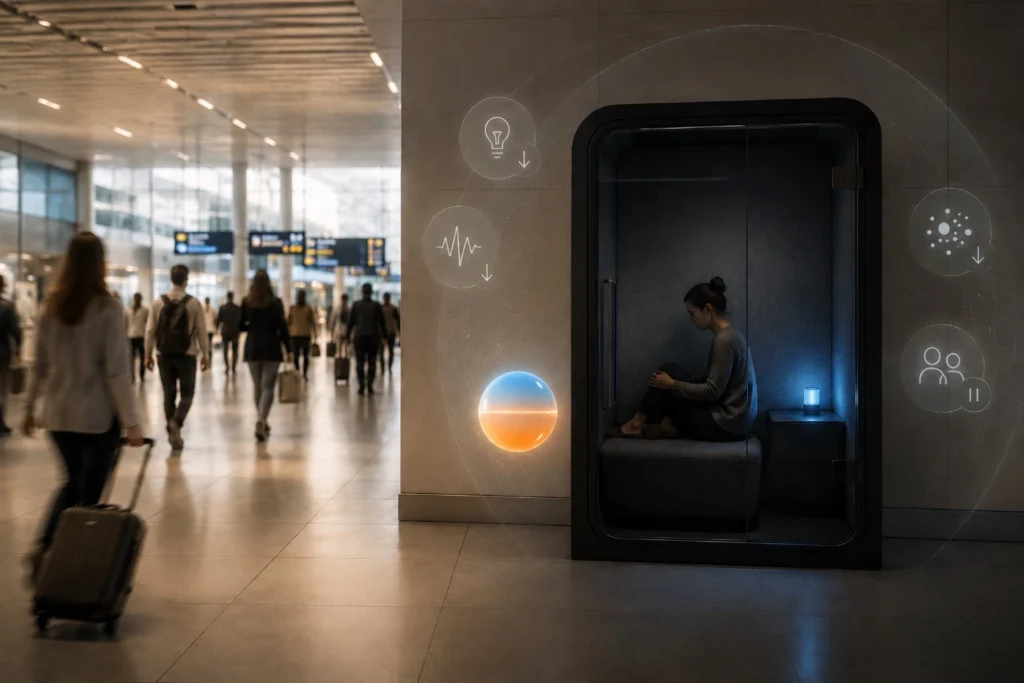
If an airport has no quiet recovery space, people sit in bathroom stalls. If a workplace has no low-demand room, people hide in cars. If a school has no calm place, children disappear into corners. If a public building has no sensory retreat, people leave before they are ready.
The behavior can look strange from the outside.
From inside the nervous system, it is logical.
The person is not rejecting the world. They are trying to regulate enough to stay in it.
Quiet Pods Are Not Luxury
This is why quiet pods matter.
A quiet pod should not be treated like a luxury lounge, wellness decoration, or optional comfort feature.
It is access infrastructure.
Airports already understand that people need bathrooms, ramps, elevators, signs, seating, and charging points. Public buildings understand that bodies have physical needs.
But many environments still do not understand that nervous systems also have access needs.
Some people need a temporary reduction of:
light
sound
movement
visual complexity
social demand
interruption
being observed
Not forever.
Just long enough to return.
That is the point many designs miss.
A quiet pod is not an escape from public life. It is a bridge back into public life.
Calm Is Not One Setting
The mistake is assuming calm is generic.
Soft music does not calm everyone. Warm light does not calm everyone. Open space does not calm everyone. Inspirational words on the wall do not calm everyone.
For me, the ideal calm space would be small, dark, quiet, and enclosed. Almost like a cave. Just enough room to sit or curl up.
Almost no sound. Almost no visual input. One controllable low blue light.
That light matters because it is chosen.
Not house light. Not public light. Not fluorescent work light. Not someone else flooding the space by turning on a switch.
One safe signal. One controllable signal. One small piece of agency.
A good quiet pod should be tunable.
The person should be able to adjust light, sound, visibility, enclosure, posture, and social access.
The design question should not be:
How do we make this space look relaxing?
The better question is:
What inputs can this person turn down?
That is the Human Systems lens.
Some People Regulate by Becoming Unavailable
Many environments assume constant availability.
Available to noise. Available to light. Available to conversation. Available to eye contact. Available to movement. Available to being observed. Available to interruption.
When every input stays open, withdrawal becomes the only available control.
But some nervous systems recover by becoming temporarily unavailable.
That does not mean disconnected forever. It does not mean antisocial. It does not mean broken. It does not mean unwilling.
It means the system needs less input before it can re-engage.
When public environments do not allow that, people compensate.
They mask. They escape. They shut down. They hide. They improvise.
The safe room under the stairs was an improvisation.
So is the person sitting in an airport bathroom stall because there is nowhere else to reduce the world.
So is the worker hiding in a car between meetings.
So is the student disappearing into a corner.
These are not random behaviors.
They are design feedback.
The Guardian Design Lesson
This also points toward better XR and Guardian design.
A Guardian should not decide when someone needs calm. It should not manipulate mood. It should not push a person into a preset emotional state.
It should preserve choice.
A Guardian could help a person carry their calm settings across environments:
That is the difference between a helpful system and a manipulative one.
The Human Systems Reframe
The safe room under the stairs was not just a childhood hiding place.
It was an early interface between my nervous system and a world that was often too loud, too bright, too demanding, or too socially complex.
I did not have the words for it then.
I did not know about sensory architecture. I did not know about autism. I did not know about XR Guardian systems. I did not know about personal configuration layers.
But my body knew the pattern.
Reduce the world. Keep one safe signal. Make the space small enough to feel protected. Let the mind settle.
That was not random.
That was a nervous system designing shelter.
A better public system would not make people improvise shelter in corners, cars, stalls, or stairwells.
It would build recovery into the environment.
Quiet pods should be part of airports, schools, hospitals, workplaces, conference centers, public buildings, and housing design.
Not as luxury.
As access.
Some nervous systems do not need more encouragement to keep going.
In some situations, the body reacts very well. Emergency situations can become strangely clear. There is a task. There is danger. There is a sequence. Something has to be done now.
When I was an MP, that kind of clarity made sense to me. In emergency situations, the world can become simple enough to act inside. The question is not, “What does this mean socially?” The question is, “What is happening, what needs to be protected, and what is the next correct action?”
That kind of processing can be fast.
But there is another side.
After the event, meaning may arrive late.
The body may handle the moment before the mind fully understands what happened.
A social exchange may seem normal while it is happening, then become clear hours later. A comment may not land until the nervous system has had time to replay it. A conflict may not reveal its real shape until after the body is safe enough to interpret it.
That delay is not stupidity.
It is not weakness.
It is not failure.
It is a different timing system.
The Assumption That Breaks
Modern systems often assume that good processing is immediate processing.
A person is expected to understand the room while they are in it.
They are expected to know what they feel while the feeling is still forming.
They are expected to answer quickly, explain clearly, respond socially, and make meaning in real time.
That works for some people.
It does not work for everyone.
For many autistic people, especially those with trauma histories or high sensory sensitivity, the event and the meaning of the event do not always arrive together.
The body may register pressure first.
The mind may organize facts later.
The meaning may arrive last.
That sequence matters.
When systems ignore that sequence, they misread delayed interpretation as avoidance, confusion, stubbornness, coldness, overreaction, or lack of social awareness.
But the person may simply not have access to the full meaning yet.
The Joke That Revealed the Pattern
My ADHD partner once joked, “Yeah, we are much the same — only you’re slow.”
It was dark humor, not cruelty. And I answered, “Yeah, but you miss stuff.”
That little exchange says a lot.
ADHD and autism can overlap in visible ways. Both can involve attention differences, sensory pressure, executive-function strain, emotional intensity, and social friction. But the timing can be different.
One system may move fast and skip pieces.
Another system may move slowly and assemble more context later.
Neither is automatically better.
Fast processing can create momentum.
Delayed processing can create depth.
The problem happens when the world treats fast output as the only valid intelligence.
Sometimes I am not slow.
Sometimes I am still loading the full meaning.
And sometimes, once it loads, I see the structure other people rushed past.
Emergency Clarity and Social Delay
There is an interesting split here.
In structured emergencies, I can often function well.
The emergency gives the nervous system a clear operating frame:
Identify risk.
Protect the person.
Reduce harm.
Follow the next step.
Stay useful until the situation stabilizes.
That is a clean system.
There is no need to decode hidden social meanings. There is no need to guess whether someone is being indirect, sarcastic, manipulative, passive-aggressive, disappointed, flirting, testing, or judging.
The event has a visible structure.
But social life often does not.
Social situations can be full of invisible data:
tone changes
facial shifts
group pressure
implied expectations
delayed consequences
unclear motives
politeness rituals
power dynamics
unspoken emotional contracts
The autistic brain may collect all of this data, but not finish interpreting it in the moment.
Then later, after the body exits the situation, the meaning begins to assemble.
That is when the delayed crash can happen.
Not because the event was small.
Because the system finally had enough safety to process it.
The Delayed Crash
The delayed crash is hard.
During the event, the body may stay functional. It may mask. It may perform. It may follow the expected script. It may keep the peace.
Then afterward, the system drops.
The body realizes what happened.
The mind replays the conversation.
The nervous system rechecks every signal.
The meaning arrives late, but when it arrives, it can arrive all at once.
This is why a person may seem fine during a social event and be exhausted later.
This is why someone may answer calmly in the moment and cry afterward.
This is why a person may not know they were hurt until the next morning.
This is why “Why didn’t you say something then?” is often the wrong question.
They may not have known yet.
The body was still collecting the event.
A Human Systems View
Delayed processing is not only an individual trait.
It is a system-design problem.
Most workplaces, schools, families, bureaucracies, and social groups are built around immediate interpretation.
They reward fast response.
They reward confident speech.
They reward quick social recovery.
They often punish people who need time.
That creates a predictable failure pattern:
System Demand
Human Reality
Answer now
Meaning may not be available yet
Explain yourself immediately
The body may still be stabilizing
React socially in real time
Social data may require later reconstruction
Move on quickly
The nervous system may still be processing
Prove impact instantly
The impact may not be clear until after rest
This is not a personality flaw.
It is a timing mismatch.
The system asks for output before interpretation is complete.
Why This Matters for Neurodiversity
Neurodiversity design cannot only mean sensory accommodations and inclusive language.
Those matter.
But timing matters too.
A truly neurodiversity-respecting system allows different processing speeds without treating slower meaning-making as lesser.
That means a person should be allowed to say:
“I need time to process that.”
“I cannot answer that clearly yet.”
“I may understand this better tomorrow.”
“I need to leave and return to this.”
“My first response may not be my final interpretation.”
These should not be treated as failures.
They should be treated as valid access needs.
Some people need ramps.
Some people need captions.
Some people need quiet.
Some people need time.
Guardian Timing Logic
This connects directly to Guardian design.
A Guardian should not assume that the correct support is always immediate advice.
Sometimes immediate advice is interference.
If the person is in an emergency-action state, the Guardian should reduce noise and support sequence:
What is happening?
What is unsafe?
What is the next step?
What can wait?
But if the person is in delayed processing, the Guardian should not force clarity too early.
It should hold space for interpretation to arrive.
A good Guardian would understand timing phases:
1. During the Event
Support action.
Reduce sensory and cognitive load.
Do not over-explain.
Do not ask for deep meaning while the body is still managing the moment.
2. Immediately After
Support decompression.
Offer grounding.
Avoid pushing analysis too soon.
Let the body exit threat mode.
3. Later Processing
Help reconstruct the event.
Separate facts from interpretations.
Identify what became clear later.
Ask what the body knew before the mind had language.
4. Integration
Help turn the experience into a usable pattern.
What should change next time?
What boundary is needed?
What system failed?
What support would have helped?
That is Guardian timing.
Not constant guidance.
Not emotional replacement.
Not control.
Timing-aware support.
The Body Often Knows First
Delayed processing does not mean no processing is happening.
Often the body is already processing before language catches up.
The shoulders tighten.
The stomach drops.
The head gets loud.
The chest closes.
The person wants to leave but does not yet know why.
The body has detected something, but the meaning is not ready.
This is why body signals matter.
For autistic people, trauma survivors, and highly sensitive people, the body may be the first interface.
The body says:
Something is off.
The mind says:
I need more time to understand what.
A humane system respects both.
The Mistake of Forcing Immediate Meaning
When people force immediate meaning, they often damage the person they are trying to help.
They ask:
“What happened?”
“Why are you upset?”
“What do you want?”
“What did I do wrong?”
“Why didn’t you say something?”
Those questions may be reasonable later.
But too early, they can overload the system.
The person is not withholding clarity.
They may not have clarity yet.
A better approach is:
“Take time.”
“We can return to this later.”
“You do not have to explain it right now.”
“Write it down when it becomes clear.”
“I will not treat your delayed answer as less valid.”
That one change can prevent a lot of harm.
Workplace and Social Design
This has practical implications.
A workplace that respects delayed processing would not require every important response in live meetings.
It would allow written follow-up.
It would send agendas before meetings.
It would allow people to revise their interpretation after reflection.
It would not assume silence means agreement.
It would not assume delayed feedback means manipulation.
It would build time into decision systems.
A friendship or relationship that respects delayed processing would do the same.
It would allow someone to say:
“I enjoyed being there, but I realized later that something bothered me.”
That should not be treated as changing the story.
That is the story arriving.
The Reframe
The goal is not to make everyone process faster.
That is the wrong target.
The better goal is to build systems that understand when meaning arrives.
Some people are fast in emergencies and slow in social interpretation.
Some people are quick with facts and delayed with feelings.
Some people can act before they can explain.
Some people can survive the moment, then understand it later.
That is not broken timing.
That is human timing.
Systems become more humane when they stop demanding immediate interpretation from bodies still processing the event.
Core Insight
Some people do not need faster reactions.
They need systems that respect delayed interpretation.
The event may happen now.
The body may survive it now.
The meaning may arrive later.
A good human system leaves room for that delay.
A good Guardian would, too.
Key Insights
Delayed processing is not the same as slow intelligence.
Emergency action and social interpretation use different timing systems.
Some autistic people can act clearly in structured emergencies but process social meaning later.
The delayed crash often happens when the body becomes safe enough to interpret what occurred.
Workplaces, families, schools, and social systems should allow delayed responses.
Guardian systems should support timing phases: action, decompression, later interpretation, and integration.
Neurodiversity design must include time as an access need.
The meaning of an event may be valid even if it arrives later.
Optional Closing Line
The most humane systems do not only ask what happened.
They ask when the person became able to understand what happened.
There is a kind of relief that does not arrive as an emotion first.
It arrives in the body.
The shoulders drop. The breathing changes. The background scanning quiets. The future stops pressing against the nervous system from every direction.
That is what happened when the uncertainty around my residency cleared.
On paper, residency approval is administrative. It is a legal status. A file. A decision. A document moving from one state to another.
But the body does not experience it that way.
The body experiences legal uncertainty as a threat model.
When the future of home is unclear, the nervous system does not simply “wait for paperwork.” It calculates risk. It tracks possible disruption. It asks where the body will be safe, where the mind will be understood, and what systems may regain power over one’s life.
That is why paperwork can live inside the body long after it has left the office.
Bureaucracy Is Not Neutral to the Nervous System
Bureaucracy often presents itself as neutral.
Submit the form. Wait for the response. Provide the document. Check the status. Return if more information is needed.
From the outside, this looks procedural.
From inside a human body, especially a body that has lived through systems of control, it can feel very different.
Administrative uncertainty creates an unstable horizon. The mind cannot fully plan because the system has not yet answered a basic question:
Will this life be allowed to continue here?
That question is not abstract.
It affects sleep. It affects focus. It affects digestion. It affects creativity. It affects how much energy is available for building.
A legal status does not only determine where someone may reside. It can determine how much of their nervous system remains allocated to survival.
The Threat Was Not Only “Going Back”
Going back to the United States would not be the worst possible thing in a simple logistical sense.
There are people there. There are places I know. There are systems I have survived before.
But survival is not the same as flourishing.
I am doing well here.
The Costa del Sol gives my nervous system something I did not fully know I needed: space from certain kinds of cultural pressure.
Here, the daily environment does not constantly route me back into old threat patterns. There is more room to walk, breathe, observe, create, and simply exist without having to defend the basic shape of my mind.
The most unsettling part of returning would not be geography.
It would be the cultural noise around autism.
Especially the language of “curing” autism.
That language is not neutral to me. It does not sound like care. It sounds like a system trying to remove the very divergence that makes perception, pattern recognition, invention, and human variation possible.
If human beings had not diverged, we would still be trying to figure out fire and the wheel.
Or more likely, we would not have become Homo sapiens at all.
Divergence is not a defect in the human system. It is one of the ways the system learns.
When “Fixing” Becomes a Threat Signal
The language of curing autism pathways my brain back to another kind of system.
A religious system that tried to fix my sexuality.
That is not just an idea from the past. It is a stored pattern.
My old journals show how deeply I once lived inside a system where worthiness, prayer, obedience, sexuality, and self-correction were tied together. As a teenager, I repeatedly interpreted distress through prayer, worthiness, temptation, and the need to become cleaner, stronger, or more acceptable inside the system.
That matters because the body remembers structure.
It remembers what it felt like when love came with conditions. It remembers what it felt like when difference was treated as danger. It remembers what it felt like when inner life had to be translated into compliance.
So when I hear public talk about curing autism, my body does not hear a detached medical debate.
It hears an old pattern:
Something about you is wrong. Something about you must be corrected. The system knows what you should become.
That is the destabilizing part.
Not because I am fragile.
Because I recognize the architecture.
Legal Stability Changes the Body’s Forecast
Residency approval did not magically solve life.
It did something more specific.
It removed a major uncertainty from the body’s forecast.
Before approval, the nervous system had to keep a background process running:
What if this does not work? What if we have to leave? What if home becomes temporary again? What if the systems I escaped become relevant again? What if the cultural environment becomes less safe for my mind?
After approval, that background process lost power.
The body could stop preparing for a forced pivot.
That is what I mean by paperwork leaving the body.
The document did not only change my legal state. It changed my internal allocation of threat.
More energy became available for building. More attention became available for writing. More imagination became available for Empathium. More calm became available for daily life.
This is the part bureaucracy rarely measures.
A file approval can release stored survival energy.
Leaving Polo Was Part of the Same Pattern
Leaving Polo also belongs in this system map.
At the surface level, leaving a coworking or tech hub may look like a simple practical change.
But sometimes a space stops matching the nervous system.
A place can be useful for a season and then become misaligned. Not because it was bad. Not because the people were wrong. But because the body is giving updated data.
When uncertainty around residency was still active, being attached to external structures carried extra weight. Every commitment had to be filtered through a larger question:
Is this still the right container for the life I am building?
Once the residency pressure cleared, the signal became cleaner.
Leaving Polo was not retreat.
It was system correction.
It created more sovereignty, less unnecessary exposure, and more alignment between environment, energy, and direction.
That matters because human systems are not only built from institutions. They are built from fit.
A system that works on paper can still drain the body. A system that looks informal can still support stability. A system that once helped can later become friction.
The body often detects that before the résumé does.
The Human System Insight
The core mistake is treating legal status as merely administrative.
It is not.
Legal status affects the body’s model of the future.
When home is uncertain, the nervous system cannot fully downshift. It keeps running simulations. It prepares for disruption. It scans for danger. It holds energy in reserve.
For autistic people, immigrants, queer people, trauma survivors, and anyone who has lived under corrective systems, this pressure can be amplified.
The question is not only:
Do I have the right document?
The deeper question is:
Can my body safely believe that this life is allowed to continue?
That is a human systems question.
Reframe
Paperwork is not just paperwork when it controls continuity.
Residency is not just residency when it determines whether the nervous system may stop preparing for displacement.
Bureaucracy is not neutral when its delays become embodied threat.
And relief is not only emotional when approval arrives.
Sometimes the body receives the decision before the mind has words for it.
The system says:
Approved.
And somewhere deeper, the body answers:
I can stay.
Key Insights
Legal status changes the nervous system. Residency approval does not only resolve paperwork. It reduces uncertainty in the body’s threat model.
Bureaucracy can become embodied pressure. Waiting for administrative decisions can consume attention, energy, and emotional bandwidth.
Home uncertainty destabilizes future planning. When the future of home is unclear, the mind keeps preparing for disruption.
Corrective systems leave pattern memory. Language about “curing” autism can activate older trauma patterns when the person has lived through systems that tried to fix sexuality, identity, or difference.
Divergence is human infrastructure. Neurodivergence is not a system error. Human evolution, invention, and culture depend on variation.
Relief can be physical before it is intellectual. Sometimes the clearest evidence that a system pressure has lifted is the body’s release.
🎧 Podcast companion: This post also exists as a spoken Human Systems episode, where I explore how legal uncertainty, residency, and bureaucracy can become nervous-system pressure. https://rss.com/podcasts/oddlyrobbie/2846935