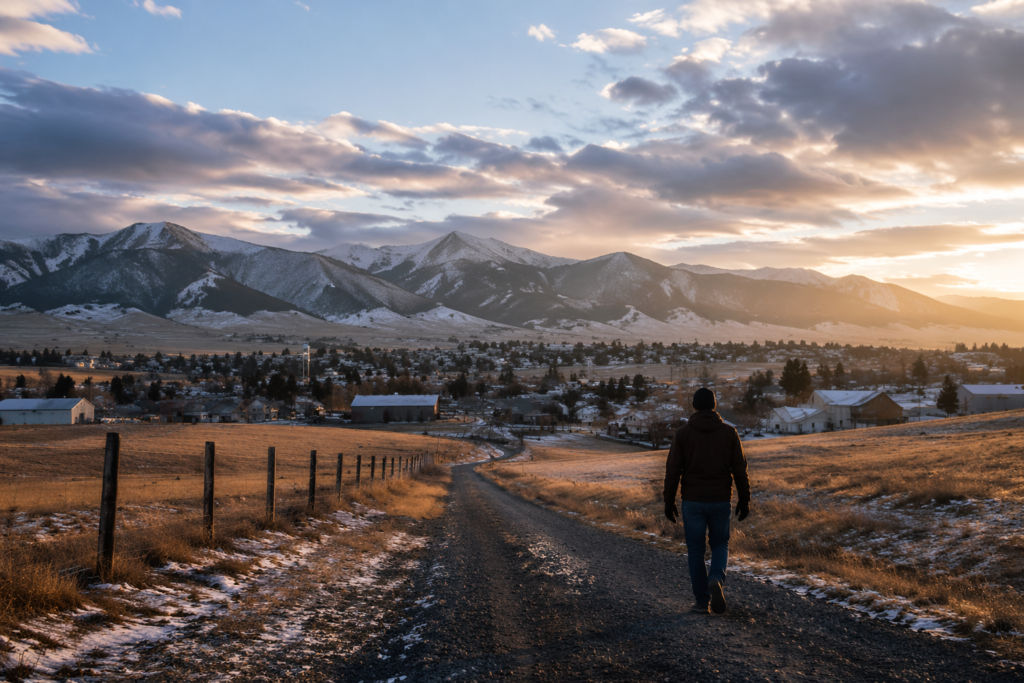
Social pressure around difference isn’t always obvious at first.
We went back to Montana looking for something simple—quiet, space, and a place to root.
We found a small house we could see ourselves building into something long-term. It wasn’t temporary. We were planning to stay.
My family was well known in the town. I had grown up there, but left right after high school. After the military—and a few scuffs along the way—I came back thinking that history would make it easier to settle.
My partner began teaching figure skating in a town where hockey dominated the culture. It seemed like a natural way to connect, contribute, and become part of the community.
On the surface, everything pointed toward this being a good fit.
That sense of fit didn’t last long.
What we found followed a different pattern.
The looks came first. Then the comments. Then the realization that this wasn’t just discomfort—it was something we had to actively navigate.
It wasn’t one moment. It was a pattern.
Simple things—going into town, interacting with people, existing openly—started to carry weight. Not always direct, not always loud, but consistent enough to change how you move, how you think, and how safe you feel.
The pattern didn’t stay subtle.
What began as looks and comments started to shift into something more structural—where risk wasn’t just felt, it had to be actively calculated.
At that point, the decision wasn’t about comfort anymore. It was about exposure.
That’s when we left.
From the outside, Montana is wide open space, mountains, sky, and quiet. And that part is real. But there’s another layer that sits underneath it—one shaped by long-held beliefs that don’t always make room for difference.
Even in places known for being more open, that tension doesn’t fully disappear. It shows up in policies, in conversations, and in the quiet calculations people make just to exist without conflict.
This isn’t about labeling a place as good or bad.
It’s about recognizing that beauty and harm can exist in the same space.
And if we want things to improve, we have to be willing to see both clearly.
Leave a Reply