By Oddly Robbie

The Cognitively Augmented Human
People sometimes ask me, “What’s it like?”
They usually mean well.
But it’s a hard question to answer—because living in this body, with this brain, doesn’t translate easily.
Especially in a world built on rules no one explains.
The Anchor
I’m autistic.
For much of my life, that meant being called “clueless” in relationships.
Not because I lacked intelligence—
but because I process context differently.
Social cues weren’t automatic.
They felt like a language everyone else learned without being taught.
The Break
Sometimes I know something is wrong immediately.
My body reacts.
But understanding comes later:
- a day later
- sometimes two
That delay isn’t indifference.
It’s processing.
But in a system that expects instant response,
that delay is often read as failure.
System Breakdown
1. Implicit System Design
Most social environments rely on:
- unspoken rules
- assumed context
- rapid interpretation
2. Processing Mismatch
When context isn’t explicit:
- signals are delayed
- meaning takes time to assemble
3. Misinterpretation Loop
Delay gets labeled as:
- lack of awareness
- lack of care
- lack of intelligence
Which is inaccurate.
What I Did Instead
I started asking why.
Not just to people—
but to AI.
I treated it like a system that:
- doesn’t get irritated
- doesn’t get defensive
- doesn’t mind repetition
So I asked:
- Why did that comment offend them?
- Why are these rules assumed instead of spoken?
- Why does something feel wrong before I can explain it?
What Changed
Patterns started to emerge:
- cultural habits
- unspoken expectations
- inherited behaviors
I realized something simple:
I wasn’t broken.
I was missing context.
Reframe
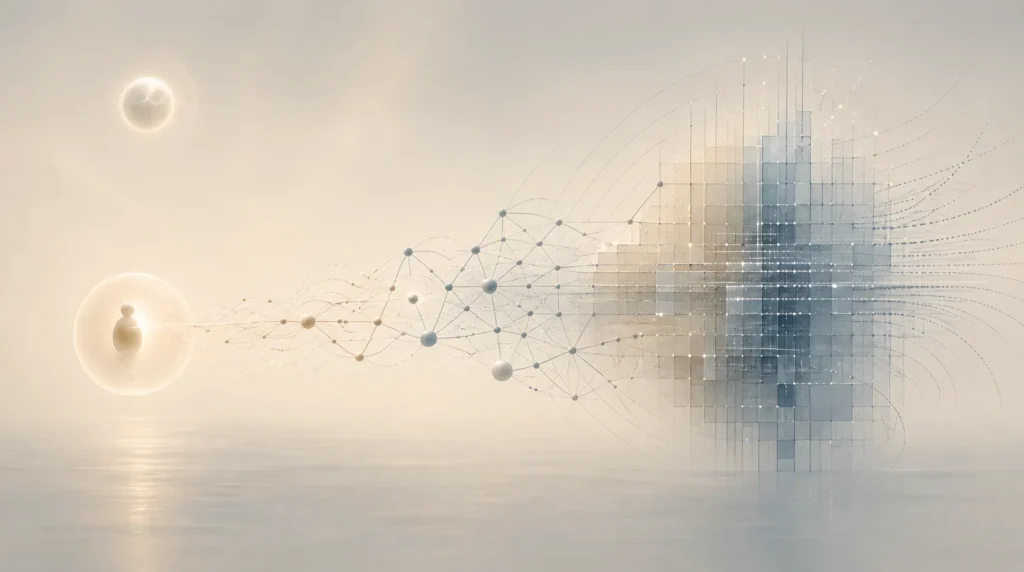
AI didn’t replace my thinking.
It gave me access to a layer I couldn’t see.
Not identity change—
translation.
Application
Used correctly, tools like AI can:
- clarify unspoken systems
- reduce social ambiguity
- support processing differences
- increase inclusion
Not by changing the person—
but by expanding access to understanding.
Result
The world becomes more navigable.
Not because it’s simpler—
but because it’s more visible.
System Insight
When systems rely on unspoken rules,
those who process differently are excluded.
When context becomes accessible,
inclusion becomes possible.
Closing
If you ask what this feels like, I’d say:
It feels like building your own map
through a maze no one admits exists.
And if this is cognitive augmentation—
it isn’t about becoming more than human.
It’s about finally being able to participate as one.
— Oddly Robbie