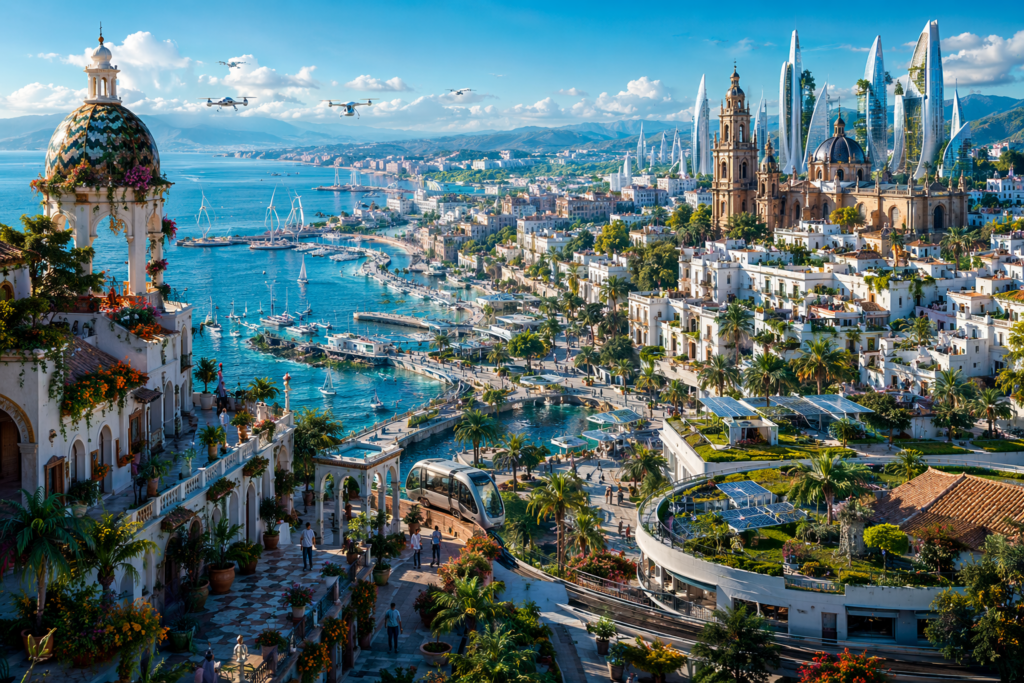
The future of smart cities is often misunderstood.
Most people imagine something sleek, efficient, and fully optimized—dense networks of sensors, autonomous systems, and perfectly managed infrastructure.
The assumption is simple: the more advanced the technology, the more advanced the city.
Break the Assumption
This assumption is incomplete.
Cities are not machines. They are lived environments shaped by culture, behavior, and time. When cities are designed primarily through abstraction—models, simulations, and efficiency metrics—they often lose the qualities that make them meaningful.
The result is a familiar pattern: cities that function better on paper, but feel less human in reality.
System Breakdown
Modern smart cities systems are built on three layers:
- Sensing — data from sensors, cameras, and infrastructure
- Modeling — digital twins and real-time representations
- Optimization — AI-driven decisions to improve efficiency
This creates cities that are increasingly aware of themselves.
But awareness alone is not intelligence.
What’s missing is a fourth layer:
- Cultural Continuity — the preservation and evolution of what people value
This includes how people gather, how streets are used, what is preserved, and what is allowed to change.
Without this layer, cities become technically advanced but culturally interchangeable.
Reframe
A city is only “smart” if smart cities culture reflects what matters to the people who live in it.
Technology can measure movement, energy, and flow. But these are not the things that give a place meaning. Culture lives in patterns that are harder to quantify but easy to feel.
The goal is not to make cities more efficient.
The goal is to make them more aware—of both their systems and their identity.
System Insight
Some cities already demonstrate this balance.
In places like Kyoto, infrastructure evolves without erasing the past. Streets remain human in scale. Architecture reflects history. Nature is integrated into daily life rather than added as decoration.
Technology exists, but it is quiet. It adapts to the city instead of redefining it.
This reveals a broader pattern:
Cities that prioritize identity first can integrate technology without losing themselves. Cities that prioritize optimization first often erase what made them unique.
Application
This changes how we design urban systems:
- Sensors should enhance awareness, not enforce control
- Digital models should reflect lived experience, not just infrastructure
- AI systems should adapt to cultural patterns, not override them
- Development should preserve identity before improving efficiency
The question is no longer how to build smarter cities.
It is how to build cities that can evolve without losing who they are.
Key Insights
- A city is a cultural system, not just an infrastructure system
- Efficiency is not neutral—it can erase identity
- Smart systems must learn what people value, not just what can be measured
- Technology should adapt to cities, not redefine them
- The future of cities is not built from scratch—it is grown from what already exists
Leave a Reply