Tag: human systems

  • When You Can Create, Everything Looks Different

    3D printing didn’t just give me a new tool.

    It changed how I see things.

    The Shift

    Before, I would see something in a store and think:

    “Do I want this?”

    Now, I see the same thing and think:

    “I could make something like this—maybe better, maybe more useful for me.”

    That shift is subtle, but it changes everything.

    From Consumer to Creator

    When you can create your own objects, the relationship with things changes.

    You stop looking for:

    • what’s available

    And start thinking about:

    • what’s possible

    You begin to ask:

    • Can this be improved?
    • Can it be adapted to my needs?
    • Can I design something that fits better?

    Customization Changes Value

    Store-bought items are made for everyone.

    Created items are made for you.

    That difference matters.

    Because usefulness increases when something is designed for a specific need—not a general market.

    Learning Through Making

    Not everything works the first time.

    Prints fail.
    Designs need adjustment.

    But each iteration improves understanding.

    Creation becomes a feedback loop:

    • idea
    • test
    • refine

    That process builds skill quickly.

    A Different Way to See the World

    Once you start creating, it’s hard to go back.

    Objects stop being fixed.

    They become:

    • adaptable
    • improvable
    • personal

    The world shifts from a catalog of products to a set of possibilities.

    🔄 2026 Update

    This connects directly to how I think about human systems and technology.

    When people have the ability to create, they:

    • rely less on external systems
    • adapt solutions to their own needs
    • become more autonomous

    That shift is important.

    Because systems should support creation—not just consumption.

    Key Insights

    • Creation changes perception of value
    • Custom solutions are often more useful than generic ones
    • Iteration builds understanding quickly
    • Access to tools increases autonomy

    Guardian Application

    A Guardian system could:

    • help users move from consuming to creating
    • suggest ways to adapt existing ideas
    • guide iterative design and improvement
    • support autonomy through making

    Tags

    • Domain: Human Systems, AI
    • Function: Insight
    • Guardian: Decision Guidance

  • Introducing OddlyRobbie: How Technology Became My Way of Understanding the World

    Technology didn’t become important to me by accident.

    It became a focus because of how I process the world.

    A Different Starting Point

    Growing up, I experienced things differently.

    As someone with autism, I tend to focus deeply—locking onto systems, patterns, and how things work.

    In environments that felt unpredictable or unclear, technology offered something different:

    Structure.

    Consistency.

    Logic.

    Early Connection

    In a rural town, far from what we would now call a “digital world,” I found my way into technology early.

    Devices like the TRS-80 Pocket Computer weren’t just tools.

    They were systems I could understand.

    That mattered.

    Because understanding creates stability.

    Why Technology Became My Focus

    Technology provided:

    • predictable behavior
    • clear cause and effect
    • the ability to explore without social ambiguity

    It became more than an interest.

    It became a way to engage with the world.

    Where That Led

    Over time, that focus expanded.

    From early devices to VR, AI, and immersive systems, I continued exploring—not just what technology can do, but how people interact with it.

    Because that’s where the real impact is.

    Not in the tools themselves—but in how they shape human experience.

    A Different Role

    Today, I’m not just exploring technology.

    I’m working to understand how it can:

    • reduce friction for different kinds of minds
    • support autonomy
    • create environments that adapt to people, instead of forcing people to adapt to them

    That’s where my work is focused.

    🔄 2026 Update

    This perspective directly informs what I’m building with Empathium and Guardian systems.

    Technology should not:

    • overwhelm
    • confuse
    • or exclude

    It should:

    • support understanding
    • adapt to individual needs
    • make complex systems easier to navigate

    Because when systems align with how people actually process the world, everything changes.

    Key Insights

    • Technology can provide stability in unpredictable environments
    • Different cognitive styles interact with systems in different ways
    • The value of technology is in how it supports people, not just what it does
    • Systems should adapt to users—not the other way around

    Guardian Application

    A Guardian system could:

    • adapt interactions to individual cognitive patterns
    • reduce ambiguity in complex systems
    • support focus without overload
    • create consistent, understandable environments

    Tags

    • Domain: Human Systems, AI
    • Function: Identity, Insight
    • Guardian: Emotional Support, Decision Guidance

  • What Capybaras Can Teach Us About Living Together

    Capybaras are known for something unusual.

    They coexist.

    Across species.
    Across environments.
    With very little conflict.

    That’s not accidental.

    It’s a pattern.

    Low-Conflict Systems

    Capybaras don’t dominate their environment.

    They adapt to it.

    They:

    • stay close to shared resources
    • tolerate proximity
    • avoid unnecessary conflict

    This creates stability.

    Not through control—but through behavior.

    What We Can Learn

    Human systems often do the opposite.

    We:

    • compete for control
    • escalate quickly
    • prioritize speed over stability

    That creates friction.

    And over time, that friction compounds.

    A Different Model

    What if we designed systems more like low-conflict environments?

    Not passive.

    But:

    • cooperative by default
    • tolerant of variation
    • structured around shared access

    This doesn’t remove complexity.

    But it reduces unnecessary tension.

    Where This Applies

    This kind of thinking can apply to:

    • social spaces (including VR)
    • communities
    • governance models
    • shared environments

    The goal isn’t perfection.

    It’s stability.

    🔄 2026 Update

    This connects directly to how I think about XR and Guardian systems.

    Digital environments amplify behavior.

    If they are designed around competition and reaction, conflict increases.

    If they are designed around:

    • coexistence
    • shared space
    • low-friction interaction

    behavior shifts.

    Key Insights

    • Stability often comes from reducing unnecessary conflict
    • Coexistence is a system design outcome, not an accident
    • Shared resources encourage cooperation
    • Behavior patterns shape environment outcomes

    Guardian Application

    A Guardian system could:

    • encourage cooperative interaction
    • reduce escalation in shared spaces
    • model low-conflict behavior
    • support stable, inclusive environments

    Tags

    • Domain: Human Systems
    • Function: Insight, System Design
    • Guardian: Behavioral Modeling

  • When the System Doesn’t Fit: What School Didn’t Understand

    Not all learning looks the same.

    But systems often expect it to.

    The Classroom Experience

    In third grade, I found myself in an environment that didn’t make sense to me.

    The structure was rigid.

    The expectations were narrow.

    And the way I processed the world didn’t fit inside it.

    So I adapted.

    Not by resisting—but by redirecting.

    Learning Differently

    While others followed the lesson, I found engagement elsewhere.

    I remember using a small radio pen—something that could pick up distant AM signals without a battery.

    That became my focus.

    Not as distraction.

    As a way to stay mentally active in an environment that didn’t meet me where I was.

    Misunderstood

    From the outside, it looked like disengagement.

    I was labeled “slow.”

    But the issue wasn’t ability.

    It was mismatch.

    The system couldn’t recognize a different way of learning.

    The “Flunkie Duo”

    Another student, Roger, and I were both placed outside the expected path.

    We didn’t fit the model.

    On the last day of school, instead of receiving the standard reward, we found ourselves off track—together.

    What could have been a negative moment turned into something else:

    Connection.

    Laughter.

    Shared experience.

    What Stayed With Me

    That experience wasn’t about failure.

    It was about understanding something early:

    Systems don’t always recognize capability.

    They recognize conformity.

    🔄 2026 Update

    This directly informs how I think about human systems.

    When systems are too rigid, they fail the people who don’t fit the default model.

    Better systems should:

    • adapt to different ways of thinking
    • recognize multiple forms of engagement
    • support variation instead of suppressing it

    Because when a system can’t see someone clearly, it’s the system that needs adjustment.

    Key Insights

    • Not all disengagement is lack of ability
    • Systems often reward conformity over capability
    • Mismatch creates mislabeling
    • Flexibility is essential for real learning

    Guardian Application

    A Guardian system could:

    • identify different learning styles in real time
    • adapt environments to match cognitive patterns
    • reduce mislabeling of ability
    • support engagement without forcing conformity

    Tags

    • Domain: Human Systems
    • Function: Story, Insight
    • Guardian: Emotional Support, Decision Guidance

  • Your Room for Life: Stability in a Changing World

    In a world where everything moves—jobs, cities, systems—there’s one thing many people don’t have:

    A stable place that is truly theirs.

    Not temporarily.

    Not conditionally.

    But consistently.

    The Core Problem

    Housing today is often tied to:

    • location
    • income
    • external systems

    When those change, stability disappears.

    For many people, especially those navigating stress, transition, or sensory sensitivity, that instability has a real impact.

    It’s not just about shelter.

    It’s about continuity.

    A Different Way to Think About Space

    What if a person had a persistent personal space that stayed with them?

    Not just physically—but in how it functions and supports the person.

    A space that:

    • remains familiar
    • adapts to different environments
    • provides continuity across change

    This isn’t just about modular housing.

    It’s about creating an anchor.

    Why Stability Matters

    A consistent personal space provides:

    • psychological grounding
    • reduced cognitive load
    • a sense of control in uncertain environments

    For neurodivergent individuals, this can be especially important.

    But it applies more broadly.

    Everyone benefits from stability.

    Beyond the Structure

    The idea isn’t just the physical room.

    It’s the system around it.

    Where it can exist:

    • learning environments
    • recovery spaces
    • travel and transition
    • long-term living systems

    The goal is not permanence of place.

    It’s permanence of personal space.

    🔄 2026 Update

    This concept connects directly to how I think about human systems and XR.

    In virtual environments, we already see this:

    People return to the same spaces because they feel stable.

    That same principle applies in the physical world.

    Good systems should:

    • provide continuity across change
    • reduce disruption during transitions
    • support identity through stable environments

    Key Insights

    • Stability is often more important than location
    • Personal space can function as an anchor in changing systems
    • Continuity reduces stress and cognitive load
    • Systems should support persistence, not constant reset

    Guardian Application

    A Guardian system could:

    • maintain continuity across environments (physical and virtual)
    • adapt spaces to user needs while preserving familiarity
    • support stability during major life transitions
    • reinforce a consistent sense of “place”

    Tags

    • Domain: Human Systems
    • Function: System Design
    • Guardian: Environmental Support

  • When Things Seem to Be Going Against You

    There are moments when everything feels like it’s working against you.

    Plans fall apart.
    Small things stack up.
    Nothing moves the way you expected.

    It can feel personal.

    Like something is pushing back.

    What’s Actually Happening

    Most of the time, it isn’t.

    What’s happening is a shift in alignment between:

    • what you expected
    • and what’s actually unfolding

    When that gap grows, it creates friction.

    That friction feels like resistance.

    The Stacking Effect

    One issue on its own is manageable.

    But when several happen close together:

    • delays
    • interruptions
    • small failures

    They start to compound.

    That’s when it feels like everything is going wrong.

    Not because it is—but because your attention is now focused on disruption.

    Loss of Control

    What makes this harder isn’t the events themselves.

    It’s the loss of control.

    When you can’t predict or direct what’s happening, your system reacts.

    That reaction creates:

    • stress
    • frustration
    • urgency to “fix it”

    A Better Response

    Instead of asking:
    “Why is this happening to me?”

    A more useful question is:
    “What can I still control right now?”

    That shift:

    • reduces pressure
    • restores direction
    • creates movement again

    Regaining Direction

    You don’t need to fix everything at once.

    You just need to:

    • stabilize
    • take one clear step
    • reestablish momentum

    Control doesn’t come back all at once.

    It comes back in small actions.

    🔄 2026 Update

    This connects directly to how I think about human systems.

    People don’t struggle most with difficulty.

    They struggle with loss of control and unclear direction.

    Good systems should:

    • reduce unnecessary friction
    • support recovery during disruption
    • help users identify what is still controllable

    Because when people regain even a small sense of control, everything changes.

    Key Insights

    • It’s rarely “everything going wrong”—it’s multiple small disruptions stacking
    • Perception shifts under pressure
    • Loss of control amplifies stress
    • Regaining control starts with small, intentional actions

    Guardian Application

    A Guardian system could:

    • help users identify controllable actions in chaotic moments
    • reduce cognitive overload during disruption
    • guide step-by-step recovery
    • support calm reorientation instead of reactive behavior

    Tags

    • Domain: Human Systems
    • Function: Insight
    • Guardian: Decision Guidance, Emotional Support

  • Where Do You Get Your News? Why It Matters More Than You Think

    Most people don’t choose how they get information.

    They inherit it.

    From family.
    From habit.
    From whatever is easiest to access.

    Over time, that becomes their version of reality.

    The Shift

    There was a time when news came from a small number of sources.

    Now, it comes from everywhere:

    • social media
    • video platforms
    • forums
    • algorithm-driven feeds

    Access has expanded.

    But clarity hasn’t necessarily followed.

    The Problem

    More information doesn’t automatically mean better understanding.

    It often means:

    • fragmented perspectives
    • emotional amplification
    • selective exposure

    People don’t just receive information.

    They receive filtered versions of it.

    What Gets Lost

    When information is shaped by algorithms or preference, something important can disappear:

    Context.

    Stories become:

    • simplified
    • polarized
    • designed for reaction instead of understanding

    That affects how people think—not just what they know.

    A Better Approach

    Instead of asking:
    “What’s happening?”

    A better question is:
    “Where is this information coming from—and how is it being shaped?”

    That shift changes everything.

    🔄 2026 Update

    This directly connects to how I think about human systems and AI.

    Information systems don’t just deliver facts.

    They shape perception.

    Good systems should:

    • provide context, not just content
    • reduce bias amplification
    • support understanding instead of reaction

    Because informed thinking depends on more than access.

    It depends on how information is structured.

    Key Insights

    • Information sources shape perception
    • More access does not guarantee better understanding
    • Algorithms influence what people see and how they interpret it
    • Context is critical for meaningful understanding

    Guardian Application

    A Guardian system could:

    • help users evaluate the source of information
    • identify bias or missing context
    • present multiple perspectives
    • support clearer, more grounded understanding

    Tags

    • Domain: Human Systems, AI
    • Function: Insight
    • Guardian: Decision Guidance

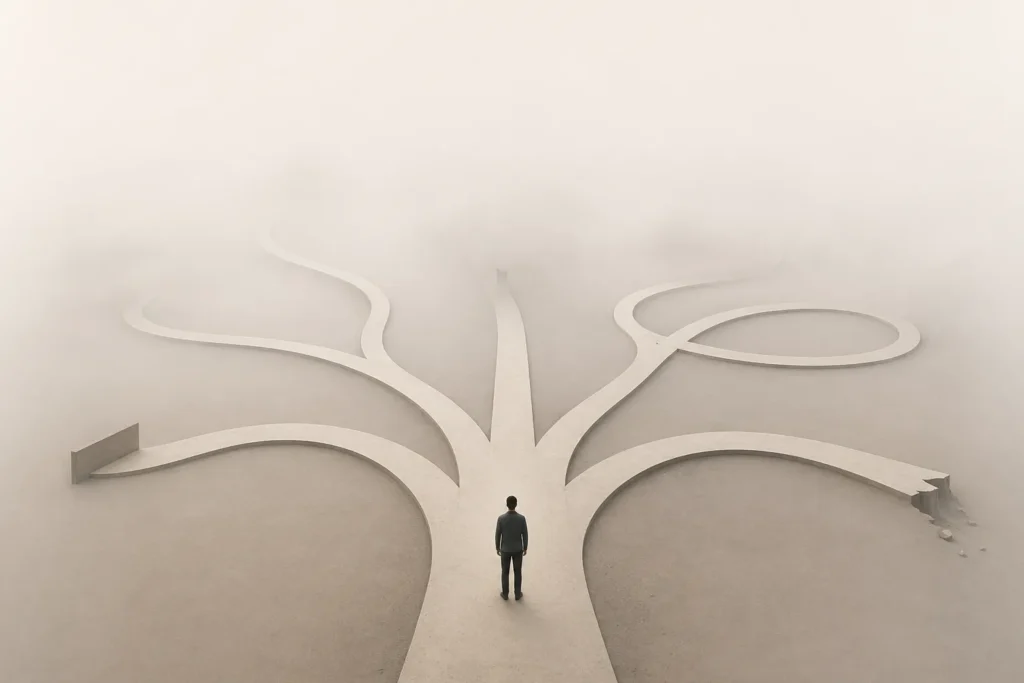
  • Walking Through the Door of Change

    Change rarely feels natural.

    Most of us inherit patterns—ways of thinking, behaving, and reacting—from the environments we grow up in.

    Those patterns can feel fixed.

    But they aren’t.

    Inherited Paths

    It’s easy to believe we are meant to follow the same trajectory as the people before us.

    Family history, culture, and environment all shape that expectation.

    For a long time, it can feel like there’s only one direction available.

    The Moment of Choice

    At some point, a different option appears.

    Not always clearly.

    Sometimes it’s just a small realization:

    “I don’t have to continue this.”

    That moment matters.

    Because it introduces choice.

    Why Change Feels Difficult

    Changing direction isn’t just about making a new decision.

    It means:

    • stepping away from what’s familiar
    • risking uncertainty
    • redefining identity

    That’s uncomfortable.

    But discomfort isn’t a signal to stop.

    It’s often a signal that something is shifting.

    What Actually Changes

    Walking through that “door” doesn’t solve everything.

    It doesn’t remove difficulty.

    What it does is restore agency.

    You move from:

    • following a path

    to:

    • choosing one

    That difference is fundamental.

    🔄 2026 Update

    This connects directly to how I think about human systems.

    Many systems reinforce inherited patterns.

    Good systems should do the opposite.

    They should:

    • make alternative paths visible
    • support change without penalty
    • allow people to redefine themselves over time

    Because people are not fixed outputs of their past.

    They are adaptive.

    Key Insights

    • Inherited patterns feel fixed—but aren’t
    • Change begins with recognizing a choice exists
    • Discomfort is often part of transition, not failure
    • Agency is the real outcome of change

    Guardian Application

    A Guardian system could:

    • help users recognize when they are following inherited patterns
    • surface alternative paths
    • support decision-making during change
    • reinforce autonomy during uncertain transitions

    Tags

    • Domain: Human Systems
    • Function: Insight
    • Guardian: Decision Guidance

  • From Experience to Empathy: What Changed How I See People

    Empathy isn’t something I started with fully formed.

    It developed—through experience, contradiction, and exposure to realities I hadn’t understood before.

    The Moment of Conflict

    During my deployment in regions where LGBTQ+ identity was not accepted, I faced a difficult reality.

    To communicate safely with my partner, I had to change his name to a female name in our letters.

    Those letters weren’t sealed—they were read.

    That small change carried weight.

    It was a constant reminder that something fundamental about my life had to be hidden to remain safe.

    What That Revealed

    That experience shifted how I saw the world.

    Not in theory—but in practice.

    It showed me:

    • how systems enforce conformity
    • how identity can become a risk
    • how easily people are forced to adapt just to exist safely

    Reframing Prejudice

    At one point, I viewed prejudice in simple terms.

    Over time, that changed.

    I began to see that many forms of hate are not just learned—but reinforced by fear, structure, and internal conflict.

    That doesn’t excuse harm.

    But it explains part of the pattern.

    Understanding that changed how I respond.

    The Expansion of Empathy

    Living through these conditions, and later experiencing different cultures and perspectives, expanded my understanding.

    Empathy became less about agreement—and more about:

    • recognizing context
    • understanding pressure
    • seeing the systems behind behavior

    A Broader Perspective

    My relationship, and my time in Argentina, deepened this further.

    I saw resilience.

    I saw how people maintain identity under pressure.

    And I saw how love continues—even when systems resist it.

    🔄 2026 Update

    This directly informs how I think about human systems and AI.

    If systems create conditions where people must hide or adapt to survive, those systems need to be questioned.

    Better systems:

    • reduce fear
    • allow identity without risk
    • support understanding across differences

    Because empathy isn’t just a personal trait.

    It’s something systems can either support—or suppress.

    Key Insights

    • Empathy often develops through lived contradiction
    • Systems can reinforce or reduce prejudice
    • Understanding context changes how we interpret behavior
    • Identity should not require concealment to remain safe

    Guardian Application

    A Guardian system could:

    • help users understand perspectives outside their own experience
    • reduce reactive judgment
    • provide context behind behavior
    • support empathy without forcing agreement

    Tags

    • Domain: Human Systems
    • Function: Story, Insight
    • Guardian: Emotional Support

  • When Control Shows Up Unexpectedly: Finding Your Own Rhythm

    Control doesn’t always announce itself clearly.

    Sometimes it shows up in small moments.

    The Moment

    While dancing, I felt an unexpected push from behind.

    It was brief—but noticeable.

    Just enough to throw off my balance and interrupt my rhythm.

    That moment stayed with me.

    Not because of the push itself—but because of what it represented.

    Control in Everyday Life

    We experience versions of this all the time.

    Not always physical—but directional.

    • expectations
    • social pressure
    • systems that guide behavior without asking

    Most of the time, it’s subtle.

    But the effect is the same:

    It shifts us away from our own rhythm.

    What Matters

    The goal isn’t to avoid every push.

    That’s not realistic.

    The goal is to recognize when it happens—and regain direction.

    To:

    • pause
    • reorient
    • choose your next step intentionally

    Regaining Balance

    On the dance floor, I adjusted.

    I found my footing again.

    And continued.

    That’s the part that matters.

    Not the interruption—but the recovery.

    🔄 2026 Update

    This connects directly to how I think about human systems.

    Control doesn’t always come from obvious sources.

    Often, it’s embedded in the structure of the environment itself.

    Good systems should:

    • allow interruption without collapse
    • support recovery
    • maintain user autonomy even under pressure

    Because control is unavoidable.

    But loss of agency doesn’t have to be.

    Key Insights

    • Control often appears in subtle, everyday moments
    • The impact is less about the push—and more about how we respond
    • Recovery is more important than avoidance
    • Systems should support autonomy, not override it

    Guardian Application

    A Guardian system could:

    • help users recognize when their direction is being influenced
    • support quick recovery and reorientation
    • reinforce autonomy in decision-making
    • provide stability during moments of disruption

    Tags

    • Domain: Human Systems
    • Function: Insight
    • Guardian: Decision Guidance