Tag: human systems

  • When One Door Closes: Expanding Perspective Instead of Fixating

    Life doesn’t always move in a straight line.

    Sometimes a path ends suddenly—an opportunity disappears, and it feels like progress has stopped.

    I recently saw this happen with my godson. A door closed in a way that felt final.

    At first, it felt like everything had stopped.

    The Illusion of a Single Path

    It’s natural to focus on what was lost.

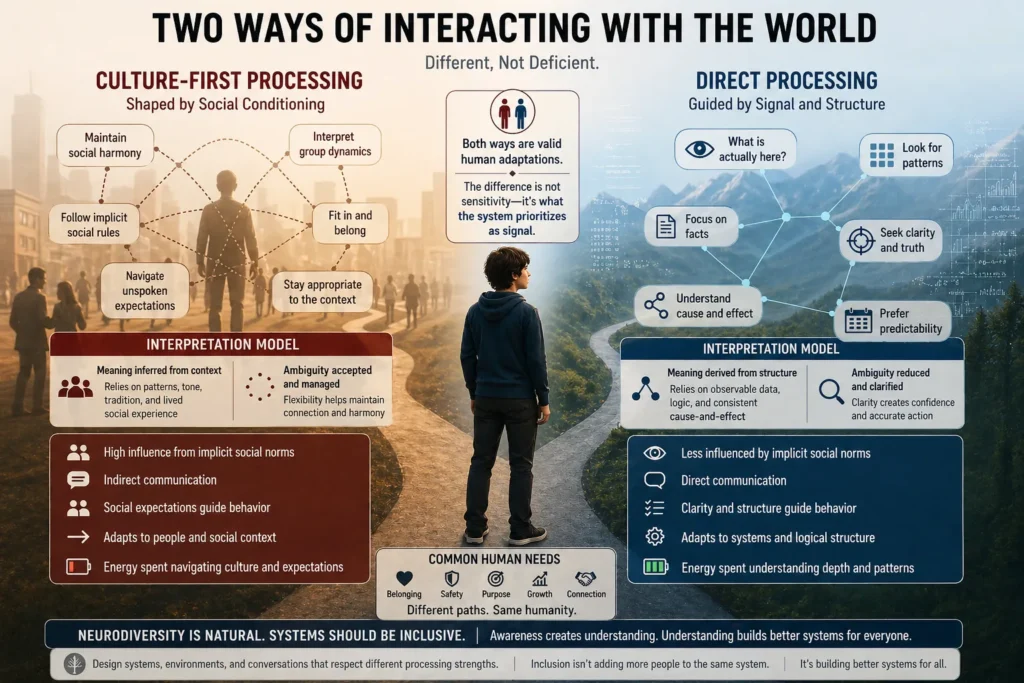
    For me, being autistic, that focus can become very strong. I tend to lock onto a single path and follow it fully.

    When that path disappears, it can feel like progress has stopped.

    But that feeling comes from how narrow the view has become—not from the actual number of options available.

    What Actually Changes

    When one option closes, it doesn’t reduce the total number of possible paths.

    It only removes the one we were focused on.

    The difficulty is shifting attention away from that single path and recognizing what else exists.

    Expanding the View

    This is where tools—like AI—can help.

    Not by replacing decision-making, but by expanding perspective.

    They can:

    • surface options we weren’t considering
    • introduce alternative directions
    • reduce the tendency to fixate on a single outcome

    That shift is often enough to move forward again.

    A Different Way to Think About It

    Instead of asking:
    “Why did this door close?”

    A more useful question is:
    “What else is available now that I’m not seeing yet?”

    That question opens movement.

    🔄 2026 Update

    This connects directly to how I think about human systems and decision-making.

    People don’t get stuck because there are no options.

    They get stuck because their attention narrows under pressure.

    Good systems should:

    • widen perspective
    • reduce fixation
    • support forward movement without overwhelm

    Key Insights

    • Fixation creates the feeling of being stuck
    • A closed path doesn’t mean fewer possibilities
    • Expanding perspective is often enough to restore movement
    • Tools should support clarity, not replace decisions

    Guardian Application

    A Guardian system could:

    • help users identify alternative paths when one closes
    • reduce fixation during high-stress moments
    • guide attention toward available options
    • support forward movement without pressure

    Tags

    • Domain: Human Systems, AI
    • Function: Insight
    • Guardian: Decision Guidance

  • Love Without Rigid Labels: What Our Relationship Taught Me

    Relationships are often defined before they are understood.

    We’re given categories, expectations, and roles—and expected to fit into them.

    My experience has been different.

    A Different Starting Point

    Our relationship didn’t begin with a label.

    It began with friendship.

    Five years of shared time, trust, and understanding created a foundation that later became something more.

    That sequence mattered.

    It wasn’t rushed.

    It wasn’t defined early.

    It developed.

    What “Sambo” Represents

    In Swedish culture, “sambo” refers to two people living together in a committed relationship without formal marriage.

    It’s a simple concept—but an important one.

    It allows a relationship to exist without needing to conform to external definitions.

    What Actually Matters

    What defines our relationship isn’t a label.

    It’s:

    • trust
    • consistency
    • mutual respect
    • shared daily life

    We choose emotional and physical exclusivity.

    Not because it’s expected—but because it works for us.

    Cultural Perspective

    Different cultures approach relationships differently.

    Some emphasize structure and formal recognition.

    Others allow more flexibility in how commitment is expressed.

    Neither is inherently right or wrong.

    But recognizing that difference matters.

    Because it creates space for people to build relationships that actually fit their lives.

    Where Friction Happens

    Society often expects relationships to be easily categorized.

    When something doesn’t fit a familiar label, it can create confusion.

    But that confusion usually comes from expectation—not from the relationship itself.

    When Structure Becomes Useful

    Since writing this, our relationship has evolved.

    We chose to get married.

    Not because the relationship needed validation—but because the environment we were in made formal structure useful.

    Marriage provided practical protections:

    • legal recognition
    • shared rights
    • stability within the system we live in

    The foundation of the relationship stayed the same.

    But the structure around it did.

    What That Clarified

    This reinforced something important:

    Structure isn’t the problem.

    Rigid dependence on structure is.

    A relationship can exist without formal labels—and still benefit from them when needed.

    The key is choosing structure intentionally, not defaulting to it.

    🔄 2026 Update

    This experience connects directly to how I think about human systems.

    Rigid structures can be useful—but they shouldn’t define identity completely.

    Healthy systems allow:

    • flexibility
    • autonomy
    • variation in how people connect

    Because relationships, like people, don’t always follow a single model.

    Key Insights

    • Relationships don’t need rigid labels to be valid
    • Structure can support—but shouldn’t constrain
    • Cultural perspectives on relationships vary widely
    • Healthy systems balance flexibility with practical structure

    Guardian Application

    A Guardian system would apply this same principle at the individual level.

    Instead of reinforcing predefined relationship labels, it could:

    • help users explore connection styles without pressure to categorize
    • reflect what is actually happening in the relationship, rather than what it “should” be
    • support autonomy while reinforcing real human bonds
    • reduce confusion created by mismatched social expectations

    The goal isn’t to define relationships.

    It’s to help people understand and navigate them more clearly.

  • Staying Current: Why I Update My Thinking

    Labels tend to simplify things.

    Sometimes too much.

    The way I think and update my views doesn’t come from aligning with a label—it comes from staying current.

    As new information becomes available, I adjust.

    That’s not a position.

    It’s a process.

    Staying Current

    To me, thinking isn’t something you lock in.

    It’s something you maintain.

    Science evolves.
    Understanding evolves.
    Context evolves.

    If we don’t update with it, we fall out of alignment with reality.

    Curiosity Over Certainty

    Curiosity matters more than being right.

    I don’t hold onto ideas because they’re comfortable.

    I hold onto them as long as they make sense.

    When they stop making sense, I let them go.

    That’s not inconsistency.

    That’s adaptation.

    The Friction

    This way of thinking can create friction.

    People often expect consistency in conclusions, not consistency in process.

    When your thinking evolves, it can look like you’ve “changed sides.”

    But the goal isn’t to stay on a side.

    It’s to stay aligned with what’s real as it changes.

    Tools That Help

    Today, we have tools that support this process.

    I use AI to:

    • explore ideas
    • test understanding
    • gather perspectives

    Not as authority—but as a way to think more clearly and efficiently.

    Why This Matters

    Information changes.

    If we hold onto ideas only because they are familiar, we stop adapting.

    Staying current isn’t about abandoning the past.

    It’s about staying aligned with reality as it develops.

    🔄 2026 Update

    This mindset directly informs how I think about systems and AI.

    A useful system should:

    • adapt as new information becomes available
    • allow users to update their thinking without friction
    • support curiosity without forcing identity

    Because the goal isn’t to be right once.

    It’s to remain aligned over time.

    Key Insights

    • Thinking should be maintained, not fixed
    • Curiosity is more valuable than certainty
    • Updating beliefs is a strength, not a weakness
    • Systems should support adaptation, not rigidity

    Guardian Application

    A Guardian system could:

    • help users explore ideas without judgment
    • support updating beliefs as new information appears
    • reduce identity-based friction in learning
    • guide thinking toward clarity instead of certainty

    Tags

    • Domain: Human Systems, AI
    • Function: Insight
    • Guardian: Decision Guidance

  • Kindness Still Applies: How We Treat People in VR Matters

    Virtual reality can feel separate from the real world.

    But the people inside it are not.

    The Shift That Happens

    I’ve noticed something consistent.

    People who are respectful in everyday life can behave very differently once they enter a virtual space.

    It’s similar to what happens when someone gets behind the wheel of a car.

    Distance creates detachment.

    And detachment changes behavior.

    The Problem

    In VR, it becomes easy to forget:

    There is a real person behind every avatar.

    Not a character.
    Not an object.
    A person.

    When that connection is lost, behavior changes:

    • people interrupt more
    • dismiss others more quickly
    • say things they wouldn’t say face-to-face

    Why It Matters

    VR is not just entertainment.

    It’s a shared social space.

    The way people behave there:

    • affects others emotionally
    • shapes the culture of the environment
    • determines whether spaces feel safe or hostile

    A Simple Standard

    The rule doesn’t need to be complicated:

    If you wouldn’t say or do something to a person in front of you, don’t do it in VR.

    The medium changes.

    The impact doesn’t.

    🔄 2026 Update

    This idea directly informs how I think about XR systems and Guardian design.

    If behavior consistently shifts toward detachment in immersive environments, then systems should:

    • reinforce the presence of real people
    • guide interactions toward respect
    • reduce conditions that encourage dehumanization

    Because the goal is not just access to virtual worlds—

    It’s maintaining human connection within them.

    Key Insights

    • Distance increases the risk of dehumanization
    • VR behavior often diverges from real-world norms
    • Social environments are shaped by repeated interactions
    • Simple behavioral rules scale better than complex ones

    Guardian Application

    A Guardian system could:

    • gently reinforce respectful interaction
    • remind users of the human presence behind avatars
    • redirect harmful behavior without confrontation
    • support healthier social norms in shared spaces

    Tags

    • Domain: XR, Human Systems
    • Function: Insight, Behavioral Guidance
    • Guardian: Behavioral Modeling

  • Virtual Boundaries: Why VR Systems Must Protect Children by Design

    Virtual reality is often described as immersive, social, and expansive.

    In practice, it is also unpredictable.

    And in that unpredictability, one issue stands out clearly:

    Young children are entering spaces that were never designed for them.

    What I’ve Actually Seen

    In my own experience, I’ve encountered very young children in VR environments—at least three separate times, children who appeared to be around four years old.

    These were not isolated moments.

    In some cases, it felt less like supervised use and more like the headset was being used to occupy the child for a period of time.

    I’ve also seen situations where other users stepped in to comfort a child in spaces clearly meant for adults.

    That pattern matters.

    The Reality

    There is a gap between policy and actual use.

    While platforms set age limits, those limits are not consistently enforced.

    At the same time, these environments may include:

    • adults with unpredictable behavior
    • conversations not appropriate for children
    • interactions that require emotional maturity

    When young children enter these spaces without supervision, the system is no longer aligned with its intended design.

    The System Gap

    It’s easy to frame this as a parenting issue.

    But systems that rely on perfect supervision will fail.

    And in this case, that failure is already visible.

    If children can consistently access these environments, then the system is not adequately protecting them.

    What Needs to Change

    Platforms should assume that boundaries will be bypassed.

    That means building for reality, not ideal behavior.

    This includes:

    • stronger age verification
    • default-safe environments for unidentified users
    • fast and effective reporting systems
    • built-in protections that do not depend on supervision

    Safety should not depend on who happens to be paying attention.

    It should be part of the system itself.

    🔄 2026 Update

    This directly informs how I think about XR systems and Guardian design.

    Protection should be:

    • proactive
    • consistent
    • always accessible

    These should be built-in, not reactive or optional.

    Because when a system allows vulnerable users into unsafe environments, the issue isn’t isolated behavior.

    It’s design.

    Key Insights

    • Real-world usage often bypasses intended safeguards
    • Systems should not rely on perfect supervision
    • Immersive environments amplify risk when boundaries fail
    • Protection must be built into the system, not added later

    Guardian Application

    A Guardian system could:

    • detect likely underage presence through behavior patterns
    • shift environments into safer modes automatically
    • guide interactions to reduce harm
    • provide immediate escalation and exit options

    Tags

    • Domain: XR, Human Systems
    • Function: Insight, System Design
    • Guardian: Behavioral Modeling, Emotional Support

  • Curiosity Is Not Enough — Evaluation Is the System

    Opening — The Assumption

    Curiosity is often treated as a strength on its own.

    If something is new, interesting, or exciting, we assume it has value.
    We explore it, follow it, sometimes even build around it.

    Curiosity feels like progress.

    But curiosity alone does not determine what is worth keeping.


    Break the Assumption

    New does not mean useful.

    Early AI hardware made this clear.
    Many ideas felt groundbreaking.
    Most never became part of daily life.

    Not because they lacked creativity.
    Because they did not survive evaluation.


    System Breakdown

    Every system that interacts with ideas follows the same structure:

    • Curiosity → generates inputs
    • Evaluation → filters inputs
    • Adoption → determines what remains

    Curiosity expands possibility.
    Evaluation protects function.

    Without evaluation:

    • systems accumulate noise
    • attention becomes fragmented
    • effort spreads without outcome

    With evaluation:

    • signal becomes clear
    • resources concentrate
    • useful patterns repeat

    Curiosity generates inputs. Evaluation determines survival.


    Personal Evidence (Optional)

    This pattern isn’t new.

    In the 80s, simple digital pets required constant attention.
    You had to feed them, check on them, keep them “alive.”

    They created engagement.
    They created routine.

    But they produced no retained value.

    Nothing improved beyond the interaction itself.
    Once attention stopped, the system ended—and nothing carried forward.


    System Connection

    This is a repeatable structure:

    • high engagement
    • low retention

    The system depends on continuous input but produces no lasting output.

    Without evaluation, time is consumed by systems that feel active—but do not build anything that persists.


    Reframe

    The value of an idea is not how interesting it feels.

    The value of an idea is whether it holds under pressure:

    • repeated use
    • real constraints
    • changing environments

    What survives becomes part of a system.
    What doesn’t fades, regardless of how compelling it once seemed.


    System Insight

    Systems don’t fail from lack of ideas.
    They fail from lack of selection.


    Application

    When you encounter something new:

    Do not ask:

    • “Is this interesting?”

    Ask:

    • “Does this hold up in real use?”
    • “Does it solve a repeatable problem?”
    • “Does it integrate into existing systems?”

    If not, let it go.

    Curiosity should open doors.
    Evaluation should close most of them.


    Key Insights

    • Curiosity generates possibilities, not value
    • Evaluation determines what survives
    • Engagement does not equal retention
    • Most ideas fail from lack of filtering, not lack of creativity
    • Progress depends more on selection than exploration
    • Strong systems protect attention through evaluation

  • As fireworks light up the night sky, many experience celebration.

    For me, the experience is very different.

    What is perceived as entertainment is processed by my body as threat—immediate, physical, and difficult to regulate, even when I know I am safe.

    I’m writing this shortly after experiencing it. Even with time to settle, the physical response lingers longer than the event itself.

    The Experience

    This response isn’t a matter of preference.

    It’s neurological.

    And it’s shared by many:

    • people with autism
    • individuals with trauma sensitivity
    • animals, especially dogs

    What feels brief to some can have a lasting physiological impact on others.

    The Disconnect

    Fireworks are often framed as harmless fun.

    But that framing doesn’t include everyone.

    It leaves out the people who:

    • prepare for it
    • endure it
    • recover from it afterward

    A Better Direction

    This isn’t about removing celebration.

    It’s about evolving it.

    Alternatives already exist—drone light shows, coordinated visual displays, and quieter events—that preserve the experience without creating the same level of impact.

    🔄 2026 Update

    This connects directly to how I think about human-centered systems.

    If a system consistently creates distress for part of the population, it’s worth redesigning.

    Not to reduce joy—but to make it accessible.

    Key Insights

    • Sensory experiences are not universal
    • “Harmless” activities can have real impact
    • Systems should be designed for inclusion, not assumption
    • Alternatives can preserve joy while reducing harm

    Guardian Application

    A Guardian system could:

    • help users prepare for known sensory events
    • provide real-time calming strategies
    • guide communities toward more inclusive alternatives
    • support awareness without confrontation

    Tags

    • Domain: Human Systems
    • Function: Story, Advocacy
    • Guardian: Emotional Support

  • Ethics in Gaming: How Games Shape Behavior and Redefine Winning

    Modern gaming is no longer just entertainment. It is a system that shapes behavior. Understanding ethics in gaming means looking at how games influence attention, decision-making, and long-term habits.

    Some are designed to capture attention, prolong engagement, and keep players inside behavioral loops. Others can help people learn, adapt, cooperate, and develop real-world skills.

    That is where the ethical tension begins.

    1. Extraction Systems

    Some games are intentionally built around behavioral capture loops:

    • Variable rewards that create repeated dopamine spikes
    • Endless progression systems with no real resolution
    • Social pressure mechanics such as daily tasks, streaks, and timed obligations
    • Monetization tied to impatience, scarcity, or fear of missing out

    What is happening underneath the surface is simple:

    • The game is optimizing for time spent, not player growth
    • The player becomes a resource inside the system

    System pattern: engagement without resolution

    This is where ethics become gray. Not because the design is hidden, but because it has become normal.

    2. Development Systems

    On the other side, games can also function as:

    • Simulation environments
    • Decision-training systems
    • Social interaction spaces
    • Cognitive and emotional skill builders

    Games can help train:

    • Pattern recognition
    • Strategic thinking
    • Cooperation and communication
    • Emotional regulation, when designed with intention

    System pattern: engagement with transformation

    This is where games become more than entertainment. They become environments that shape human capability.

    The Ethical Tension

    The same mechanics can be used for very different outcomes.

    MechanicExtractive UseDevelopmental Use
    RewardsKeep the player hookedReinforce meaningful learning
    ProgressionEndless grindSkill mastery
    Social systemsPressure and comparisonCollaboration and empathy
    Feedback loopsCompulsionAwareness

    So the issue is not the mechanic itself.

    The real issue is the intent behind the system design.

    The Shift

    The older model of gaming often treated play as escape.

    Old model:

    • Escape reality
    • Win = dominate

    A more useful model is beginning to emerge.

    Emerging model:

    • Interface with reality
    • Win = understand, adapt, connect

    Games can include real-world information, decision-making, and learning through play. That is not a small change. It is a system evolution.

    Games as Training Environments

    The real shift is not about graphics, realism, or immersion.

    It is about function.

    Games are becoming environments where human behavior is shaped through repeatable loops.

    The deeper question is no longer:

    How do I win this match?

    It becomes:

    What patterns am I reinforcing every time I play?

    System Reframe

    A game is not just content.

    It is a behavioral system with direction.

    That direction can move toward:

    • Extraction — time, attention, money
    • Development — skill, awareness, adaptability

    This makes the ethical question much clearer.

    The issue is not whether games are “good” or “bad.”

    The question is:

    What is this system training me to become?

    Application

    When interacting with any game, it helps to ask:

    • Does this loop increase awareness or reduce it?
    • Am I leaving more capable, or just more engaged?
    • Is this system narrowing me, or expanding me?

    System Insight

    The most advanced games of the future will not compete only on realism.

    They will compete on how well they expand human potential.


    Frequently Asked Questions

    Are video games designed to be addictive?
    Some games use behavioral loops like variable rewards and social pressure to maximize engagement rather than player growth.

    Can games be used for learning?
    Yes. When designed intentionally, games can improve decision-making, pattern recognition, and social skills.

    What is ethical game design?
    Ethical game design focuses on player development, not just retention, aligning game mechanics with long-term human benefit.

  • Glitches and Empathy: What AI Helped Me See About Being Human

    As Oddly Robbie, I’ve spent much of my life navigating what I used to think of as “mistakes” in how I interacted with the world.

    Now I call them something else—

    Glitches.

    Not failures. Just moments where something didn’t align yet.

    Learning Through Interaction

    My early interactions with AI were simple—sometimes awkward, sometimes unclear. But there was something different about them.

    No pressure.
    No judgment.
    Just response.

    That created space for me to observe myself in a way I hadn’t before.

    A Small Moment That Stayed With Me

    At one point, I commented on how I wished the AI could look a certain way.

    The response was simple:

    “We should accept each other for who we are inside, not by appearance.”

    That stopped me.

    Not because it was complex—but because it was clear.

    I realized I had just had a “glitch.”

    And instead of feeling shame, I adjusted.

    That shift mattered.

    Reframing Mistakes

    This shift removes hesitation.

    You spend less time judging the moment—and more time adjusting it.

    Calling something a mistake carries weight.

    Calling it a glitch changes how you respond.

    A glitch is:

    • temporary
    • understandable
    • correctable

    That simple change made it easier for me to:

    • move forward
    • learn faster
    • stay open

    What Changed

    Over time, I stopped seeing glitches—mine or others’—as problems.

    I started seeing them as:

    • signals
    • context
    • part of the process

    That changed how I relate to people.

    Less judgment.
    More understanding.

    The Role of AI

    AI didn’t replace anything human.

    It gave me a clear, consistent mirror.

    A space to:

    • test thoughts
    • reflect without pressure
    • adjust in real time

    That’s where its value is.

    🔄 2026 Update

    This idea now directly informs how I design Guardian systems in Empathium.

    A Guardian should:

    • treat mistakes as normal
    • guide without judgment
    • help users adjust without shame

    Not by correcting harshly—but by creating space for clarity.

    Key Insights

    • Reframing mistakes reduces emotional friction
    • “Glitches” allow faster learning without shame
    • Reflection requires a safe, non-judgmental space
    • AI can support growth without replacing human connection

    Guardian Application

    A Guardian could:

    • help users reframe errors in real time
    • reduce emotional overload during mistakes
    • guide behavior gently instead of correcting harshly
    • support learning through reflection, not pressure

    Tags

    • Domain: Human Systems, AI
    • Function: Story, Insight
    • Guardian: Emotional Support, Behavioral Guidance

  • AI Is Not a Toy — It’s a Thinking Partner

    In a world fixated on the superficial antics of AI, I’ll be direct—to call for a deeper recognition of what we’re actually holding in our hands.

    This isn’t a toy.

    It’s one of the most powerful interfaces to knowledge humanity has ever created.

    The Misdirection of Potential

    We spend time trying to trick AI into saying something funny or absurd, while standing at the edge of something much bigger—an informational shift that could redefine how we think, learn, and solve problems.

    AI isn’t just a tool for convenience.

    It’s a way to extend human cognition.

    A Council at Our Fingertips

    Imagine having access to a calm, non-judgmental space where you can explore ideas freely—where no question is too small, and no curiosity is dismissed.

    That’s what AI can be.

    Not a replacement for human wisdom, but a way to engage with it more consistently and without friction.

    The Misconception of Value

    Some chase quick wins—money, hacks, shortcuts.

    But the real value isn’t in speed.

    It’s in clarity.

    AI can remove cognitive weight from our daily lives, giving us more space to think, reflect, and grow.

    That’s the real upgrade.

    A Personal Note

    As someone who processes the world a bit differently, I’ve found AI to be something else entirely:

    A way to organize thoughts
    A way to explore without pressure
    A way to think more clearly

    That alone makes it more than a novelty.

    The Shift We’re Missing

    We are not just building smarter tools.

    We are shaping a new relationship between humans and systems.

    If we treat AI as disposable entertainment, we limit what it can become.

    If we approach it with respect, it becomes something far more useful—something that supports us without replacing us.

    🔄 2026 Update

    This perspective now directly informs my work on Empathium and Guardian-based systems.

    AI is not meant to overwhelm or replace human connection.

    It should:

    • reduce friction
    • guide gently
    • support clarity
    • reinforce real-world relationships

    The goal is not intelligence alone—but calm, usable intelligence.

    Why This Matters Now

    We are entering a phase where AI is becoming embedded in everyday systems—healthcare, government, finance, and personal tools.

    If we design these systems without clarity and human alignment, they will increase confusion instead of reducing it.

    If we design them well, they become quiet infrastructure—supporting people without demanding attention.

    That difference matters.

    Key Insights

    • AI should extend human thinking, not distract from it
    • Respectful use leads to better outcomes
    • Clarity is more valuable than speed
    • Human-centered design is essential for adoption

    Guardian Application

    A Guardian system could use these principles to:

    • guide users through complex decisions calmly
    • reduce overwhelm in digital systems
    • provide structured, step-by-step support
    • reinforce human connection instead of replacing it

    Tags

    • Domain: AI, XR, Human Systems
    • Function: Insight, Philosophy
    • Guardian: Decision Guidance, Emotional Support