From a shag carpet in Montana to a light bulb in Spain.
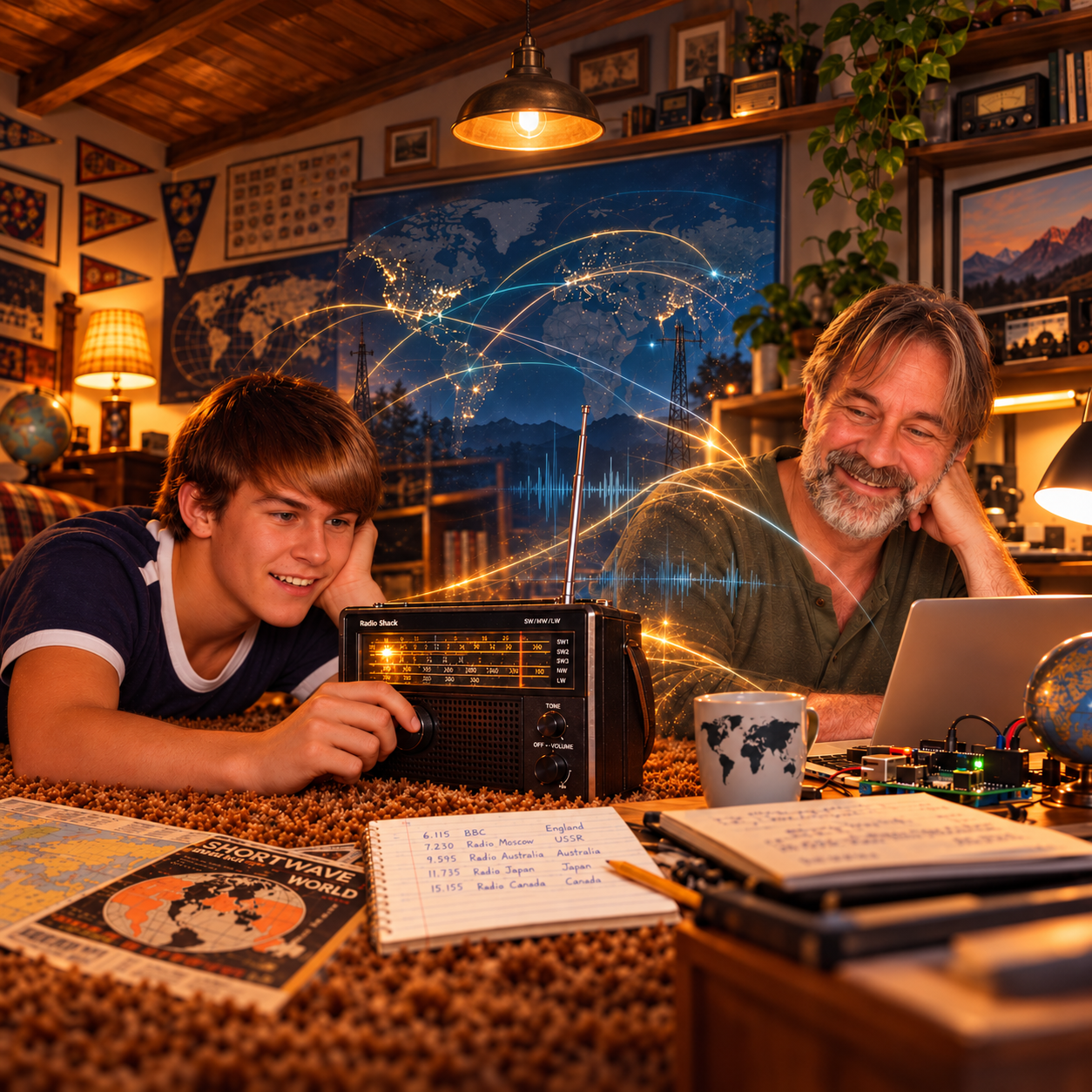
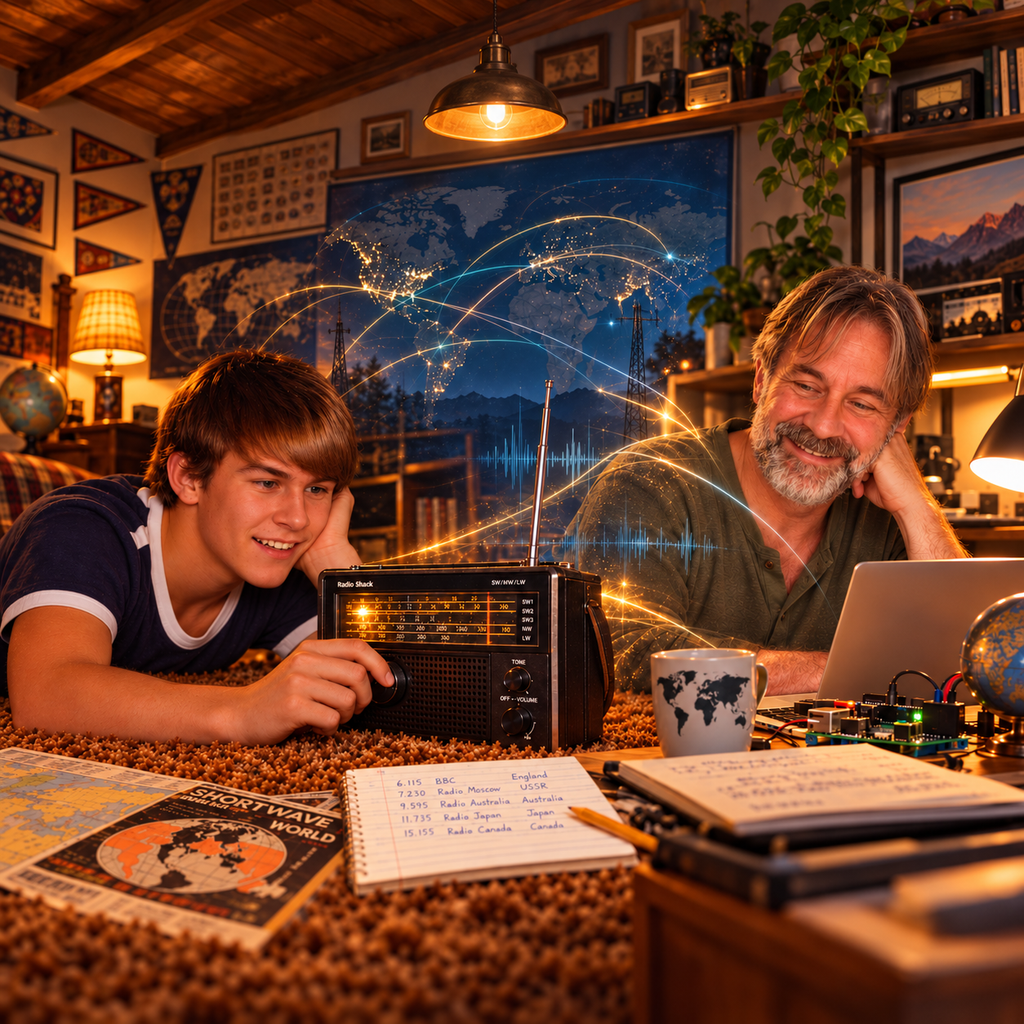
When I was a boy in a small Montana town, I used to lie on my tummy on the shag carpet and listen for the rest of the world. There was a little Radio Shack shortwave radio in front of me. Antenna up. I stretched an extra antenna wire a good distance, hoping to get more. More signal. More stations. More somewhere else.
It was the late 1970s, and I’d noticed that it worked better at night. I would move the tuning knob slowly back and forth, trying to catch a voice between the noise. Canada. Britain. Russia. China. Sometimes I found a language I couldn’t understand. Naturally, I listened harder. There might be a clue. A place name. A station announcement. Something to tell me where the voice belonged. I’d stay with it for as long as the signal lasted, hoping to work it out.
I also listened for the Greenwich time signal so I could set my watch to exactly the right time. A boy on a shag carpet in Montana, setting his watch by Greenwich. I wasn’t going anywhere. But I would know precisely when I wasn’t going.
I didn’t have a search box. I had a knob, some wire, and a considerable willingness to keep trying. Somewhere far beyond my little town, people were going about their lives. And a bit of their world was reaching me on the carpet.
Sometimes it was just a short
Radio Shack had another attraction. They let me have broken returns. For a kid interested in how things worked, this was a rather generous arrangement. Something had stopped working, someone had brought it back, and now I could take it apart.
I’d look at how it worked and try to see what had gone wrong. Quite often, I found a short. Not every repair needed a grand revelation. Sometimes there was a particular fault, and finding it made the difference between a broken object and a working one.
I fixed things like cassette players. Often, once I got them working, I gave them away. Apparently, the interesting part for me wasn’t always keeping the gadget. It was getting inside the problem.
There was a pleasure in understanding something well enough to make it work again. Giving it to someone else meant it could go back to being useful, rather than becoming another object I owned.
I didn’t have to understand the whole machine at once. I could look at one connection, follow a wire, and try to work out what that particular part was doing. Sometimes I could fix it. That was enough encouragement to open the next one.
The store also let me play with its computers. This suited both of us. I got to explore them, and adults could see a kid making one work. I was enjoying myself. Radio Shack was getting a demonstration. I still think I had the better deal.
Looking back, there was quite a lot going on in that little patch of my childhood. I was listening for distant places, opening broken equipment, and trying things on computers. At the time, I wasn’t assembling a philosophy of technology. I wanted to see what happened.
I may need a moment with the elbow
That feeling is still very familiar. Tell me about a new way to store energy, and I want to know what it might make practical. Show me a new sensor, and I start wondering what it can notice, where it could be useful, and what happens when you connect it to something else.
Mention a robot actuator with computing built into the joint, and we may need to stop there for a moment. What does the joint handle for itself? What does the rest of the robot still need to tell it? What changes when the processing happens right where the movement happens?
Other people may be admiring the entire robot. I’m still occupied with the elbow.
Sometimes one small part changes what could be built next. Once I notice that, I want a moment to follow the thought. What else could use it? What becomes easier? What would I try if I had one? I don’t necessarily need to buy it. Sometimes understanding the possibility is enough to keep me happily occupied.
That doesn’t mean I’ve been endlessly delighted by every device released in my lifetime. Looking back through my journals, I found a 2020 entry in which I thought technology was getting rather stagnant. I remembered enjoying the search for new apps, but the novelty had faded. Apparently, releasing another rectangle is not enough to secure my enthusiasm.
I need something to get curious about. A capability I haven’t explored. A setting that makes me wonder what it changes. A connection I hadn’t considered. Something that gives me a reason to turn the knob again.
Some of the equipment arrived broken
At a technology meetup, I once mentioned that I’d always loved technology, although I hadn’t gone to university to study it. A man who had studied AI replied:
“I have a secret. It doesn’t matter if you did.”
I smiled. I didn’t take that as a dismissal of education. I took it as an invitation to stop treating my own route into the subject as something requiring an apology. I’d been learning for a long time. Some of the equipment had simply arrived broken.
There are things I don’t know. There are things I need explained. Sometimes I have to go back and understand something that someone else learned years ago. I can do that. Being interested doesn’t require me to arrive already knowing the answer. That would take quite a lot of the enjoyment out of it.
Getting something wrong can also give me a more useful question than the one I started with. What did I expect to happen? What actually happened? Where did those two things part company? That is a fairly good way to spend an afternoon. Depending on the problem, it can also become the evening.
A chair for curiosity
I sometimes leave technology meetups feeling a little frustrated. I arrive wanting to hear what people are discovering. What they’ve tried. What works, what doesn’t, and what has become possible since the last time we talked.
Sometimes we spend so much of the conversation on fear that we barely reach any of those things.
I don’t want to dismiss the concerns. A person worried about their livelihood deserves more than a cheerful instruction to retrain. Questions about privacy, control, and who benefits are worth asking. But I’d like curiosity to get a chair at the table, too.
I’d like someone to have time to say, “I tried something interesting this week,” and then tell us about it. Perhaps it failed. Perhaps it did something modest. Perhaps it helped one person with a task nobody else in the room had thought much about. I’d still like to hear.
At one meetup, someone suggested technological growth would begin to plateau. We talked about constraints such as chip production and the electricity needed for data centres.
My mind went toward everything happening outside those particular constraints. Could a different approach accomplish the same task? Could we make something more efficient? Was there another development, somewhere less visible, that might change the problem?
I don’t know which possibilities will work. I’m not claiming every bottleneck will obligingly disappear. But I’m reluctant to treat the limits we can currently see as a complete map of what comes next. I’d rather investigate. And I don’t need to settle the future of technology before I can try something useful this afternoon.
One light in Spain
These days, more of that investigation happens at home, in Spain. I’m building Guardian, a personal AI system around my own life. Memory, thinking, sound, lighting—pieces I can experiment with and connect as I discover what is useful to me.
One milestone was getting a light working locally through an app on my phone, with a little computer at home handling the control. One light. After decades of technological curiosity, I had successfully switched on a bulb.
I appreciate that this may require some explanation.
The interesting part was being able to understand the connections and change what happened. I wasn’t limited to pressing the buttons someone else had decided to give me.
Now I could ask another question. Could the light change more gradually? Could I make an evening setting that suited me? How would it fit with the other things I was building?
Those were possibilities to explore. Switching on the bulb didn’t mean I’d already done all of them. But I had somewhere to begin.
Guardian has grown since that first light. There are more controls now, along with ways to see information about my surroundings, look at calendar events, and save a journal entry. Each addition gives me something to learn. It also gives me something to reconsider. What do I actually use? What helps? What looked interesting while I was building it, but turns out to be something I rarely need?
Building something for myself means I can come back to it. Change the arrangement. Leave a possibility for later. I don’t need to turn every idea into a feature by Friday. Although I may need reminding of that when I’ve found an interesting elbow.
More ways to begin
Looking through my journals, I found a reflection from 2024:
“I have become much more the person I wanted to be without reliance on others.”
That matters to me more than owning an impressive collection of gadgets. When I read it now, I think about having more ways to begin. If I have an idea, I can explore it. If I want to understand something, I can ask questions and keep going until more of it makes sense. If part of my surroundings doesn’t suit me, there may be something I can adjust.
I still learn from other people. Guardian itself involves help, explanations, and tools that other people have made. But I can take part in shaping the result. I can bring my own preferences, notice what helps, and say, “That’s close, but I want to try it this way.” Then see what happens.
Guardian is where I’m putting some of those possibilities into practice. It’s a build for my own life. I don’t need it to become everyone else’s answer before it can be useful.
And there’s something familiar about sitting with a small piece of equipment, trying a change, and watching to see what happens. I can recognise the boy who took the broken cassette player apart. The one who wanted another turn on the shop computer. The one lying on the shag carpet, listening carefully to a language he couldn’t understand.
The equipment is different now. And I’m doing this from Spain, a place that would once have been part of that distant world I was listening for. I like that thought.
Somewhere beyond the room I grew up in, people were going about their lives. Now I’m here, going about mine. Still finding things I don’t understand yet. Still willing to spend a little longer with them.
That boy on the carpet wasn’t waiting for a complete explanation of where technology was going. There was something interesting in front of him. And he wanted to find out a little more.
I still do.
Leave a Reply