When systems stop pulling on you
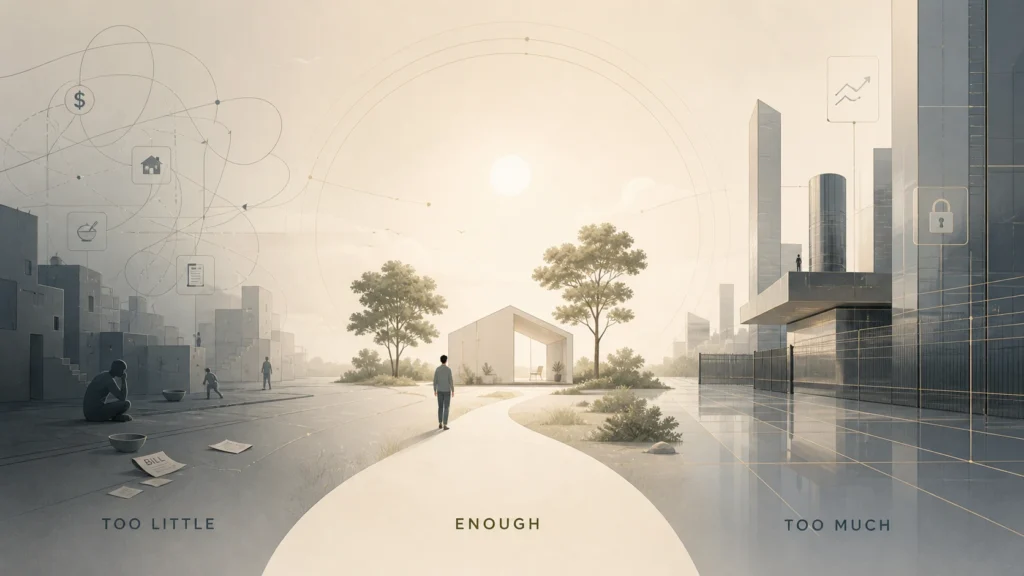
Enough is the stabilizing point where pressure drops and attention returns to life.
Some systems do not fail all at once.
They pull.
A little pressure here.
A little hunger there.
A little uncertainty that never fully resolves.
When I was growing up, breakfast on school days was usually oatmeal. It was food, and I was grateful there was something. But by the middle of the school day, my stomach would be rumbling hard before lunch.
That kind of hunger does not stay in the stomach.
It enters the decision system.
It changes how the future feels.
It changes how risk feels.
It changes what looks like hope.
When people live too close to scarcity, they are not just “bad at decisions.” Their systems are overloaded. Their attention is consumed by immediate pressure. Their nervous system keeps asking one question:
How do I get out of this?
And when that question stays active long enough, almost anything that looks like an exit can start to feel reasonable.
A lottery ticket.
A get-rich scheme.
A risky opportunity.
A belief system that promises certainty.
A person who says they have the answer.
A system that offers escape but quietly extracts more.
Scarcity makes people easier to steer.
Not because they are weak.
Because pressure narrows the field of vision.
Scarcity Is Not Just Having Less
Scarcity is often treated as a personal condition.
Someone has less money.
Less food.
Less time.
Less security.
Less support.
But scarcity is also a system condition.
It creates recurring loops:
- Check the balance.
- Delay the bill.
- Stretch the food.
- Wait for approval.
- Hope nothing breaks.
- Look for the break that finally changes everything.
Each loop uses attention.
Each unresolved pressure keeps running in the background.
A person can look calm from the outside while their inner system is constantly calculating survival.
That calculation has a cost.
It reduces patience.
It reduces long-term planning.
It increases emotional reactivity.
It makes promises of rescue more powerful.
This is why scarcity is not just an economic issue. It is a cognitive issue. It is a nervous system issue. It is a human systems issue.
When More Becomes Another Trap
There is another side to this pattern. People who move beyond enough can also get trapped. Once someone has more than they need, the system can shift from survival pressure to protection pressure.
Now the loop becomes:
- How do I keep this?
- Who might take it?
- What if I lose status?
- What if someone else gets what I have?
- What if enough is not actually enough?
The pressure changes shape, but it does not always disappear.
Scarcity says, I need more so I can be safe.
Excess says, I need more so I can stay safe.
Both can become loops.
Both can distort judgment.
Both can make people easier to manipulate.
A person trapped in scarcity may chase escape.
A person trapped in excess may chase control.
The system is different, but the underlying pressure is similar:
Enough has not been defined.
The Missing Boundary
Many human systems fail because they do not teach people how to recognize enough.
They teach people to endure lack.
They teach people to chase more.
They teach people to compare.
They teach people to compete.
They teach people to fear falling behind.
But they rarely teach the stabilizing question:
What amount allows life to function without consuming the whole person?
Enough is not laziness.
Enough is not lack of ambition.
Enough is a boundary condition.
It is the point where the system has enough stability to stop consuming attention and start supporting life.
Enough food means the body can stop scanning for hunger.
Enough money means the mind can stop looping around every bill.
Enough rest means the nervous system can stop running in emergency mode.
Enough belonging means a person does not have to perform constantly to feel safe.
Enough autonomy means decisions can come from clarity instead of pressure.
Enough is not the end of growth.
It is the foundation that makes healthier growth possible.
Pressure Changes the Meaning of Choice
A choice made under pressure is not the same as a choice made from stability.
Technically, both may look like free will.
But functionally, they are different.
When a person is hungry, afraid, isolated, ashamed, indebted, or overwhelmed, their decision system changes. The mind becomes more short-term. The body looks for immediate relief. The future becomes harder to model.
This is where exploitative systems enter.
They do not always force people.
They wait until pressure makes people more likely to agree.
That is how predatory loans work.
That is how manipulative belief systems work.
That is how gambling systems work.
That is how attention platforms work.
That is how many political and economic systems work.
They do not need people to be irrational.
They only need people to be pressured.
The Reframe
The problem is not that humans always want too much.
The problem is that many systems keep humans from feeling what enough is.
Some people are held below enough for so long that any escape looks sacred.
Others rise above enough but never exit the fear that someone will take it away.
So the system keeps moving.
More pressure.
More extraction.
More comparison.
More protection.
More hunger disguised as ambition.
A healthier human system would not ask only, “How do we produce more?”
It would also ask:
Where does pressure drop enough for people to think clearly, relate honestly, and live without constant defensive calculation?
That is where enough becomes just right.
Not because everyone gets the same life.
But because every person needs a stable enough base to make real choices.
System Insight
Enough is a stabilizing threshold.
Below it, people are pulled by need.
Far beyond it, people can be pulled by fear of loss.
At enough, attention can return to life.
This matters because many social problems are not caused only by bad values or bad individuals. They are caused by systems that keep people outside the zone where clear decisions are possible.
If we want better decisions, we need better conditions.
If we want healthier communities, we need fewer pressure loops.
If we want people to act with more patience, empathy, and foresight, we have to stop designing systems that keep them in survival calculation.
Application
A practical human system should help people identify and protect their enough.
Not as a fixed number for everyone.
As a functional state.
Enough means:
- The body is not constantly deprived.
- The mind is not consumed by unresolved pressure.
- The person can make decisions without panic.
- The future can be imagined without fantasy or dread.
- Growth can happen without becoming extraction.
- Security can exist without becoming control.
This applies to money.
It applies to food.
It applies to housing.
It applies to relationships.
It applies to work.
It applies to technology.
It applies to attention.
A system that never lets people reach enough will keep producing instability.
A system that never teaches people to recognize enough will keep producing excess.
The goal is not endless more.
The goal is a life where the system stops pulling so hard that the person can finally become present.
Key Insights
- Scarcity changes decision-making by keeping attention trapped in survival loops.
- Excess can also become a trap when people become afraid of losing what they have.
- “Enough” is not weakness or lack of ambition; it is a stabilizing threshold.
- Many exploitative systems work by waiting until pressure makes people easier to steer.
- Healthier human systems should reduce pressure loops so people can make clearer, freer decisions.
Leave a Reply