
Opening
Watching events unfold from the Mediterranean, something becomes clear:
Human systems in crisis reveal something most people don’t expect:
Systems are designed to coordinate response.
But when pressure rises beyond their capacity, they hesitate.
People don’t.
They move.
Break the Assumption
We tend to believe large-scale action must come from:
- governments
- institutions
- official organizations
These systems are built to:
- manage risk
- maintain control
- move deliberately
That works under normal conditions.
But when urgency exceeds system speed, a gap forms.
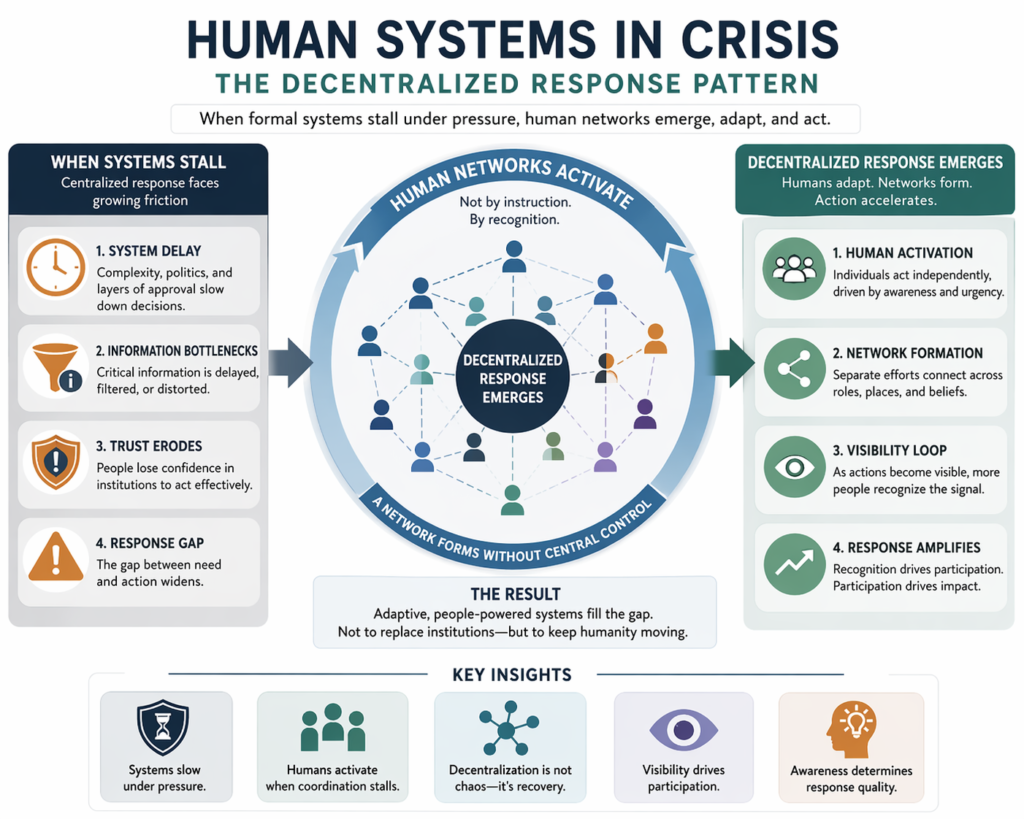
System Breakdown
This pattern appears consistently across crisis environments:
1. System Delay
Formal systems slow under complexity, politics, and layered decision-making.
2. Human Activation
Individuals begin acting independently.
Not coordinated at first—just responsive.
3. Convergence
Separate efforts begin to connect:
- across countries
- across roles
- across beliefs
A network forms without central control.
4. Visibility Loop
As actions become visible, more people recognize the signal.
Recognition → participation
Participation → amplification
Case Signal (Observed Pattern)
In moments of visible crisis, individuals organize themselves:
- civilians
- doctors
- artists
- workers
Not because they were instructed to.
Because something aligns:
this matters.
This is not unique to one place or event.
It is a repeatable human response pattern.
Reframe
The question is not:
“Why aren’t systems solving this?”
The better question is:
“What happens when systems can’t move fast enough?”
System Insight
Human systems are not dependent on formal systems.
They are adaptive.
When institutions pause, human networks don’t disappear.
They reorganize.
Decentralized action is not disorder.
It is recovery.
Application
This pattern extends far beyond any single crisis:
- disaster response
- mutual aid networks
- grassroots coordination
- community survival systems
What this changes:
- Don’t assume systems will hold under pressure
- Build awareness, not just reliance
- Support distributed response capability
- Recognize early signals before systems react
Key Insights
- Systems slow under pressure
- Humans activate when coordination stalls
- Decentralization is a recovery mechanism
- Visibility drives participation
- Awareness determines response quality
Closing
What we are seeing is not just reaction.
It is structure revealing itself.
Human systems have always been there—
quiet, distributed, waiting.
The real question is:
What would happen if we supported these systems intentionally?
Not to replace institutions—
but to complement them.
This is where emerging tools matter.
Not to make decisions for us—
but to help us see clearly, coordinate faster, and act with awareness.
That’s the difference between reaction and design.
And it’s where the next layer of human systems begins.

Leave a Reply to ascensionrose Cancel reply