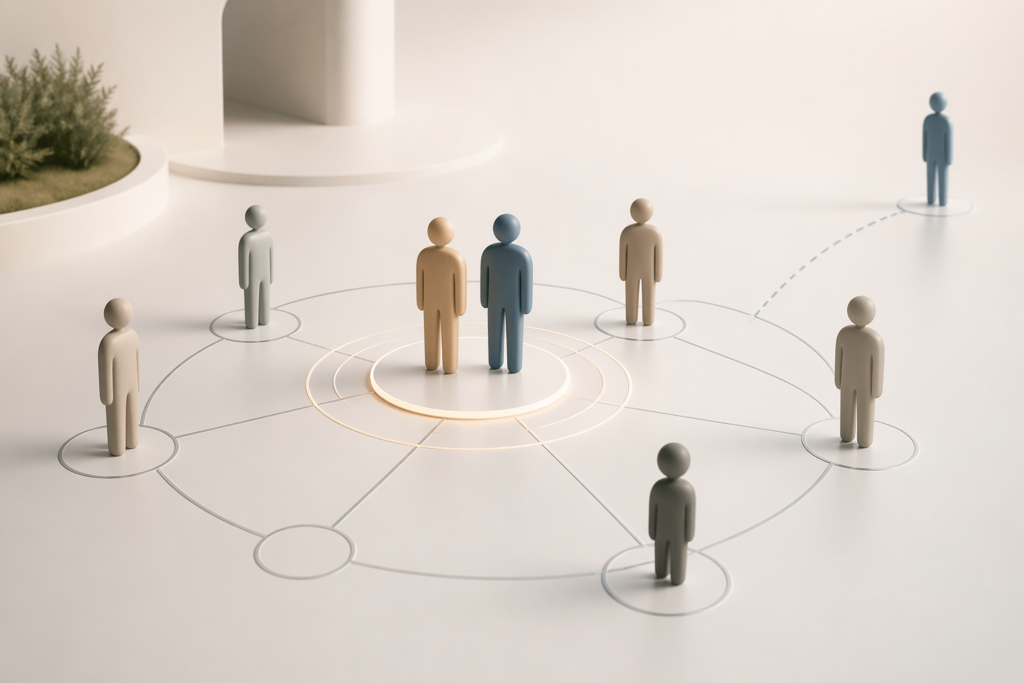
Tag: decision guidance

  • Connection Doesn’t Require Shared Experience

    Opening

    There’s a hill above a small-town football field.

    Second tier.

    That’s where the brown station wagon parked on Friday nights.

    1970s brown. Long. Heavy doors. More room than car.

    Down below, my dad was the head coach.

    At that age, he might as well have been invisible to me—not emotionally, just physically. I didn’t see him. I didn’t interact with him.

    I only knew that being there mattered.


    Break the Assumption

    We tend to believe connection requires interaction.

    Shared activity. Conversation. Engagement.

    If those aren’t present, we assume distance.

    But that assumption doesn’t hold.


    System Breakdown

    There are at least two distinct modes of human connection:

    1. Participatory Connection

    • Direct interaction
    • Shared experience
    • Active engagement

    2. Observational Presence

    • No interaction
    • No shared activity
    • But stable, known presence within the same environment

    Both are valid. Both create connection.


    Personal Evidence (Controlled)

    Inside the station wagon, my mom engineered warmth.

    Heat turned up high. Blankets. Contained comfort.

    Outside, my dad existed in a completely separate layer—focused, unavailable, part of another system entirely.

    I didn’t engage with him.

    But I knew where he was.

    And that mattered.


    Reframe

    Connection is not binary.

    It is not “connected” or “not connected.”

    It operates across different modes.

    Presence alone—when stable and predictable—can create a form of connection that does not require interaction.


    System Insight

    Humans don’t require shared experience to feel connected.

    They require:

    • Consistent presence
    • Predictable placement in a shared structure
    • Awareness that the other exists within their world

    This creates:

    A low-demand connection system that still supports emotional stability.


    Application

    This matters more than it seems.

    In relationships

    Not every connection needs constant interaction.
    Some people connect through proximity, not participation.

    In neurodivergent systems

    Lower-interaction connection models reduce social load while preserving connection.

    In digital and XR environments

    Systems like Guardians don’t need to constantly engage.
    They can exist as stable, peripheral presence—available, but not intrusive.

    In everyday life

    Being there—consistently—often matters more than trying to perform connection.


    Key Insights

    • Connection does not require interaction
    • Presence can be enough when it is consistent
    • Shared space can replace shared activity
    • Predictability creates emotional stability
    • Low-demand connection systems are still real connection

    Closing

    I didn’t need to see him.

    I didn’t need to interact.

    I just needed to know he was there.

    And that was enough.

  • Narcissus Takes a Holiday: Digital Attention and the Modern Reflection Trap

    Classical-style painting of Narcissus looking into a smartphone reflection instead of water, symbolizing modern digital attention and self-focus

    The Spanish coast.

    The Costa del Sol.

    The place where people come to feel alive again.

    Sunlight. Movement. Laughter. Real presence.

    And then—

    phones.

    Everywhere.

    Faces angled just right, eyes locked on screens, moments adjusted to fit the frame.

    The sea behind them.

    Ignored.


    The Anchor

    We met one of them.

    Not a bad person. Just… disconnected.

    Everything filtered through the phone:

    • conversations interrupted
    • moments staged
    • attention constantly pulled away

    At one point he said:

    “My followers live vicariously through me.”

    But being there with him, something felt off.

    His life wasn’t being lived.

    It was being managed.


    The Break

    This isn’t about personality.

    It’s about design.

    Digital platforms are built to:

    • capture attention
    • hold it
    • reward it

    Not to return you to your environment.


    System Breakdown

    1. Attention Capture
    Notifications, visuals, and social signals pull focus away from the present.

    2. Reflection Loop
    The self becomes the subject:

    • how do I look
    • how is this perceived
    • what will this get

    3. External Validation
    Feedback replaces internal experience:

    • likes
    • comments
    • views

    4. Disconnection
    The environment becomes background.

    Real moments become secondary.


    What This Reveals

    The issue isn’t technology.

    It’s where attention is anchored.

    When attention stays external:

    • experience becomes performance
    • presence disappears
    • connection weakens

    Reframe

    The goal isn’t to stop using technology.

    The goal is to return attention to the moment you’re actually in.


    Application (Healthy Use)

    You don’t need to remove your phone.

    You need to reposition it.

    1. Capture, then return
    Take the photo—then rejoin the moment.

    2. Limit reflection time
    Don’t stay in:

    • editing
    • reviewing
    • checking responses

    3. Anchor in reality
    Ask:

    • who is here with me?
    • what is actually happening right now?

    4. Notice disconnection early
    The moment you feel pulled out of the experience—pause.

    Return.


    Result

    The same place becomes:

    • more vivid
    • more real
    • more shared

    You stop documenting life
    and start participating in it.


    System Insight

    Attention determines experience.

    Where your attention lives,
    your life follows.


    Closing

    Narcissus didn’t fall because he loved himself.

    He fell because he couldn’t look away.

    The difference now is simple:

    The reflection fits in your hand.

    And you still decide when to put it down.

    — Oddly Robbie

  • Sovereignty Isn’t Control — It’s a System

    by oddly robbie

    Conceptual illustration of personal sovereignty showing a small human node maintaining autonomy while connected to a larger expanding system network.

    The Pattern Most People Don’t See

    Sovereignty is being discussed loudly at the level of nations.

    Large systems push outward. Smaller systems push back.

    The language sounds political—but the pattern is structural.

    What’s happening between countries is the same thing happening inside systems.

    And the same thing happening inside a single human life.


    Break the Assumption

    Most people think sovereignty is about control.

    That nations, systems, or individuals must hold power to remain secure.

    But control is not sovereignty.

    Control expands outward.
    Sovereignty stabilizes inward.


    The System Behind It

    As systems grow, they lose visibility.

    • Decisions move further from real people
    • Abstraction replaces direct experience
    • Impact becomes harder to feel

    To maintain coherence, large systems expand their influence.

    Not because they are malicious—but because scale creates distance.

    Smaller systems—and individuals—experience the effects directly.

    So they push back.

    This creates a repeating pattern:

    • Expansion from scale
    • Resistance from proximity

    The same structure appears everywhere:

    • Nations vs smaller states
    • Institutions vs individuals
    • Systems vs the human inside them

    Reframe

    Sovereignty is not dominance.

    Sovereignty is self-containment with awareness.

    At the human level, it means:

    • Belonging to yourself
    • Choosing connections freely
    • Owning no one
    • Letting no one own you

    At the system level, it means:

    • Maintaining function without overreach
    • Respecting the autonomy of smaller systems

    Application

    You don’t need to fight every system to maintain sovereignty.

    You need to recognize when expansion is compressing your autonomy.

    Then respond with clarity, not escalation:

    • Define your boundaries clearly
    • Choose participation, don’t default to it
    • Reduce dependence where possible
    • Stay connected—but not absorbed

    Sovereignty is not isolation.

    It’s the ability to remain whole while connected.


    Key Insights

    • Sovereignty is a structural pattern, not just a political concept
    • Large systems expand because scale reduces visibility
    • Resistance comes from those who feel the impact directly
    • Control and sovereignty are not the same
    • True sovereignty is maintaining autonomy while staying connected

  • When Customs Outlive Their Purpose

    A Human Systems View

    Diagram showing how customs outlive their purpose when behavior continues without function

    When customs outlive their purpose, they stop supporting human life and start operating on habit alone. Moving across cultures makes this visible fast—what feels “normal” in one place disappears completely in another.

    Across every culture, customs shape behavior long before conscious thought.

    We inherit them early:
    How to greet
    How to eat
    How to gather
    What to celebrate
    What to avoid

    Most of the time, we don’t question them.

    Because customs don’t present themselves as systems.

    They present themselves as “the way things are.”

    Break the Assumption

    The default belief:

    Custom = truth
    Tradition = value
    Repetition = correctness

    But customs are not truth.

    They are solutions created under past conditions.

    And like any system, they can become outdated.

    Why Customs Outlive Their Purpose

    Every custom begins with a function.

    It exists to solve something:

    • Environmental (seasons, survival, scarcity)
    • Social (coordination, bonding, identity)
    • Psychological (comfort, predictability, meaning)
    • Structural (power, order, hierarchy)

    When the environment changes—but the custom does not—the system drifts.

    That drift follows a predictable pattern:

    Function → Habit → Obligation → Enforcement

    At the end of that chain, the original purpose is often gone.

    Only the behavior remains.

    Distortion Layer

    A custom becomes distorted when:

    The story stays the same
    But the function disappears

    At that point, the system sustains itself through:

    • Social pressure
    • Identity protection
    • Emotional attachment
    • Authority reinforcement

    People don’t follow it because it works.

    They follow it because not following it has a cost

    Power and Preservation

    Power rarely needs to invent customs.

    It only needs to preserve and stabilize them.

    Once a custom aligns with:
    • Identity
    • Belonging
    • Order

    It becomes self-reinforcing.

    Institutions, leaders, and systems may then:
    • Formalize it
    • Normalize it
    • Protect it from questioning

    Not always out of manipulation—

    But because stable systems are easier to maintain than changing ones.

    Harm Signals

    Not all customs are harmful.

    But all customs should be evaluated.

    Watch for these signals:

    • Obligation replaces meaning
    • Participation feels performative
    • Questioning creates tension or rejection
    • The outcome no longer matches the purpose
    • Individuals must suppress themselves to comply

    When these appear, the system is no longer serving the human.

    The human is serving the system.

    Reframe

    You are not required to reject all customs.

    You are required to understand them.

    A functional custom:
    • Supports your life
    • Aligns with current reality
    • Allows flexibility

    A non-functional custom:
    • Drains energy
    • Enforces outdated conditions
    • Persists through pressure rather than value

    The goal isn’t to reject traditions—it’s to recognize when customs outlive their purpose and no longer serve you.

    Application

    Instead of asking:
    “Is this tradition good or bad?”

    Ask:

    What was this designed to do?
    Is it still doing that?
    What is the actual outcome now?

    Then choose:

    • Keep (if it still serves)
    • Modify (if it partially works)
    • Exit (if it no longer aligns)

    All three are valid.

    System Insight

    Customs are inherited systems.

    But participation is a choice.

    Awareness is the point where inheritance becomes autonomy.

    Key Insights

    • Customs originate as solutions, not truths
    • Systems drift when conditions change
    • Social cost keeps outdated systems alive
    • Power stabilizes systems more than it creates them
    • Evaluation restores autonomy

  • Being Wrong is Not Failure

    Why being wrong is essential for adaptive thinking and human system growth

    It is one of the ways a human system stays updateable.

    Every person, relationship, culture, and institution depends on feedback. When feedback is allowed in, the system can adjust. When being wrong is treated as shame, the system protects its old answer instead of learning from reality.

    That is where breakdown begins.

    A fixed belief can feel safe because it creates certainty. But certainty can also become a closed door. New information gets ignored. Patterns repeat. Small mistakes become larger ones because the system refuses to update.

    The advantage of being wrong is not the mistake itself.

    The advantage is the correction.

    A healthy human system does not need to be perfect. It needs to stay responsive. It needs enough humility to notice when reality has changed, enough stability to handle correction, and enough flexibility to choose a better response.

    Being wrong, then, is not the opposite of intelligence.

    It is part of intelligence.

    It is the moment where the system receives new data and has a chance to become more aligned with what is real.

  • The Swipe Loop: How Digital Platforms Keep You Hooked

    This infographic illustrates the Swipe Loop, a behavioral system used by digital platforms to maintain user engagement. It shows the cycle of trigger, action, reward, and repetition, similar to a slot machine. The visual also explains key mechanisms such as variable rewards, low-effort interaction, and lack of stopping points. Practical strategies are included to help users break the loop, including intentional app use, adding friction, setting exit conditions, and replacing the behavior with physical movement.

    The Swipe Loop Visual Model

    The Swipe Loop starts the same way every time.

    The bells ring first—sharp, bright, demanding.

    Then the reward.

    That pattern isn’t limited to casinos.

    It’s in your pocket.


    The Anchor

    Every time you:

    • refresh a feed
    • check a notification
    • scroll “just one more time”

    you’re pulling a lever.

    Sometimes you get something:

    • a message
    • a like
    • something interesting

    Most of the time, you don’t.

    That unpredictability is the key.

    This pattern has a name:

    The Swipe Loop


    The Break

    This isn’t accidental.

    Digital platforms are built around a pattern called intermittent reinforcement:

    • rewards come randomly
    • not every time
    • just often enough to keep you engaged

    This is the same mechanism used in slot machines.

    And it’s one of the most powerful behavioral hooks humans have.


    System Breakdown

    1. Variable Reward

    You don’t know when something good will appear.
    That uncertainty keeps you checking.

    2. Low Effort Loop

    • flick
    • refresh
    • repeat

    No friction. Easy to continue.

    3. Social Signal Layer

    • likes
    • views
    • responses

    Your brain reads this as attention and approval.

    4. Endless Design

    There’s no natural stopping point.
    So the loop continues unless you interrupt it.


    Personal Evidence (Loop Resistance in Practice)

    I’ve tried to break the loop in simple ways:

    • hide the app
    • move it off the screen
    • reduce visibility

    When that doesn’t work, I delete it.

    And it works—for a while.

    But then something interesting happens:

    The app comes back.

    Not because I need it.

    Because the loop isn’t finished.

    So I delete it again.

    What this reveals is simple:

    Removing access doesn’t remove the system.

    The urge is not about the app.

    It’s about the loop continuing without closure.


    What This Reveals

    The behavior isn’t a personal flaw.

    It’s a system interacting with your nervous system.

    You’re not weak.

    You’re responding exactly as designed.


    Reframe

    This isn’t about discipline.

    It’s about unfinished loops.

    Deleting the app interrupts access.

    But it doesn’t complete the cycle your brain is trying to resolve.

    Until the loop is closed, it will keep trying to reopen.


    Application (Healthy Use)

    The goal isn’t to quit technology.

    The goal is to stop interacting with it unconsciously.

    1. Create Entry Points

    • open apps intentionally
    • not automatically

    2. Add Friction

    • pause before refreshing
    • ask: “why am I opening this?”

    3. Set Exit Conditions

    Decide before you start:

    • time limit
    • purpose

    4. Replace the Loop

    When the urge hits:

    • stand up
    • move
    • shift your environment

    Break the pattern physically.


    Result

    You still use the tools.

    But they stop using you.


    System Insight

    The Swipe Loop works because it removes closure.

    • no defined start
    • no defined end
    • no completion signal

    Your brain keeps searching for resolution that never arrives.

    When you reintroduce:

    • clear entry
    • defined exit
    • intentional purpose

    the loop weakens.


    Closing

    The machine is designed to keep you pulling.

    But you still decide when to stop.

    And that’s where your control begins.

    — Oddly Robbie

  • Cognitive Optimization vs Physical Strength: A Human Systems View

    cognitive optimization vs physical strength human systems comparison

    Opening — The Shift Most People Miss

    In the past, survival depended on physical strength.

    Today, it depends on cognitive resilience.

    We’ve upgraded our environment—but most people are still training for the wrong system.


    Break the Assumption

    The common belief:

    “If I take care of my body, I’m optimizing my life.”

    That’s incomplete.

    Because modern life is not physically demanding—it’s mentally overwhelming.


    System Breakdown — Input → Processing → Output

    Every human system follows the same structure:

    1. Input

    • Food (body)
    • Information (mind)

    2. Processing

    • Metabolism
    • Cognitive interpretation

    3. Output

    • Physical performance
    • Decisions, emotions, behavior

    Most people optimize body input
    but ignore mental input quality.


    Personal Evidence (Controlled)

    For muscle, I don’t rely on supplements.

    A vegan Mediterranean diet—lentils, tofu, olive oil, vegetables—combined with movement is enough.

    But for my brain, I stack intentionally:

    • Omega-3s
    • Functional mushrooms
    • Antioxidants

    Not as hype—
    but as support for the system I actually use most: my mind.


    Reframe

    “Stacking” isn’t about supplements.

    It’s about intentional system design.

    You are already stacking:

    • Social media
    • News cycles
    • Cultural loops

    The question is:

    Are you stacking by default, or by design?


    System Insight

    Uncontrolled input leads to:

    • Anxiety
    • Stagnation
    • Reactive thinking

    Intentional input leads to:

    • Clarity
    • Adaptability
    • Long-term resilience

    Your brain is not just an organ.

    It is your primary survival system in the Information Age.


    Application

    You don’t need a complex stack.

    Start with this:

    Reduce noise

    • Limit repetitive, low-value inputs

    Add signal

    • New languages
    • New systems
    • New perspectives

    Train output

    • Use what you learn daily
    • Build, speak, create

    Key Insights

    • Muscles support your body — brains guide your life
    • Input quality determines system performance
    • Most people are unconsciously stacked
    • Intentional stacking creates resilience

    Final Thought

    For my body, food is enough.

    For my mind, I design the inputs.

    At 60, strength matters.

    But clarity matters more.

    That’s the real edge.


    ✨ Human Systems Tag:
    Function: Decision Guidance
    Domain: Human Systems
    Context: Cognitive Optimization

  • Why Indirect Communication Drains Your Energy (and What Actually Protects It)

    Most people think indirect communication is safer.

    Sarcasm. Distance. Withholding. Subtle signals instead of clear words.

    It can feel like control.

    But it isn’t.

    Why Indirect Communication Feels Like Protection

    Indirect communication looks like protection.

    In reality, it’s effort.

    It requires:

    • constant monitoring
    • interpreting signals
    • maintaining a version of yourself

    That costs energy.

    The Break

    We’re often taught that:

    • being direct is risky
    • being unclear is safer

    So people default to indirect communication.

    This is where indirect communication quietly drains you.

    They leak it.

    System Breakdown

    1. Indirect Mode (Friction)

    • signals instead of statements
    • guessing instead of knowing
    • tension instead of clarity

    Result: continuous energy drain

    2. Direct Mode (Clarity)

    • clear communication
    • defined limits
    • intentional responses

    Result: stable energy

    What This Reveals

    Energy isn’t protected by hiding.

    It’s protected by clarity.

    When you’re unclear:

    • you stay engaged longer than needed
    • you process more than necessary
    • you carry interactions with you

    When you’re clear:

    • interactions end cleanly
    • energy returns faster
    • your system resets

    Reframe

    The goal isn’t to protect yourself by being hard to read.

    The goal is to protect your energy by being clear enough to close loops.

    Application

    Instead of:

    • hinting
    • signaling
    • withdrawing indirectly

    Try:

    • stating your response clearly
    • ending the interaction cleanly
    • not carrying it forward

    No extra processing needed.

    Result

    Less mental load.
    Less emotional residue.
    More available energy.

    System Insight

    Unclear behavior extends interaction.
    Clear behavior completes it.

    Completion is what restores energy.

    Closing

    Indirect communication feels like control.

    Clarity actually is.

    — Oddly Robbie

  • Music Isn’t Expression — It’s a System for Moving Experience

    Opening — The Assumption

    Music as a system explains why it works across time.

    Most people think music is about expression.

    Something you use to:

    • say something
    • feel something
    • release something

    But that framing misses what’s actually happening.

    Music isn’t just expression.

    It’s structure.


    Break the Assumption

    When something carries emotional weight, most people respond in two ways:

    • push it away
    • or replay it

    Neither changes the structure of the experience.

    So it stays unresolved.

    Not because it’s still happening externally—
    but because it’s still active internally.


    System Breakdown

    Here’s what actually changes the structure of an experience:

    1. Capture

    A real experience is taken as it is—without pushing it away or replaying it.

    It’s held as a signal, not a story.

    No explanation.
    No judgment.

    Just recognition.


    2. Translate

    That experience is converted into structure.

    Not explained.
    Not analyzed.

    Structured.

    This is where music comes in.


    Why Music Works

    Music functions as a translation system because it aligns with how the human system already operates:

    • Rhythm organizes internal chaos into timing
    • Pattern makes the experience predictable
    • Progression allows movement and release

    Without structure, experience loops.
    With structure, experience moves.

    The more precisely the music matches the state,
    the more efficiently the system moves.


    3. Move With It

    Once structured, the experience is no longer stuck.

    It can be:

    • felt without overwhelm
    • repeated without looping
    • released without force

    You’re not escaping it.

    You’re giving it a form the system can process.


    Why Certain Music Works in Specific Situations

    This isn’t preference—it’s alignment.

    Breakups

    The system is processing:

    • loss
    • identity shift
    • unresolved loops

    Breakup songs work because they:

    • mirror the emotional pattern
    • provide structure
    • move through progression (pain → reflection → release)

    They help the system complete a process.


    Productivity

    The system needs:

    • stability
    • low interruption
    • predictable flow

    Music helps when it:

    • repeats
    • avoids surprise
    • maintains steady rhythm

    This reduces internal noise and stabilizes focus.


    Workouts

    The system needs:

    • drive
    • synchronization
    • momentum

    Music supports this by:

    • increasing tempo
    • reinforcing rhythm with movement
    • creating clear peaks and progression

    The body begins to move with the rhythm instead of resisting effort.


    System Pattern

    Across all cases:

    • The state determines the need
    • The music provides structure
    • The system aligns and moves

    Music doesn’t create the state.

    It organizes it.


    Reframe

    Music isn’t something you turn to for relief.

    It’s a system that converts experience into movement.


    System Insight

    Because the human system hasn’t fundamentally changed:

    • rhythm still regulates the body
    • pattern still drives cognition
    • progression still processes emotion

    That’s why music works across time.

    Not because it’s remembered.

    Because it still fits.


    Application

    Use this intentionally:

    • Need calm → slower, steady rhythm
    • Need focus → repetition and simple patterns
    • Need release → clear build and resolution

    Or create:

    • start with the experience
    • translate into rhythm
    • shape into progression

    You’re not making music.

    You’re structuring experience.


    Key Insights

    • Unresolved experiences persist because their structure doesn’t change
    • Music provides structure where none exists
    • Rhythm, pattern, and progression map directly to human systems
    • The closer the match between music and state, the more effective the result
    • Music works across time because the human system is stable

    Closing

    Music doesn’t remove what happened.

    It makes it workable.

    And once something is workable—

    it can finally move.

  • When Systems Get Loud, the Human Gets Lost

    A Human Systems view of control, environment, and identity


    Opening — The Assumption

    If everything around you is structured, optimized, and controlled…
    then you should function better.

    More systems = more stability.
    More control = more clarity.

    That’s the belief.


    Break the Assumption

    Some systems don’t support the human.

    They replace them.

    When a system becomes too loud—
    too structured, too controlling, too constant—

    it doesn’t guide behavior.

    It overrides it.


    System Breakdown

    Humans are adaptive systems.

    We regulate through:

    • environment
    • pacing
    • internal signals
    • autonomy of choice

    A healthy system:

    • supports regulation
    • reduces friction
    • allows variation

    But controlling environments do something different:

    They:

    • remove variation
    • suppress internal signals
    • enforce constant external structure
    • replace choice with compliance

    Over time, the human system stops referencing itself.

    It starts referencing the system.


    What Actually Happens

    At first:

    • things feel easier
    • decisions are reduced
    • structure feels supportive

    Then gradually:

    • internal signals get quieter
    • identity becomes reactive
    • behavior becomes scripted

    Eventually:

    The person is functioning—
    but not self-directed.


    The Real Question

    If the system went quiet…

    Who is left?

    Not the role.
    Not the routine.
    Not the behavior shaped by the environment.

    The actual human.


    Reframe

    The goal of a system is not control.

    It’s support without replacement.

    A system should:

    • hold structure lightly
    • amplify awareness
    • protect autonomy
    • adapt to the human—not the other way around

    System Insight

    A system becomes harmful when it becomes the primary source of truth.

    Instead of:

    “This helps me function”

    It becomes:

    “This is how I exist”

    That’s the shift where the human gets lost.


    Application

    Check any system in your life:

    Ask:

    • Can I step out of this and still feel like myself?
    • Do I notice my internal signals, or only external demands?
    • Is this system helping me choose—or choosing for me?

    If the system goes quiet and there’s discomfort…

    That’s not failure.

    That’s signal returning.


    Key Insights

    • Not all structure supports the human system
    • Control can replace regulation if it becomes constant
    • Identity weakens when internal signals are ignored
    • Healthy systems are adjustable—not dominant
    • If you can’t function without the system, the system is too loud

    The human system isn’t meant to be controlled.
    It’s meant to be supported—and still remain itself.