Mental clarity in a noisy world is becoming rare.
Not because people lack intelligence—
but because they are surrounded by too much input.
People are overwhelmed.
Not because they lack information—
but because they are surrounded by too much of it.
What most experience in a day isn’t signal.
It’s noise.
Break the Assumption
We’re taught that confusion is solved by adding more:
- more information
- more opinions
- more input
But this approach fails.
Because clarity doesn’t come from accumulation.
It comes from separation.
System Breakdown
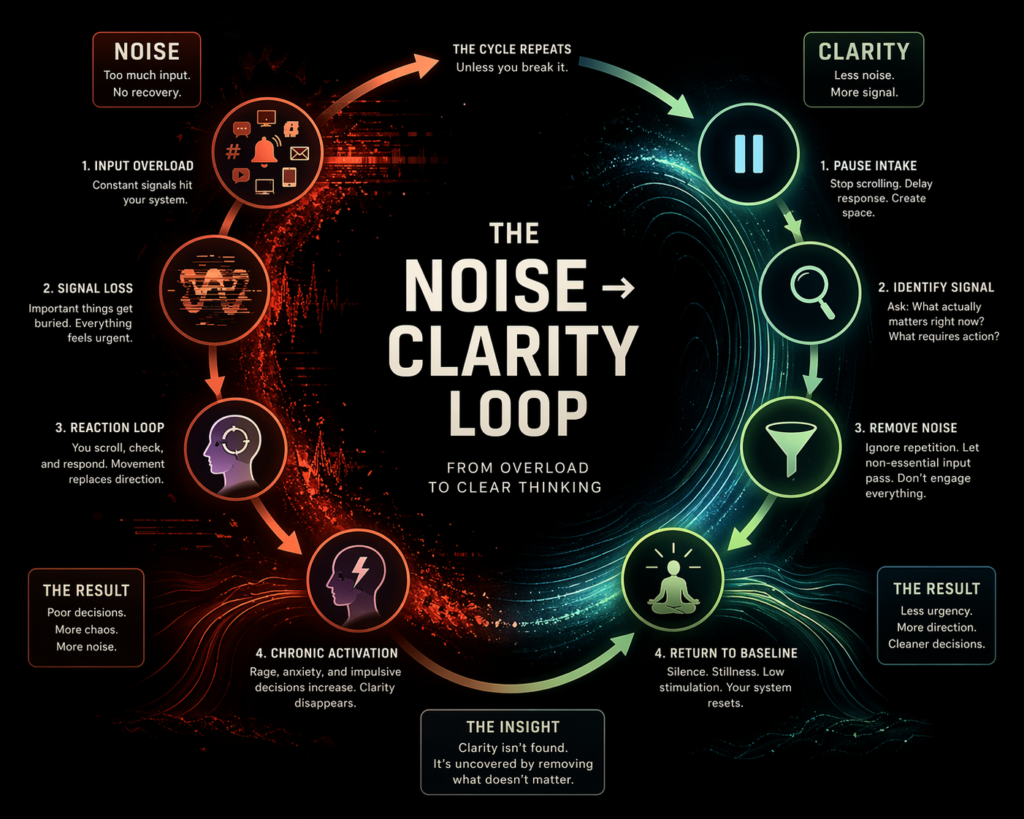
1. Input Overload
The nervous system absorbs more than it can process:
- digital signals
- social expectations
- constant stimulation
There is no recovery window.
2. Signal Loss
Important information gets buried under:
- repetition
- artificial urgency
- emotional amplification
Everything begins to feel equally important.
3. Reaction Loop
Without separation, people stop choosing and start reacting:
- scrolling
- checking
- responding
Movement replaces direction.
4. Chronic Activation
The system stays in a heightened state:
- low tolerance for ambiguity
- faster emotional escalation
- reduced ability to think clearly
Rage, anxiety, and impulsive decisions increase.
Reframe
Clarity isn’t something you find.
It’s something you uncover
by removing what doesn’t matter.
System Insight
Clarity requires contrast.
Without access to:
- silence
- stillness
- low stimulation
…the mind loses the ability to distinguish signal from noise.
Poor decisions are not the root problem.
They are the outcome of overloaded conditions.
Application
Instead of adding more input, subtract:
1. Pause Intake
- stop scrolling
- delay response
- step away from constant input
2. Identify Signal
Ask:
- what actually matters right now?
- what requires action?
3. Remove Noise
- ignore repetition
- let non-essential input pass
- don’t engage everything
4. Return to Baseline
Give your system space to reset:
- silence
- stillness
- low stimulation
Result
Less urgency.
More direction.
Cleaner decisions.
Key Insights
- More input does not create clarity
- Overload destroys signal detection
- Reaction replaces decision under pressure
- Clarity emerges through subtraction
- Calm is a requirement for good decisions
Closing
The world isn’t getting quieter.
So the skill isn’t waiting for silence.
It’s learning how to sift.
— Oddly Robbie