Tag: decision guidance

  • Music Isn’t Expression — It’s a System for Moving Experience

    Opening — The Assumption

    Music as a system explains why it works across time.

    Most people think music is about expression.

    Something you use to:

    • say something
    • feel something
    • release something

    But that framing misses what’s actually happening.

    Music isn’t just expression.

    It’s structure.


    Break the Assumption

    When something carries emotional weight, most people respond in two ways:

    • push it away
    • or replay it

    Neither changes the structure of the experience.

    So it stays unresolved.

    Not because it’s still happening externally—
    but because it’s still active internally.


    System Breakdown

    Here’s what actually changes the structure of an experience:

    1. Capture

    A real experience is taken as it is—without pushing it away or replaying it.

    It’s held as a signal, not a story.

    No explanation.
    No judgment.

    Just recognition.


    2. Translate

    That experience is converted into structure.

    Not explained.
    Not analyzed.

    Structured.

    This is where music comes in.


    Why Music Works

    Music functions as a translation system because it aligns with how the human system already operates:

    • Rhythm organizes internal chaos into timing
    • Pattern makes the experience predictable
    • Progression allows movement and release

    Without structure, experience loops.
    With structure, experience moves.

    The more precisely the music matches the state,
    the more efficiently the system moves.


    3. Move With It

    Once structured, the experience is no longer stuck.

    It can be:

    • felt without overwhelm
    • repeated without looping
    • released without force

    You’re not escaping it.

    You’re giving it a form the system can process.


    Why Certain Music Works in Specific Situations

    This isn’t preference—it’s alignment.

    Breakups

    The system is processing:

    • loss
    • identity shift
    • unresolved loops

    Breakup songs work because they:

    • mirror the emotional pattern
    • provide structure
    • move through progression (pain → reflection → release)

    They help the system complete a process.


    Productivity

    The system needs:

    • stability
    • low interruption
    • predictable flow

    Music helps when it:

    • repeats
    • avoids surprise
    • maintains steady rhythm

    This reduces internal noise and stabilizes focus.


    Workouts

    The system needs:

    • drive
    • synchronization
    • momentum

    Music supports this by:

    • increasing tempo
    • reinforcing rhythm with movement
    • creating clear peaks and progression

    The body begins to move with the rhythm instead of resisting effort.


    System Pattern

    Across all cases:

    • The state determines the need
    • The music provides structure
    • The system aligns and moves

    Music doesn’t create the state.

    It organizes it.


    Reframe

    Music isn’t something you turn to for relief.

    It’s a system that converts experience into movement.


    System Insight

    Because the human system hasn’t fundamentally changed:

    • rhythm still regulates the body
    • pattern still drives cognition
    • progression still processes emotion

    That’s why music works across time.

    Not because it’s remembered.

    Because it still fits.


    Application

    Use this intentionally:

    • Need calm → slower, steady rhythm
    • Need focus → repetition and simple patterns
    • Need release → clear build and resolution

    Or create:

    • start with the experience
    • translate into rhythm
    • shape into progression

    You’re not making music.

    You’re structuring experience.


    Key Insights

    • Unresolved experiences persist because their structure doesn’t change
    • Music provides structure where none exists
    • Rhythm, pattern, and progression map directly to human systems
    • The closer the match between music and state, the more effective the result
    • Music works across time because the human system is stable

    Closing

    Music doesn’t remove what happened.

    It makes it workable.

    And once something is workable—

    it can finally move.

  • When Systems Get Loud, the Human Gets Lost

    A Human Systems view of control, environment, and identity


    Opening — The Assumption

    If everything around you is structured, optimized, and controlled…
    then you should function better.

    More systems = more stability.
    More control = more clarity.

    That’s the belief.


    Break the Assumption

    Some systems don’t support the human.

    They replace them.

    When a system becomes too loud—
    too structured, too controlling, too constant—

    it doesn’t guide behavior.

    It overrides it.


    System Breakdown

    Humans are adaptive systems.

    We regulate through:

    • environment
    • pacing
    • internal signals
    • autonomy of choice

    A healthy system:

    • supports regulation
    • reduces friction
    • allows variation

    But controlling environments do something different:

    They:

    • remove variation
    • suppress internal signals
    • enforce constant external structure
    • replace choice with compliance

    Over time, the human system stops referencing itself.

    It starts referencing the system.


    What Actually Happens

    At first:

    • things feel easier
    • decisions are reduced
    • structure feels supportive

    Then gradually:

    • internal signals get quieter
    • identity becomes reactive
    • behavior becomes scripted

    Eventually:

    The person is functioning—
    but not self-directed.


    The Real Question

    If the system went quiet…

    Who is left?

    Not the role.
    Not the routine.
    Not the behavior shaped by the environment.

    The actual human.


    Reframe

    The goal of a system is not control.

    It’s support without replacement.

    A system should:

    • hold structure lightly
    • amplify awareness
    • protect autonomy
    • adapt to the human—not the other way around

    System Insight

    A system becomes harmful when it becomes the primary source of truth.

    Instead of:

    “This helps me function”

    It becomes:

    “This is how I exist”

    That’s the shift where the human gets lost.


    Application

    Check any system in your life:

    Ask:

    • Can I step out of this and still feel like myself?
    • Do I notice my internal signals, or only external demands?
    • Is this system helping me choose—or choosing for me?

    If the system goes quiet and there’s discomfort…

    That’s not failure.

    That’s signal returning.


    Key Insights

    • Not all structure supports the human system
    • Control can replace regulation if it becomes constant
    • Identity weakens when internal signals are ignored
    • Healthy systems are adjustable—not dominant
    • If you can’t function without the system, the system is too loud

    The human system isn’t meant to be controlled.
    It’s meant to be supported—and still remain itself.

  • Autistic Grouping Myth: Why Grouping Limits Human Potential

    A single ember spark rising from a campfire into the dark night, symbolizing individuality and separation from the group

    Belief

    The error behind the autistic grouping myth is not grouping itself.

    People assume that shared neurology means shared experience.
    If someone is autistic, they must benefit from autistic groups, shared spaces, and common support structures.


    Break

    That assumption fails in high-variance systems.

    Autistic individuals may share underlying traits—sensory amplification, pattern sensitivity, boundary awareness—but the way those traits express is wildly different.

    Shared mechanism does not produce shared behavior.


    System Breakdown

    Human systems follow a predictable pattern:

    1. Detect a signal
      → “This person is autistic”
    2. Assign a category
      → “They belong to this group”
    3. Project expectations
      → “They will benefit from this type of environment”
    4. Apply constraint
      → Limited options, prebuilt support models, reduced flexibility

    This works for efficiency.
    It fails for complexity.

    Autism is a high-variance system.


    Personal Evidence

    In a VR space designed for open conversation, I was invited—kindly—to join an autism group.

    The assumption was simple:
    shared label → shared comfort.

    But the environment didn’t match how I operate.

    Not because it was bad.
    Because it was designed for a generalized version of something that doesn’t generalize well.


    Reframe

    Autistic people are not a flock.

    They are more like sparks.

    They emerge from similar conditions,
    but they do not move together.

    Each follows its own trajectory—
    independent, unpredictable, self-directed.


    System Insight

    The error is not grouping.

    The error is assuming:

    Shared trait → shared needs → shared solutions

    In reality:

    Shared trait → divergent expression → individualized environments

    The more complex the system,
    the less reliable the group model becomes.


    Application

    Instead of asking:

    • “What group does this person belong to?”

    Shift to:

    • “What function does this environment serve for this individual?”

    Practical adjustments:

    • Observe behavior before applying labels
    • Avoid default support structures
    • Let individuals define their own optimal environments
    • Treat grouping as optional, not assumed

    Key Insights

    • Grouping reduces cognitive load but increases error in complex systems
    • Autism shares mechanisms, not outcomes
    • Standardized support often mismatches individual needs
    • Flexibility outperforms categorization in high-variance populations
    • The individual signal is always more accurate than the group model

    Closing

    If you’ve ever watched a fire, you’ve seen it.

    A spark lifts, breaks away, and moves on its own path—
    not guided, not grouped, not contained.

    Some people want to gather those sparks back into something predictable.

    But sparks don’t organize.

    They move.

    And some of us were never meant to stay in the fire.

  • Real Food vs Processed Food: Why Taste Was Never the Point

    It Was About Signal Integrity in Human Systems

    Opening

    I didn’t change my discipline.
    I changed my environment.

    Within weeks of living in Spain, my body responded—more stable energy, clearer skin, better muscle response. No supplements. No tracking. Just different food.

    That shift wasn’t random.


    Break the Assumption

    The assumption is simple:

    If you’re eating enough, you’re being nourished.

    That assumption fails.

    Modern food systems optimize for shelf life, cost, and repeat consumption, not biological alignment.


    System Breakdown

    Food is not just fuel. It is a signaling system.

    What you eat sends instructions to your body:

    • Metabolism regulation
    • Hormonal balance
    • Energy stability
    • Cognitive clarity

    When food is altered, the signal degrades.

    In degraded systems:

    • “Fat-free” = sugar compensation
    • “Healthy” = marketing layer, not biological truth
    • Serving sizes = perception manipulation
    • Ingredients = obscured complexity

    The result:

    High caloric intake + low functional nourishment = system confusion


    Personal Evidence (Controlled)

    In the U.S., I experienced what I’d call nutritional saturation without fulfillment.

    Plenty of food. Persistent depletion.

    In Spain, without trying:

    • Simpler ingredients
    • Shorter supply chains
    • Fewer additives

    The system corrected itself.


    Reframe

    This isn’t about “good vs bad food.”

    It’s about system design differences:

    System TypeOptimization TargetResult
    Industrial Food SystemProfit + shelf stabilitySignal distortion
    Local Food SystemFreshness + simplicitySignal clarity

    System Insight

    The human body does not interpret labels.
    It interprets inputs.

    When inputs are:

    • Over-processed
    • Chemically stabilized
    • Nutritionally reconstructed

    …the body must compensate.

    That compensation shows up as:

    • Fatigue
    • Cravings
    • Instability

    Not because the body is weak—
    but because the system signal is degraded.


    Application

    If you want to improve biological performance:

    Don’t start with restriction. Start with signal clarity.

    Practical shifts:

    • Choose foods with fewer transformations
    • Favor local over global supply chains
    • Read ingredients as signals, not branding
    • Observe how your body responds within days, not months

    Key Insights

    • Food is a signaling system, not just fuel
    • Industrial optimization distorts biological signals
    • “Healthy” labels are often system noise
    • Simpler food environments reduce decision load
    • The body stabilizes quickly when signals are clean

    Closing

    If you feel off—foggy, tired, inconsistent—
    look at the system before blaming yourself.

    Because in many cases:

    It’s not a willpower problem.
    It’s a signal problem.

    And signal problems are fixable.

  • When Systems Destabilize: What Happens to Human Behavior Under Stress

    Opening — The Assumption

    When systems begin to fail, people look for explanations in culture, politics, or morality.

    They ask:
    Why are people acting like this?
    Why is this happening here?

    But this framing misses the deeper pattern.

    Across countries, histories, and systems, human behavior under instability follows consistent rules.

    The surface changes.

    The underlying system does not.


    Break the Assumption

    Instability does not create random behavior.

    It reveals how the human system responds under stress.

    When large systems destabilize—economic, political, social, or environmental—humans do not become irrational.

    They become adaptive to survival conditions.


    System Breakdown

    When stability drops, the human system recalibrates:

    Uncertainty rises → perception narrows
    Trust drops → control behaviors increase
    Coordination weakens → fragmentation begins
    Fear increases → reaction replaces decision-making

    This pattern appears everywhere:

    Economic collapse
    Conflict zones
    Natural disasters
    Institutional failure
    Rapid technological disruption

    Different environments. Same system response.


    Clarification — Fear Is Not the Cause

    It’s easy to assume fear breaks systems.

    More accurate:

    Fear is the signal.

    It reflects that the system has already lost stability.

    When predictability disappears, the human system shifts into protection mode.

    This is not failure.

    It is function.


    System Insight

    Stable systems are not defined by power, size, or authority.

    They are defined by:

    Trust continuity
    Predictable response systems
    Shared reality (agreement on what is happening)
    Capacity to absorb stress without fragmentation

    When these degrade, behavior changes.

    Not because people are worse—

    But because the conditions no longer support stable behavior.


    Reframe

    The wrong question:

    Why are people behaving this way?

    The better question:

    What conditions caused the human system to shift into survival mode?


    Application

    If you want to understand—or design—resilient systems:

    Watch trust erosion early, not just visible collapse
    Reduce unnecessary uncertainty signals
    Maintain clear, shared communication
    Design systems that degrade gracefully, not abruptly
    Support human regulation capacity, not just control mechanisms

    Focus on conditions, not blame.


    Key Insight

    Humans do not break systems.

    Systems that cannot regulate stress shift humans into states where breakdown becomes inevitable.


    Closing

    When systems hold, humans expand.

    When systems destabilize, humans contract.

    Not by choice—

    By design.

  • Stability Is Not a Place — It’s a System

    moving to spain with cats personal story stability system

    Right now, as you read this, I’m in the air—literally.

    Suspended in that liminal space between the familiar and the foreign, crossing invisible lines that mark not just countries but chapters.

    Two suitcases.
    Two carry-ons.
    Two cats.
    My partner and I.


    The Belief

    At the time, I thought I was moving toward stability.

    A new country.
    A new environment.
    A place that might feel better, safer, more aligned.

    Like many people, I believed stability came from where you are.


    The Reality

    This wasn’t a sprint away from something.
    It was a walk toward something new.

    And I didn’t dislike where I came from. I felt deeply for the U.S.—for the people navigating its increasingly jagged terrain.

    But for someone like me—neurodivergent, routine-oriented, soothed by predictability—change like this isn’t just hard.

    It’s seismic.


    The Preparation

    I had never been to Spain before. Not physically.

    But I prepared intensely:

    • I walked its streets in virtual reality
    • I studied its rhythms daily
    • I followed local news
    • I learned language, slang, and custom

    Not just to survive—but to belong.

    I trained for this like an athlete trains for their debut:

    with empathy in one hand and self-protection in the other.


    What Actually Happened

    Something unexpected happened in that process.

    I changed.

    I became:

    • more effective
    • more reflective
    • more capable of handling uncertainty

    I learned to pack light—not just in my suitcase, but in my thinking.


    The System I Didn’t See Yet

    At the time, I thought Spain would give me stability.

    But looking back, that’s not what happened.

    What I actually built was something portable:

    • routines
    • awareness
    • adaptability
    • internal regulation

    Spain didn’t create those.

    The preparation did.


    The Reframe

    Stability isn’t a place you arrive at.

    It’s a system you build.

    And once you build it:

    It travels with you.


    Why This Matters

    Because if your stability depends on:

    • a country
    • a job
    • a situation

    Then uncertainty will always feel like a threat.

    But if your stability comes from:

    • what you do daily
    • how you think
    • how you adapt

    Then no single outcome can take it from you.


    Looking Back

    At the time, I thought I was flying toward a new life.

    Now I see it differently.

    I was building the ability to function anywhere.


    Today

    Now, I find myself in a different kind of uncertainty.

    Not in the air—but in between outcomes.

    Waiting on decisions that could shift where I live, how I move, what comes next.

    And I notice something important:

    I’m not reacting the same way.

    I’m still walking.
    Still training.
    Still thinking clearly.
    Still building.


    What Changed

    Back then, I thought stability was something I was flying toward.

    Now I see it differently.

    It’s something I already built.


    The Real Test

    The move to Spain wasn’t the achievement.

    This is.

    The ability to stay steady when nothing is guaranteed.


    Final Insight

    You can’t remove uncertainty from life.

    But you can build a system that doesn’t collapse when it shows up.

    That’s the difference.

    That’s stability.

  • Challenge Claims with Evidence: A Human Systems Method

    1. Opening

    Challenge claims with evidence sounds simple—but most people don’t actually do it.

    “Don’t take my word for it” is often used as a signal of truth. In reality, it usually replaces the process of verifying information with the feeling of confidence.

    In most cases, people still accept the claim at face value.

    That’s where the system breaks.


    2. Break the Assumption

    We assume that inviting challenge leads to verification.

    It doesn’t.

    Most people hear:

    • “Trust me”
    • “It’s true”
    • “Don’t take my word for it”

    …and stop there.

    The phrase creates the feeling of openness—without the process of testing anything.


    3. System Breakdown

    In human systems, claims are often accepted based on delivery, not evidence.

    When someone says:

    • “Don’t take my word for it”
    • “Look it up”
    • “Do your own research”

    it can signal one of two things:

    • Genuine openness to verification
    • Or a transfer of responsibility without providing structure

    This creates a failure pattern:

    The burden shifts to the listener—but without tools to evaluate the claim.

    So what happens?

    • People don’t investigate
    • Or they investigate poorly
    • Or they confirm what they already believe

    The result is not truth—it’s reinforced bias.


    4. Personal Evidence (Controlled)

    Over time, I noticed something consistent:

    When I actually did challenge claims—slowing down, checking structure, asking for evidence—the outcome changed.

    Some ideas held up.

    Many didn’t.

    The difference wasn’t intelligence.

    It was method.

    At one point, I was part of a highly structured belief system that openly encouraged questioning.

    On the surface, it sounded aligned with truth-seeking.

    But when I actually questioned—when I slowed down, asked for evidence, and pushed beyond surface answers—the response changed.

    The encouragement disappeared.

    What was allowed in language wasn’t supported in practice.

    That’s when I started to see the pattern:

    Some systems don’t resist questions directly—they signal openness, but react negatively when real investigation begins.

    That gap—between what a system says and how it responds—is where you learn what actually holds.


    5. Reframe

    “Don’t take my word for it” is not a conclusion.

    It’s an entry point.

    The real process starts after the statement—not before it.

    Once you see that gap, you stop listening to claims—and start watching systems.


    6. System Insight

    Across human systems:

    People are rarely taught how to challenge—only that they should.

    So language substitutes for process.

    Phrases like:

    • “Do your research”
    • “It’s obvious”
    • “Everyone knows”

    create the illusion of rigor without the structure of it.

    Real verification requires:

    • Evidence
    • Traceability
    • Repeatability

    Without these, “challenge” becomes performance—not investigation.


    7. Application — The “Challenge It” Test

    When you hear a claim:

    Step 1 — Pause

    Don’t react to confidence or tone.

    Step 2 — Ask

    • What evidence supports this?
    • Where does this information come from?

    Step 3 — Investigate

    • Can this be independently verified?
    • Is the source credible or just repeated?

    Step 4 — Analyze the System

    • What mechanism makes this true?
    • Does it hold under different conditions?

    Step 5 — Decide

    • Evidence holds → keep it
    • Evidence weak → discard or flag

    You’re not rejecting the claim.

    You’re testing it.


    8. Key Insights

    • “Don’t take my word for it” often shifts responsibility without guidance
    • Confidence and openness can mask lack of structure
    • Most people are told to question—but not how
    • Evidence requires method, not intention
    • Truth survives investigation—weak claims don’t

    Closing

    The next time someone says:

    “Don’t take my word for it.”

    Take them seriously.

    Challenge it.

    Because real understanding doesn’t come from hearing claims—

    It comes from learning what makes them actually work.

  • Why Traveling with a Service Animal Breaks Down Across Systems

    person traveling with a service animal in an airport

    The Belief

    There’s a common assumption:

    If you have a service animal, accessibility is guaranteed.

    On paper, that belief makes sense. Laws exist. Policies are written. Protections are defined.

    But once you begin traveling, something else becomes clear:

    Those systems don’t actually operate as one system.


    Why Service Animal Travel Breaks Down

    Traveling with a service animal isn’t difficult because of one barrier.

    It becomes difficult because you are moving through multiple systems that don’t align.

    Airports, airlines, countries, transportation networks, hotels, and individual staff all operate under different interpretations of the same idea.

    What looks consistent in law becomes inconsistent in practice.


    System Breakdown

    1. Legal Systems vs. Operational Reality

    A country may recognize service animals.

    An airline may have its own documentation rules.

    An individual employee may not fully understand either.

    Legal protection does not guarantee smooth execution.


    2. Policy vs. Enforcement

    Policies are static.

    Humans applying them are not.

    Two travelers with identical documentation can have completely different experiences depending on:

    • the airport
    • the airline staff
    • the level of training
    • the moment in time

    Consistency breaks at the human layer.


    3. System Boundaries Create Friction

    Most breakdowns don’t happen inside a system.

    They happen between systems.

    Examples:

    • Crossing from one country’s rules into another’s
    • Moving from airline policy to airport security procedures
    • Transitioning from transport to accommodation

    Each boundary introduces uncertainty.


    4. Classification Confusion

    The distinction between:

    • service animals
    • emotional support animals
    • comfort animals

    is not globally standardized.

    Different systems interpret these categories differently.

    This creates friction before you even begin moving.


    The Reframe

    Traveling with a service animal is not a single accessibility problem.

    It is a multi-system navigation problem.

    You are not interacting with one unified structure.

    You are moving through a chain of loosely connected systems, each with:

    • different rules
    • different interpretations
    • different levels of awareness

    Once you see this clearly, expectations shift.


    Application

    Prepare for Variation, Not Compliance

    Instead of expecting consistency, plan for differences.

    • Verify requirements at each stage
    • Reconfirm before transitions
    • Assume rules may be interpreted differently in practice

    Reduce Dependence on a Single Point of Approval

    Don’t rely on one document or one confirmation.

    Carry layered support:

    • documentation
    • backups
    • clear explanations if needed

    Manage Transitions Carefully

    Pay extra attention at system boundaries:

    • check-in → security
    • security → boarding
    • arrival → local transport

    These are the highest-risk points for friction.


    Build Buffer Into the System

    Time, flexibility, and contingency planning matter more than precision.

    The smoother experiences usually come from over-preparation, not perfect systems.


    System Insight

    Accessibility doesn’t fail because it doesn’t exist.

    It fails because it is not consistently integrated across systems.

    When systems don’t align, the responsibility shifts back to the individual to bridge the gaps.

    That’s where most of the real effort lives.


    Key Insights

    • Accessibility laws are not the same as lived accessibility
    • System boundaries are where friction appears
    • Human interpretation introduces variability
    • Preparation outperforms expectation
    • You are navigating systems, not just traveling

    Closing

    Traveling with a service animal reveals something broader:

    Even well-intentioned systems break down when they aren’t designed to work together.

    Understanding that doesn’t remove the challenge—

    but it gives you a clearer way to move through it.

  • You Don’t Need More News — You Need Control of Your Information Intake System

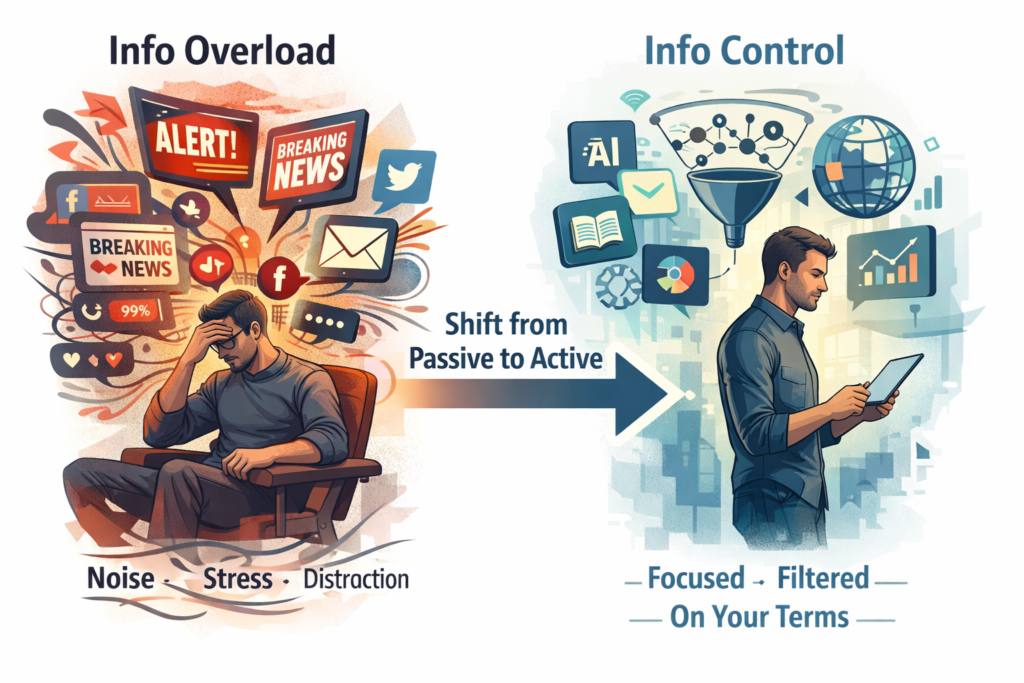
    Control of your information intake system using AI to filter news overload into clear, focused understanding

    The Belief

    Being informed means staying constantly updated with the news.

    The Break

    Constant exposure to information does not produce understanding.

    It produces noise, emotional fatigue, and reactive thinking.

    System Breakdown

    Information today is not delivered as neutral signal.

    It is processed through systems designed for:

    • Attention capture
    • Emotional activation
    • Continuous engagement

    This creates a shift:

    • Signal → Noise
    • Awareness → Reactivity
    • Understanding → Fragmentation

    The human mind, when left unfiltered, becomes a passive endpoint in a high-noise signal network.

    Personal Evidence

    There was a time when news arrived at intervals—delivered, processed, discussed.

    Now it is continuous.

    I chose to step out of that loop—not to disconnect, but to control my information intake system and decide when and how I engage.

    Reframe

    Information is not something you consume.

    It is something you regulate.

    Being informed is not about volume.

    It is about timing, context, and clarity.

    System Insight

    A healthy information intake system behaves like a regulated system:

    • On-demand, not constant
    • Context-rich, not fragmented
    • User-controlled, not algorithm-driven

    Without this, external systems define:

    • what you see
    • when you see it
    • how you feel about it

    Application

    To regain control of your information intake:

    • Shift from passive to active intake
      Ask for information when you need it—don’t absorb it continuously.
    • Add context before reaction
      Historical and structural understanding reduces emotional distortion.
    • Use tools that remove noise
      AI can aggregate, compare, and filter information without ads or manipulation.
    • Control timing
      Choose when to engage with heavy topics instead of letting them interrupt your state.

    AI Layer (System Extension)

    AI introduces a different model of information access:

    • Multi-source aggregation
    • Reduced emotional framing
    • Customizable output (data, summaries, analysis)

    Used correctly, AI becomes:

    A controlled interface to global information—not a replacement for thinking.

    Key Insights

    • More information does not equal better understanding
    • Unfiltered input increases emotional volatility
    • Control of information intake improves clarity and decision-making
    • AI enables structured, user-defined information flow
    • Awareness is built through intentional engagement, not constant exposure

    Internal System Links

    • Cognitive Load & Noise Systems → /cognitive-load-noise-systems
    • AI as a Filtering Layer → /ai-filtering-layer
    • Decision Systems Under Pressure → /decision-systems-pressure
    • Human Systems: Input → Processing → Output → /human-systems-core

    Final Thought

    You are not required to absorb everything that happens in the world.

    You are responsible for how you process what you choose to engage with.

    That is where clarity begins.

  • System Misalignment: You’re Not Bad at the Game — You’re in the Wrong System

    Opening

    System misalignment happens when your strengths don’t match what your environment rewards. Most people don’t realize they’re in the wrong system—they assume they’re the problem.

    Growing up in a sports-obsessed small town meant one thing: your value was measured in performance.

    If you could throw, catch, or score—you mattered.

    If you couldn’t, you adapted… or disappeared.


    Break the Assumption

    We’re taught early that struggle in a system means personal failure.

    But that assumption is flawed.

    Struggling inside a system often says more about the system than the individual.


    System Breakdown

    Human environments tend to operate on narrow success criteria:

    • One dominant skill set (sports, academics, social charisma)
    • One visible hierarchy (winners vs. non-performers)
    • One shared definition of value

    In small, closed systems:

    • Feedback loops are tight
    • Labels stick early
    • Identity becomes assigned, not discovered

    If your strengths don’t match the system’s reward structure:

    • You’re seen as underperforming
    • You self-identify as “less capable”
    • You adapt through avoidance, masking, or disengagement

    The system doesn’t expand.

    You shrink to fit—or step out.


    Personal Evidence

    In school sports, survival meant staying out of the way.

    Dodgeball wasn’t competition—it was risk management.

    So I optimized for safety.

    Later, in the military, that same pattern translated differently:

    • awareness became situational control
    • avoidance became strategy
    • observation became performance

    Same person.

    Different system.

    Different outcome.


    Reframe

    Skills are not absolute.

    They are context-dependent expressions of capability.

    What looks like weakness in one system may be:

    • efficiency in another
    • intelligence in another
    • specialization in another

    System Insight

    Misalignment creates false negatives.

    When a system only measures one type of output:

    • it mislabels unused capability as deficiency
    • it rewards conformity over adaptability
    • it suppresses alternative strengths

    Over time, this produces:

    • misplaced confidence in some
    • unnecessary self-doubt in others

    This is how system misalignment creates false negatives.


    Application

    Instead of asking:

    “Why am I not good at this?”

    Ask:

    “What does this system actually reward?”

    Then evaluate:

    1. Stay and adapt
      Learn the rules if the outcome matters.
    2. Redefine your role
      Use the system differently (observer, strategist, builder).
    3. Exit and reposition
      Find or build environments aligned with your strengths.

    Once you recognize system misalignment, your decisions become clearer.


    Key Insights

    • Systems define value before individuals express it
    • Struggle often signals misalignment, not inability
    • Strength is revealed through context, not effort alone
    • Adaptation is intelligence, not avoidance
    • You don’t need to win the wrong game to succeed

    Closing

    You might not fit the system you were placed in.

    That doesn’t mean you’re losing.

    It means you haven’t found—or built—your real game yet.