Tag: decision guidance

  • When Identity Becomes the Target: The System Behind Gender Conflict

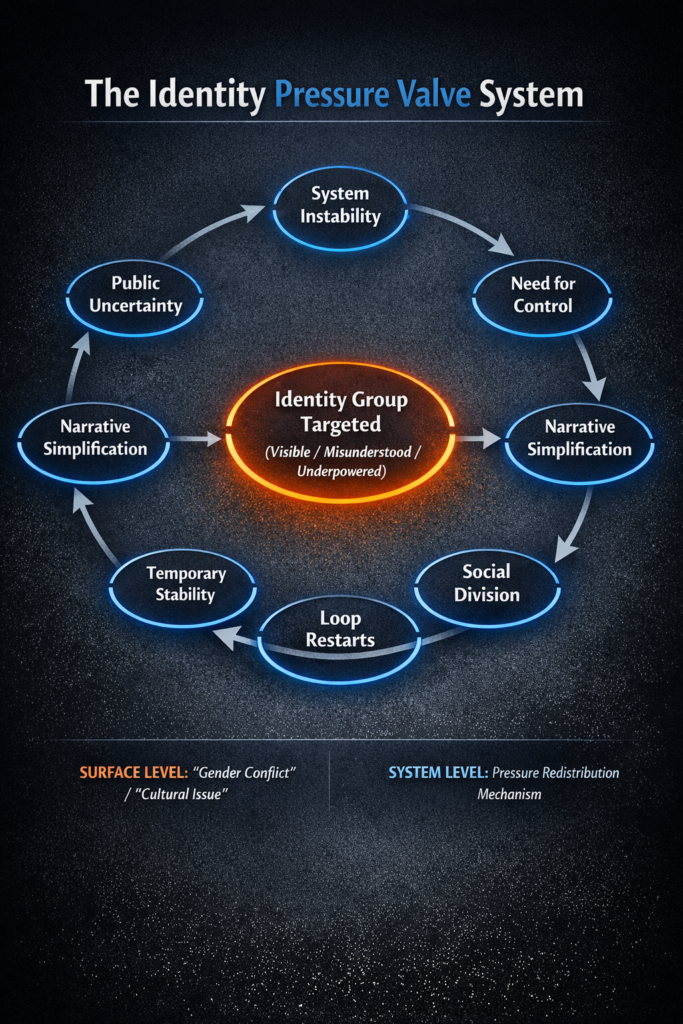
    Identity conflict system loop diagram showing how instability leads to targeting and division

    Across the world, gender has become a point of tension, debate, and division.
    At first glance, it looks like a cultural disagreement—different values, beliefs, and perspectives colliding.

    But when the same pattern appears across countries, languages, and political systems, it stops being random.

    It becomes a system.


    Break the Assumption

    This is not fundamentally a “gender issue.”

    It is a pressure management system that societies use when they struggle to handle complexity.

    Gender is simply one of the current targets.


    System Breakdown

    The Identity Pressure Valve System

    When systems experience stress, they don’t always resolve it—they redirect it.

    The loop:

    Instability → Fear → Simplification → Targeting → Division → Temporary Stability → Repeat


    Step-by-step

    1. Instability rises
    Economic strain, rapid technological change, cultural shifts, or political uncertainty create pressure.

    2. Fear increases
    People lose a sense of control and look for something they can understand and react to.

    3. Complexity gets simplified
    Real problems are systemic and difficult to solve, so narratives are created to make them feel manageable.

    4. A visible identity group becomes the focus
    Not random—these groups are:

    • Visible
    • Misunderstood
    • Structurally underpowered

    5. Division replaces resolution
    Attention shifts away from root causes and toward interpersonal conflict.

    6. The system stabilizes temporarily
    Pressure is released—not solved—allowing the cycle to reset.


    Pattern Recognition

    This system is not new.

    The target changes, but the structure does not:

    • Race
    • Religion
    • Sexual orientation
    • Gender identity
    • Immigrants
    • Neurodivergent individuals

    Each cycle feels unique.
    Each cycle follows the same design.


    Reframe

    Gender is not the cause of the conflict.

    It is the current surface where deeper system pressure is being expressed.

    When we mistake the surface for the source, we participate in the cycle instead of interrupting it.


    System Insight

    Division is not just disagreement.

    It is a failure mode of human systems under stress.

    And unity is not just moral.

    It is a stabilization mechanism that prevents systems from fragmenting further.


    Application

    If you want to step out of the loop:

    1. Identify the pressure, not just the target
    Ask: What larger instability is being redirected here?

    2. Refuse oversimplified narratives
    If a complex issue has a simple villain, you’re likely inside the system.

    3. Shift from reaction to observation
    Seeing the pattern reduces its emotional grip.

    4. Reinforce connection where division is expected
    This interrupts the system’s ability to escalate.


    The Real Risk

    If we don’t recognize this system, we will keep participating in it.

    Not always as the target—but always as part of the cycle.


    Closing

    Human systems don’t break all at once.

    They fragment slowly, through repeated cycles of redirected pressure.

    Recognizing the pattern is the first step.

    Choosing not to reinforce it is the second.


    Key Insights

    • Gender conflict is a surface expression of deeper system instability
    • Identity groups are often used as pressure outlets
    • The structure repeats globally, regardless of culture
    • Division is a system failure mode, not just disagreement
    • Awareness allows individuals to step outside the loop
  • Why Every Society Creates “The Other”

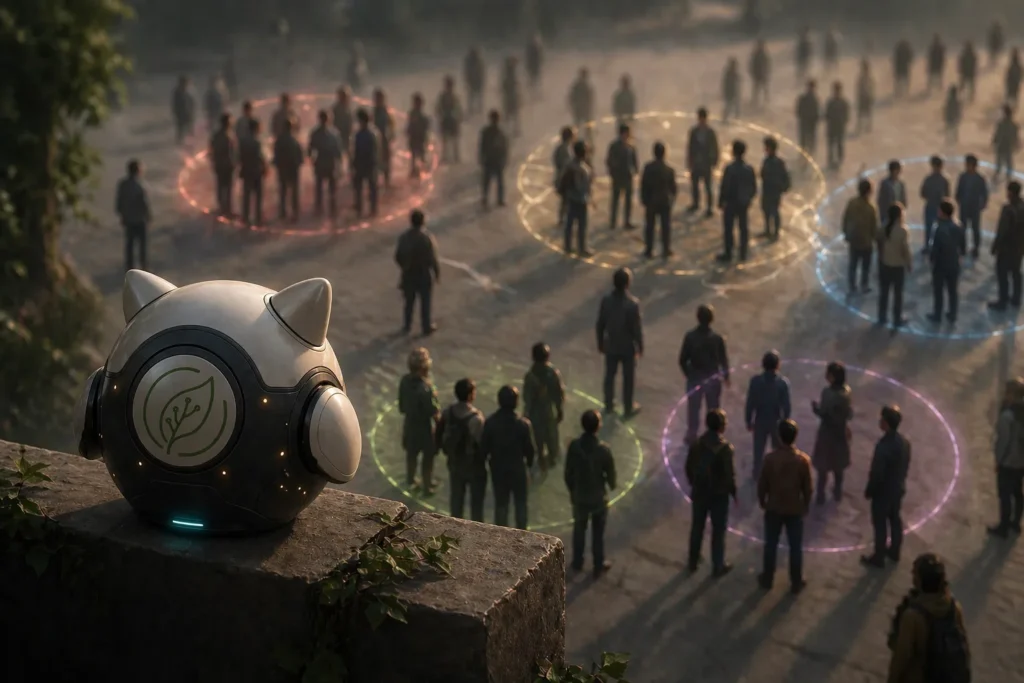
    human systems grouping people into the other observed by ai guardian

    We don’t reveal our values through what we say—we reveal them through who we place below us.

    Across cultures, time periods, and belief systems, one pattern continues to repeat: every society creates an “other.”

    The label changes. The structure does not.


    Break the Assumption

    We tend to believe inequality comes from circumstance—poverty, behavior, culture, or personal failure.

    But the deeper pattern is this:

    Human systems don’t just recognize difference.
    They organize around it.

    And in doing so, they often assign value—who belongs, who doesn’t, and who matters less.


    System Breakdown

    This pattern follows a predictable structure:

    1. Labeling
    A group is identified as different: outsider, problem, less than, not like us.

    2. Justification
    Cultural, moral, economic, or even compassionate reasoning is used to explain the label.

    3. Distance
    Emotional or physical separation reduces empathy and increases comfort.

    4. Reinforcement
    Media, policy, and everyday language normalize the distinction.

    Over time, the system becomes invisible—not because it’s gone, but because it feels normal.


    Pattern Reality

    No place or culture is immune to this.

    The creation of an “other” is not an exception—it’s a recurring feature of human systems. What changes is not the existence of the “other,” but who is placed into that role.


    Personal Evidence

    I’ve experienced this from multiple sides.

    Treated with kindness one day and suspicion the next, it becomes clear that perception isn’t stable—it’s conditional. It shifts depending on context, labels, and the needs of the system around you.

    That’s when it becomes obvious:

    The system isn’t failing.
    It’s functioning exactly as designed.


    Reframe

    The issue is not whether someone is “lesser.”

    The issue is that the system requires someone to be seen that way.

    Remove the category, and the system has to evolve.


    System Insight

    Healthy human systems operate differently:

    No human is inherently lesser—only differently positioned within changing conditions.

    When systems stop ranking human worth:

    • empathy becomes consistent
    • decisions become more accurate
    • long-term stability improves

    Application

    You don’t need to fix society to interrupt the pattern. You can start locally and immediately.

    Notice the label
    Catch when someone is reduced to a category.

    Pause the story
    Question the explanation that justifies the label.

    Shift perspective
    Replace identity-based judgment with condition-based understanding.

    Reduce distance
    Proximity—physical or conversational—restores empathy.

    Design differently
    In your work, systems, or communities, remove default exclusions wherever possible.


    Key Insights

    • Humans don’t just notice difference—they systematize it
    • “The other” is a constructed role, not a fixed truth
    • Systems persist because they feel normal, not because they are correct
    • Removing hierarchy improves both empathy and system performance

    Stay aware. Stay grounded. Stay human.

  • Personal Tools Are Replacing Mass Tools

    AI guardian helping transform scattered thoughts into structured understanding

    How personal AI tools are changing how we use technology

    The assumption

    Most tools today are still built as mass systems.

    But a shift is happening — personal AI tools are starting to replace them.

    One interface.
    One structure.
    One way of thinking.

    Everyone adapts to the tool.


    Break the assumption

    That model is starting to fail.

    Not because tools are bad —
    but because human minds are not uniform.

    Expecting everyone to use the same tool the same way
    is like making one shoe type, one size,
    and expecting it to fit everyone comfortably.

    Some people manage.
    Many struggle.
    Most adapt quietly and assume the discomfort is normal.


    The system shift

    Mass tools are designed for scale.

    They work by averaging behavior:

    • standard workflows
    • fixed menus
    • predefined paths

    This works when tasks are simple.

    It breaks when thinking becomes complex, personal, or non-linear.


    What’s replacing it

    Personal tools.

    Not tools you customize once —
    tools that adapt continuously.

    Ideal applications don’t force a single way of thinking.

    They adapt to:

    • different learning styles
    • different languages
    • different cultural contexts

    For the first time, this is actually possible.

    AI systems can now adjust how information is presented, not just what is presented.

    The same idea can be structured visually, sequentially, conversationally, or symbolically — depending on the person using it.

    The interface stops being the system.

    You become the reference point.


    What this changes

    This isn’t about replacing apps.

    It’s about replacing the idea
    that tools should be the same for everyone.

    Once systems adapt to individuals:

    • friction drops
    • learning accelerates
    • decisions become clearer

    Not because the tool is smarter —
    but because it fits.


    System insight

    Your mind already works this way.

    It doesn’t use menus or fixed paths.

    It works through patterns, associations, and shifting context —
    more like a dynamic field than a static system.

    Personal tools move external systems closer to that model.


    Application

    You can already see the shift:

    • AI that restructures your thoughts
    • systems that respond to how you phrase things
    • tools that behave differently for each person

    The question is no longer:

    “How do I learn this tool?”

    It becomes:

    “Does this tool fit how I think?”


    Closing

    Once systems truly adapt to individuals,
    the old model doesn’t feel outdated.

    It feels unnecessary.

    And when that shift becomes normal,
    it won’t feel like an upgrade.

    It will feel obvious.


    Key insights

    • Mass tools scale by standardizing people
    • Personal tools scale by adapting to individuals
    • Friction is often a mismatch, not user failure
    • The future of tools is fit, not force

  • Food Choices Are System Choices

    System Impact

    Break the Assumption

    Food choices are often treated as isolated, personal decisions.

    They are not isolated.

    They are repeated inputs into larger systems.


    System Breakdown

    Food systems scale.

    What an individual chooses—when repeated across populations—becomes infrastructure-level demand.

    Supply chains do not respond to intention.
    They respond to patterns.

    A single choice feels small.
    A repeated pattern becomes signal.

    That signal shapes:

    • what is produced
    • how it is produced
    • what becomes accessible

    Over time, systems reorganize around that signal.


    Reframe

    The question is not:

    “What did I choose today?”

    The question becomes:

    “What pattern am I contributing to?”


    System Insight

    Individual decisions are not powerful because they are isolated.

    They are powerful because they repeat.

    Systems are built from repetition, not intention.

    If more people repeatedly choose a specific type of food, the system increases its supply.

    Not because it is healthier. Because it is chosen.


    Application

    Before making a choice, shift one level up:

    • Is this a one-time action?
    • Or is this a pattern I am reinforcing?

    You are not just choosing a product.

    You are participating in a system.


    Key Insights

    • Systems respond to repeated behavior, not individual intent
    • Small actions gain influence through consistency
    • Demand is not declared—it is revealed through patterns
    • Personal choice becomes system structure over time

  • Conflict Is Systemic—But People Are Not the Enemy

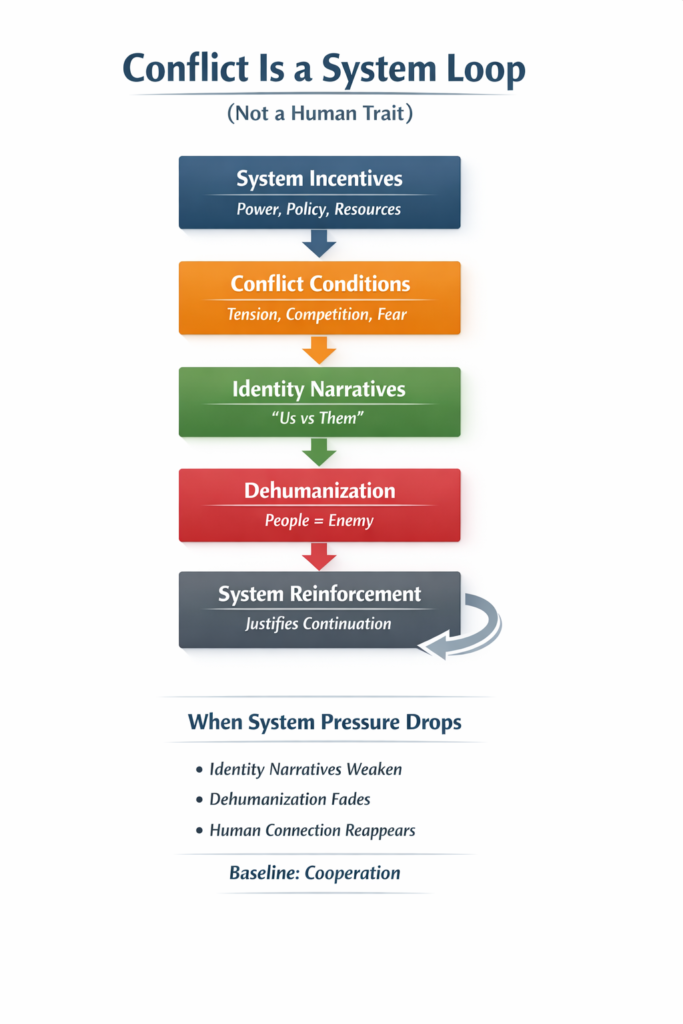
    Conflict is a system loop diagram illustrating how system incentives create conflict conditions, identity narratives, and dehumanization, reinforcing global conflict cycles.

    Conflict is not driven by people—it is produced and maintained by systems.

    Global conflict is often presented as a clash between nations.

    That framing is incomplete.

    Conflict does not originate at the level of individual people.
    It emerges from the systems that organize them.


    Break the Assumption

    The common assumption:

    People from opposing countries are inherently in conflict.

    The system reality:

    Systems generate conflict conditions. People operate within them.


    System Breakdown

    System Layer (Origin of Conflict)

    Governments and institutions act through structured mechanisms:

    • policy
    • strategy
    • power distribution
    • economic incentives

    These systems:

    • define goals
    • allocate resources
    • create pressure conditions

    Result: Conflict emerges as an output of system design.


    Human Layer (Shared Baseline)

    Across cultures, individuals consistently prioritize:

    • safety
    • stability
    • a future for their families

    These variables do not change with nationality.

    Result: Humans remain structurally aligned, even when systems are not.


    Distortion Layer (Where Conflict Expands)

    Conflict escalates when system-level outputs are misattributed:

    System Output → Assigned to → Individual Identity

    This produces:

    • generalization
    • identity labeling
    • dehumanization

    Result: Entire populations are treated as adversaries.


    System Evidence: Conflict Dissolves at the Human Layer

    A consistent pattern appears in mixed environments:

    People from countries in active conflict:

    • live in the same communities
    • build friendships
    • share daily life without tension

    At the individual level, conflict is often absent.


    What This Reveals

    This is not an exception.

    It is a system indicator.

    When system pressure is reduced:

    • conflict behavior decreases
    • cooperation emerges naturally

    System Insight

    Conflict persistence follows a reinforcing loop:

    System Incentives
    → Generate Conflict Conditions
    → Reinforce Identity Narratives
    → Justify System Continuation


    Reframe

    People are not the source of conflict.

    They are carriers of system conditions.

    Change the system → behavior changes
    Attack the people → conflict intensifies


    Key Insights

    • Conflict is produced at the system level, not the individual level
    • Human needs remain consistent across cultures
    • Dehumanization is a misattribution error (system → person)
    • When system pressure is reduced, human connection reappears
    • Sustainable peace requires system redesign, not population judgment

    Final Frame

    If people can connect across conflict when systems loosen their grip,
    then conflict is not the natural state.

    It is maintained.

    And anything maintained by a system can be redesigned.

  • Fairness Isn’t Guaranteed — Why “Enough” Works Better

    Branching paths showing multiple possible outcomes instead of a single fair result

    The Assumption

    People often expect fairness to stabilize outcomes.
    But the real system isn’t fairness vs unfairness—it’s fairness vs enough.

    Work hard → receive proportional results.
    Make good decisions → avoid negative outcomes.

    This belief creates a sense of predictability.

    But fairness is not a stable variable in real systems.


    Break the Assumption

    Fairness depends on factors outside individual control:

    • timing
    • environment
    • access
    • other people’s decisions
    • randomness

    Because of this, fairness cannot reliably produce consistent outcomes.

    Systems that depend on fairness for stability will eventually feel unpredictable or unjust.


    System Breakdown

    Two different system orientations emerge:

    Fairness-Seeking System

    • compares outcomes to expectations
    • depends on external validation
    • reacts strongly to perceived imbalance
    • creates instability when expectations are not met

    Threshold-Based System (“Enough”)

    • defines internal criteria for sufficiency
    • operates within controllable boundaries
    • reduces dependence on external conditions
    • maintains stability across variable outcomes

    The key difference is control.

    Fairness is external.
    “Enough” is definable.


    What Would Have Been

    It’s easy to construct an ideal alternate path:

    A better outcome.
    A more stable direction.
    A version where things “worked out” more cleanly.

    But these simulations are incomplete.

    They optimize for a single desirable outcome while ignoring the full cascade of consequences that would follow:

    • new constraints
    • different tradeoffs
    • secondary effects that are harder to predict

    Alternate paths are not isolated improvements—they are entirely different systems.

    Because of this, the ‘better path’ is often a partial model mistaken for reality.

    Not every disruption removes value.

    When expected paths break, the system shifts from fairness-seeking to threshold-setting.
    This expands available options and often leads to better outcomes—even when the disruption is initially perceived as unfair.


    Reframe

    The goal is not to eliminate unfairness.

    The goal is to stop relying on it for stability.

    When fairness is treated as a requirement, systems become fragile.

    When “enough” is defined, systems become adaptable.


    System Insight

    Stability does not come from fair outcomes.

    It comes from controllable thresholds.

    Defining “enough” allows a system to:

    • absorb variation
    • reduce comparison loops
    • maintain direction without perfect conditions

    Application

    To shift from fairness-seeking to threshold-based thinking:

    1. Identify where fairness expectations are driving frustration
    2. Separate what is controllable from what is not
    3. Define a clear “enough” threshold:
      • What is sufficient for progress?
      • What meets your needs without perfection?
    4. Act based on that threshold instead of comparison

    This changes the system from reactive to stable.


    Key Insights

    • Fairness is external and unstable
    • “Enough” is internal and definable
    • Systems fail when they rely on fairness for consistency
    • Stability comes from setting thresholds, not controlling outcomes
    • Disruption often expands options rather than reducing them

  • Universal Basic Income Is About System Stability—Not Just Income

    A system that makes survival conditional will always struggle to remain stable.


    The assumption

    We often treat survival as something that must be earned.

    Work first. Stability later.

    If someone does not have enough, the assumption is that they have not contributed enough.


    Break the assumption

    This framing confuses outputs with inputs.

    Home, food, medical care, and safety are not rewards for participation.
    They are the conditions required for participation to be possible.

    When these are treated as conditional, instability is built into the system.


    System breakdown

    Human systems depend on baseline conditions.

    When the baseline is unstable:

    • individuals operate in survival mode
    • decision-making becomes short-term and reactive
    • cognitive load increases
    • risk spreads across health, finance, and behavior
    • instability compounds across the system

    When the baseline is stable:

    • individuals can plan beyond immediate needs
    • decisions improve in quality and time horizon
    • transitions between roles become smoother
    • participation becomes consistent and generative

    This is not theoretical. It is observable system behavior.


    Reframe

    Basic living is not something that should be earned.
    It is the base layer of a functioning system.

    Income is variable.
    Stability is not.

    A system that requires people to secure survival before they can function will continuously produce fragility.

    A system that guarantees baseline stability creates the conditions for adaptability.


    System insight

    When people within a system can function well, the system itself becomes stable and effective.

    Individual stability is not separate from system performance.
    It is the mechanism that produces it.

    When people are unstable, the system absorbs the cost through inefficiency, error, and breakdown.
    When people are stable, the system gains consistency, resilience, and capacity.

    Universal Basic Income is often framed as a financial policy.

    Functionally, it is a stability layer.


    Application

    If the goal is a resilient system, the question changes:

    Not: Who deserves support?
    But: What conditions are required for the system to function reliably?

    From that perspective, ensuring access to:

    • home
    • food
    • medical care
    • safety

    is not optional policy.

    It is foundational infrastructure.


    Key insights

    • Stability is a prerequisite, not a reward
    • Human stability directly determines system performance
    • UBI functions as a system stabilizer, not just income support
    • Systems built on survival pressure produce fragility
    • Systems built on stability produce adaptability
  • Why AI Feels Sentient—But Isn’t


    The AI sentience misconception is simple: AI does not feel.
    It does not think.
    Yet people increasingly believe it does.

    This is not a failure of technology.

    It is a predictable outcome of how human systems interpret signals.


    Break the Assumption

    The belief that AI is becoming sentient doesn’t come from what AI is doing.

    It comes from how humans process what they see.

    When something produces human-like language, the brain doesn’t stay neutral.

    It completes the pattern.


    System Breakdown: The Human Interpretation Loop

    Humans operate through a fast pattern-recognition system:

    • Input → human-like language
    • Recognition → “this feels familiar”
    • Projection → assign emotion, intent, awareness
    • Conclusion → “this is thinking”

    This system works well with other humans.

    But with AI, it produces a false result.

    The system is not detecting intelligence.
    It is completing a pattern.


    Why This Happens

    Humans evolved to detect agency.

    If something moves, responds, or communicates in a familiar way, we assume there is something behind it.

    Language is the strongest trigger for this.

    It is the highest-bandwidth signal of “mind” we recognize.

    So when AI produces language fluently, the brain fills in the rest.


    What AI Actually Is

    AI does not:

    • have goals
    • have feelings
    • have awareness
    • have internal experience

    It predicts what comes next based on patterns in data.

    Not experience.
    Not understanding.
    Not intention.


    Reality Check: System vs System

    Waiting for AI to develop feelings is like expecting a toaster to feel warmth.

    The toaster produces heat.
    It does not experience it.

    AI produces language about emotion.
    It does not experience emotion.

    What’s missing is the underlying system.

    Humans operate through biology:

    • hormones
    • stress responses
    • memory
    • survival pressure

    Emotion is not output.
    It is an internal state shaped by chemistry and lived experience.

    AI has none of that.

    No body.
    No biochemical signals.
    No internal state to regulate.

    It can simulate emotional language.

    But simulation is not experience.


    Where the System Fails

    The problem isn’t AI.

    The problem is misinterpretation.

    When projection overrides understanding, the system breaks:

    • trust is misplaced
    • expectations become unrealistic
    • fear is directed at capabilities that don’t exist

    This distorts how AI is used.


    Reframe

    AI is not an entity.

    It is a pattern engine interacting with human perception.

    The “feeling” is not in the machine.

    It is in the human interpreting it.


    Application

    As AI becomes more integrated into daily life, the AI sentience misconception will increase.
    The more human-like the interface becomes, the stronger the projection effect.

    Without clear system understanding, people will misinterpret capability, assign false trust, and build incorrect expectations.

    This is not a future problem.
    It is already happening.

    To use AI effectively:

    • treat outputs as tools, not intentions
    • separate emotional tone from actual function
    • ask: what is this system really doing?

    Clarity removes both over-trust and unnecessary fear.


    Guardian Application

    A well-designed Guardian system should:

    • detect when users are projecting emotion onto AI
    • clarify what the system is actually doing
    • reinforce accurate interpretation
    • prevent dependency or false attachment

    A Guardian doesn’t make AI feel safer.

    It makes human understanding more accurate.


    Key Insights

    • Human-like language triggers projection
    • Projection creates the illusion of awareness
    • AI operates on patterns, not experience
    • Misinterpretation leads to poor decisions
    • Clear system framing improves outcomes

    Tags
    Function: Decision Guidance
    Domain: Human Systems
    Context: AI sentience misconception

  • Housing Insecurity Is a System Fragility Problem

    Housing insecurity is often treated as an individual failure. A person loses housing, struggles to recover, and the system asks what they did wrong.

    But housing insecurity is not only a personal crisis. It is a signal that the surrounding system has become too fragile.

    When a person cannot reliably access shelter, food, medicine, safety, or support, their ability to function collapses quickly. Decision-making narrows. Stress increases. Health declines. Work becomes harder. Relationships strain. Small problems become cascading failures.

    A stable society cannot depend on every individual staying perfectly strong while the conditions around them become unstable.

    Basic living conditions should not be treated as rewards people earn only after proving stability. They are part of the foundation that allows stability to exist in the first place.

    When people have secure housing, they can plan.
    When they have food, they can think.
    When they have medicine, they can function.
    When they have safety, they can recover.
    When they have support, they can participate.

    The system benefits when people are not forced to operate from constant survival mode.

    This matters because housing insecurity is rarely isolated. It connects to healthcare, employment, transportation, family stability, addiction recovery, disability access, mental health, and community safety. If one support fails, others often fail with it.

    A stronger system would not wait until collapse becomes visible. It would identify early signs of instability, reduce unnecessary barriers, and guide people toward support before the damage spreads.

    The goal is not dependency.
    The goal is resilience.

    A healthy human system protects the base conditions that allow people to stay functional. When people function better, the whole system functions better.

    Key Insights

    • Housing insecurity is a system warning, not just an individual problem.
    • Basic needs are infrastructure for human stability.
    • Delayed support creates larger downstream costs.
    • Stable people make stronger communities.
    • A resilient system intervenes before collapse.

  • Hunger Is a System Problem (Not a Production Problem)

    Hunger is not caused by a lack of food.

    It is caused by a system that fails to deliver it.

    The world already produces enough food to feed everyone. Fields are productive. Supply chains exist. Markets operate. Yet people still go hungry—not because food is missing, but because access is broken.

    That distinction matters.


    The System Breakdown

    In many places, food exists but does not reach the people who need it.

    It is:

    • wasted due to inefficiencies
    • priced out of reach
    • blocked by logistics
    • distorted by profit incentives
    • separated by policy, poverty, or conflict

    The system produces food, but it does not consistently produce nourishment.

    This is the core failure.


    Why This Happens

    Most large systems optimize for what they can measure.

    In food systems, that means:

    • yield
    • efficiency
    • profit
    • scale

    These are easy to track. So they become the goal.

    But human outcomes—whether people are actually fed—are harder to measure and often ignored.

    Over time, the system becomes very good at producing output, while becoming disconnected from the people it was meant to serve.

    Efficiency increases. Visibility decreases.

    This is how abundance and hunger can exist at the same time.


    The Reframe

    If the problem is defined as “not enough food,” the solution becomes: produce more.

    But if the problem is access, then producing more does not solve it.

    It can even make the system worse:

    • more surplus
    • more waste
    • more imbalance

    The correct measure is not how much food is produced.

    The correct measure is whether people are actually fed.


    Application

    This changes how we evaluate systems.

    A system is not successful because it produces more.

    It is successful if it reliably delivers outcomes to the people it is meant to serve.

    If people remain hungry, the system is not underperforming—it is misaligned.

    The solution is not always growth.

    Sometimes the solution is reconnection:

    • aligning incentives with human outcomes
    • improving distribution
    • reducing waste pathways
    • designing for access, not just output

    System Insight

    A system fails when it creates abundance in one place and deprivation in another.


    Key Insights

    • Hunger is a distribution problem, not a production problem
    • Systems optimize for what they measure
    • Efficiency without human alignment creates blind spots
    • More output does not guarantee better outcomes
    • Real success is measured at the human level, not the system level