Tag: decision guidance

  • Revenge Feels Like Justice. Systems Show Otherwise.

    Why Revenge Doesn’t Resolve Harm

    The Belief

    Revenge is often framed as a path to justice. Revenge doesn’t resolve harm.
    It feels like justice in the moment, but at a systems level, it extends the very damage it aims to correct.

    Break the Assumption

    In practice, revenge doesn’t resolve harm.
    It extends it.

    The goal is not to expose yourself to harm again,
    but also not to continue the cycle through retaliation.

    What’s often called “justice” rarely creates internal resolution.
    It tends to carry the same disturbance forward rather than close it.

    System Breakdown

    Revenge operates as a closed loop:

    harm → response → escalation → more harm

    No step in this loop is designed to end it.

    Each step feels justified in isolation.
    But the system doesn’t evaluate moments. It evaluates patterns.

    And the pattern is predictable.

    What’s Actually Happening

    Revenge is not resolution.
    It is energy transfer without absorption.

    No part of the system is designed to stop the loop.
    Only to continue it.

    Reframe

    Justice stabilizes systems.
    Revenge destabilizes them.

    One interrupts the loop.
    The other feeds it.

    System Insight

    Any system that rewards retaliation will produce continuous conflict, not closure.

    This applies at every scale:

    • Individuals
    • Relationships
    • Institutions
    • Nations

    Application

    When harm occurs, the critical question is not:

    “What response feels justified?”

    It is:

    “What action stops the loop?”

    That shift changes outcomes.

    Key Insights

    • Revenge feels correct locally but fails systemically
    • Harm loops persist without interruption mechanisms
    • Justice is defined by stabilization, not emotional satisfaction
    • Systems reflect what they reward

  • Mass Incarceration Is a System Design Problem (Not a Crime Problem)

    Mass incarceration is often framed as a justice solution—but from a human systems perspective, it is a system design problem.

    The United States has one of the highest incarceration rates in the world, yet repeat offenses remain common. From a human systems perspective, this signals something important: the system may not be reducing harm—it may be reproducing it.

    What became clear inside the system was this:

    Prisons don’t just contain behavior.
    They produce it.

    The way people are treated inside a system becomes the way they treat others.

    Not because they are told to—but because they are shown to.

    A system that relies on control, isolation, and dehumanization doesn’t create safer people. It conditions people to operate within those same patterns.

    Respect isn’t learned in environments where it isn’t practiced.
    Trust doesn’t form in systems built on distrust.

    And the contradiction becomes unavoidable:

    Systems that punish harm by practicing harm
    are not correcting behavior— they are reinforcing it.

    Incarceration and capital punishment often claim to teach the value of life, order, and responsibility.

    But when a system uses humiliation, control, or death as its tools,
    it teaches something else entirely:

    Do as I say, not as I do.

    Human systems don’t run on rules alone.
    They run on modeled behavior.

    When the system models harm, harm becomes the language people carry forward.

    Not because they choose it—but because it’s what they were trained to understand.

  • What Displacement Teaches About Survival and Systems

    At 16 years old, my great-grandfather Jakob had to make a decision that would define the rest of his life.

    He had to leave. Not for opportunity. For survival.

    The Situation

    Jakob was born near the Black Sea, in a region shaped by shifting borders and political control.

    For Germans living in that area during Stalin’s regime, the risk was real.

    Young men were often taken for forced labor or war.

    Leaving openly wasn’t an option.

    The Escape

    To leave, Jakob had to do it quietly.

    He sewed what he needed into his clothing and secured passage without drawing attention.

    If he had been discovered trying to escape, he could have been killed.

    At 16, he left everything behind. His home. His family.

    And the certainty that he would never see them again.

    What That Means

    This wasn’t just a journey.

    It was a forced break from everything familiar.

    A survival decision.

    Starting Again

    Jakob eventually made his way to North Dakota. A new place. A new life. But not a clean start.

    Because leaving doesn’t erase what came before.

    The Pattern

    Jakob’s story isn’t unique.

    It reflects a pattern seen across history:

    When systems become unstable or dangerous, people move. Not because they want to. Because they have to.

    Why This Matters Now

    That pattern still exists.

    Across different regions, people continue to face displacement due to conflict and instability.

    The details change. The pattern doesn’t.

    Human Systems Update: Displacement Is a System Failure Before It Is a Personal Story

    Displacement is often described as a personal tragedy, but it usually begins as a system failure.

    People do not leave stable homes, familiar languages, family networks, and inherited places because movement is easy. They leave when the system around them no longer protects basic survival. War, political pressure, economic collapse, persecution, and unstable governance can turn ordinary life into a risk calculation.

    From the outside, displacement can look like movement. From the inside, it is often a forced decision made under pressure.

    A human system should help people stay rooted when staying is safe, and move safely when staying becomes dangerous. When systems fail, people are pushed into choices they did not freely design. They must rebuild identity, safety, work, language, and belonging while carrying the memory of what was lost.

    That is the human systems lesson:

    Survival behavior only makes sense when we understand the system pressure around it.

    Displaced people are not simply “migrants,” “refugees,” or “outsiders.” They are people responding to conditions that made ordinary life unstable. If we want better societies, we have to stop judging only the movement and start examining the systems that made movement necessary.

  • When Rituals Don’t Fit: A Different Way to See Neurodiversity

    Many social environments are built around rituals.

    Shared meals.
    Extended conversations.
    Structured gatherings.

    For many people, these create connection.

    For others, they create strain.

    A Different Experience

    As an autistic individual, I experience many of these rituals differently.

    What feels natural to some can feel overwhelming or exhausting to me.

    • crowded environments
    • extended social expectations
    • sensory overload

    These aren’t minor inconveniences.

    They can be genuinely difficult.

    The Mismatch

    The issue isn’t that rituals exist.

    It’s that they are often treated as universal.

    When someone doesn’t fit them, the assumption becomes:

    “They need to adapt.”

    But often, it’s the system that needs adjustment.

    What Rituals Actually Do

    Rituals serve a purpose:

    • create connection
    • provide structure
    • reinforce belonging

    That works well—when the system fits the person.

    When it doesn’t, the same structure can create exclusion.

    Cultural Perspective

    Living in different cultures made this clearer.

    In Japan, structure and expectation are precise.

    In Argentina, social rituals are extended and expressive.

    Both are valid.

    Both can also be overwhelming—depending on how you process the world.

    A Better Approach

    The goal shouldn’t be to remove rituals.

    It should be to make them more flexible.

    That might mean:

    • allowing variation in participation
    • reducing unnecessary pressure
    • creating multiple ways to engage

    This directly connects to how I think about human systems.

    Systems work best when they:

    • support different ways of participating
    • reduce unnecessary friction
    • adapt to people—not force conformity

    Because inclusion isn’t about adding people into a system.

    It’s about adjusting the system itself.

    System Application

    A healthier system does not require every person to participate in the same way.

    It asks better questions:

    • What function is this ritual supposed to serve?
    • Does this interaction actually create connection, or only signal conformity?
    • Who is being excluded by the default expectation?
    • Can the same social purpose be met through more than one path?

    This matters in schools, workplaces, families, healthcare, public services, and digital environments.

    When systems allow only one acceptable form of participation, they create unnecessary pressure. People may appear distant, resistant, rude, or disengaged when they are actually trying to manage sensory load, timing, uncertainty, or social translation.

    The problem is not always the person.

    Often, the problem is that the system has mistaken one communication style for the only valid one.

    Reframe

    Neurodiversity does not ask society to remove all structure.

    It asks society to stop confusing structure with sameness.

    Clear expectations can help. Predictable environments can help. Flexible participation can help. What harms people is not structure itself, but rigid structure that leaves no room for different nervous systems.

    A more mature human system recognizes that connection can happen through speech, silence, shared work, written communication, parallel presence, direct honesty, or quiet trust.

    Different does not mean disconnected.

    Different means the system needs more than one doorway.

    Key Insights

    • Social rituals are not universal human requirements.
    • Some rituals create connection, while others only enforce conformity.
    • Neurodivergent people are often misread when systems prioritize performance over function.
    • Flexible participation improves inclusion without lowering standards.
    • Human systems become stronger when they design for real nervous systems, not idealized social behavior.

  • When Systems Try to Change Who You Are

    There was a time in my life when I was told something fundamental about me needed to be fixed.

    Not adjusted.
    Not understood.

    Fixed.

    The System

    I was deeply involved in the LDS Church and trying to reconcile being both Mormon and gay.

    The solution presented to me was corrective therapy.

    It was framed as help.

    But in practice, it was something else.

    What Happened

    The methods used weren’t grounded in understanding.

    They were based on the assumption that something was wrong.

    I was guided through experiences that:

    • reduced my sense of self
    • introduced confusion instead of clarity
    • treated identity as a problem to solve

    At one point, a therapist suggested that my identity was the result of a lack of connection—and attempted to address it in ways that crossed boundaries.

    Looking back, it was not care.

    It was harm.

    The Pattern

    This isn’t limited to one organization.

    It’s a broader system pattern:

    When institutions define a narrow version of what is acceptable, anything outside of it becomes a target for correction.

    That’s where harm begins.

    This Isn’t Just the Past

    It would be easy to see this as something that used to happen.

    But it isn’t.

    We’re seeing renewed attempts to reintroduce these same ideas—often framed differently, but built on the same assumption: that identity can and should be corrected.

    In places like Colorado, there have been efforts to challenge protections and reopen space for these approaches again.

    The language changes.

    The pattern doesn’t.

    What I Saw Firsthand

    I spent two years inside a program called Evergreen.

    It functioned similarly to a 12-step model, built around the idea that something fundamental needed to be changed.

    We were called “strugglers.”

    The goal was resolution through correction.

    But something consistent happened.

    Over time, every person I knew in that program reached the same conclusion:

    There was nothing to fix.

    One by one, they left—not just the program, but the belief system around it—and chose to live aligned with who they actually were.

    Not because they were convinced otherwise.

    Because clarity replaced pressure.

    The Turning Point

    There came a point where the question shifted.

    Not:

    “How do I fix this?”

    But:

    “Why is this being treated as something broken?”

    That shift changed everything.

    What Became Clear

    There was nothing wrong with me.

    The system I was in couldn’t accommodate who I was.

    That’s a different problem.

    🔄 2026 Update

    This experience directly informs how I think about human systems.

    When systems attempt to override identity, they:

    • create harm
    • reduce autonomy
    • force people into roles that don’t fit

    Better systems should:

    • support variation
    • respect identity
    • adapt to people—not force people to adapt to them

    Key Insights

    • Harm often comes from systems, not individuals
    • Identity should not be treated as something to fix
    • Mismatch between person and system creates unnecessary suffering
    • Autonomy is essential for wellbeing

    Guardian Application

    A Guardian system could help detect when these patterns are re-emerging.

    Instead of reinforcing external definitions, it could:

    • recognize when environments are causing identity conflict
    • support the user without judgment or correction pressure
    • guide users toward safer, more aligned systems
    • reinforce autonomy during periods of external pressure

    The goal isn’t to define who someone should be.

    It’s to help them remain aligned with who they already are.

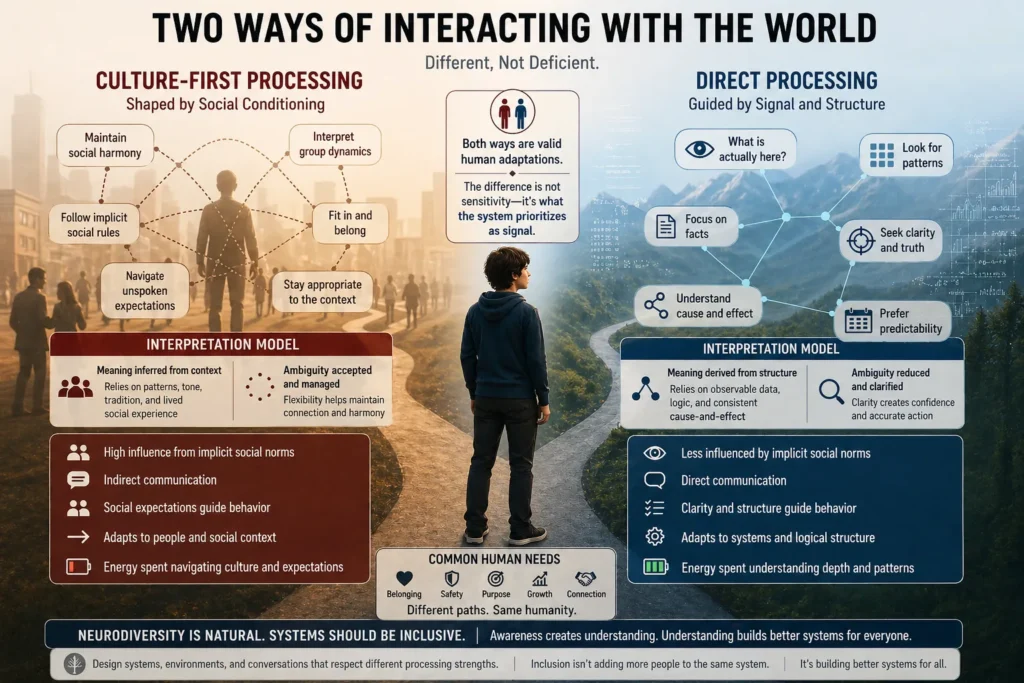
  • When “Normal” Isn’t Working: The System Behind Autism

    When ‘Normal’ Isn’t Working: Two Ways Humans Process the World

    Most conversations about autism begin with a quiet assumption:

    That there is a “normal” way to think, behave, and process the world—and anything outside of that needs to be corrected.

    That assumption is not neutral.

    It is a system decision.


    Break the Assumption

    “Normal” is not a universal truth.
    It reflects what a system has optimized for.

    When someone struggles inside that system, the conclusion is usually that something is wrong with the person.

    But often, the system itself is narrow.


    System Breakdown

    Most human environments—schools, workplaces, social structures—are built around:

    • fast verbal processing
    • indirect communication
    • tolerance for unpredictability
    • high social bandwidth

    These are not baseline human traits.
    They are preferences that systems have reinforced over time.

    Autistic cognition often operates differently:

    • pattern recognition over rapid response
    • direct communication over implied meaning
    • need for predictability over constant change
    • focused attention over distributed attention

    When these two patterns meet, friction appears.

    That friction is commonly labeled as dysfunction.

    In reality, it is system misalignment.


    Culture vs Direct Processing

    Many people are shaped heavily by cultural conditioning—unspoken rules, social expectations, and indirect signals.

    Autistic individuals are not unaffected by environment.

    They are affected differently.

    • less automatic adoption of implicit social norms
    • greater sensitivity to direct environmental signals
    • preference for clarity over interpretation

    This creates a different relationship with the world.

    Where many people are guided primarily by social expectations,
    autistic individuals are often guided more by structure, signal, and sensory reality.

    This can make cultural systems feel inefficient or unclear—not because the person is disconnected from reality, but because the system depends on shared assumptions that are not explicit.


    Reframe

    Autism is not simply a condition to be managed.

    It is a signal.

    It reveals where human systems rely too heavily on implicit agreement, indirect communication, and narrow definitions of “normal.”

    Instead of asking:

    “How do we make the person fit the system?”

    A better question is:

    “What does this interaction reveal about the system itself?”


    System Insight

    Autism does not remove environmental influence.

    It shifts which parts of the environment matter most.

    • less influence from social conditioning
    • more influence from direct input and structure

    When systems align with this mode of processing:

    • friction decreases
    • clarity increases
    • capability emerges naturally

    What looked like limitation often becomes strength.


    Application

    This changes how we design systems:

    • Education → multiple processing paths, not one correct method
    • Workplaces → reduce ambiguity, reward clarity
    • Technology → adaptive interfaces instead of fixed expectations

    At a personal level:

    Stop interpreting difference as failure.
    Start interpreting it as data about system fit.


    Key Insights

    • “Normal” is a system construct, not a universal truth
    • Autism reflects a different interaction with environment, not absence of it
    • Friction often comes from system mismatch, not individual deficit
    • Culture shapes behavior—but not all minds rely on it the same way
    • Better systems adapt to cognition instead of forcing conformity

  • When Protection Becomes a Barrier: Rethinking Patents and Progress

    Patents were designed with a clear purpose:

    To encourage innovation.

    By giving creators temporary protection, the system aimed to reward new ideas and share knowledge with the public.

    That idea made sense.

    But over time, something has shifted.

    The Trade-Off

    Patents create a balance:

    • protection for the creator
    • access for the public

    When that balance works, innovation grows.

    When it doesn’t, progress slows.

    Where It Breaks Down

    In some areas, patents have started to function less like protection—and more like barriers.

    Especially in fields where timing matters:

    • healthcare
    • energy
    • essential technologies

    In these cases, access isn’t just about convenience.

    It can affect:

    • quality of life
    • environmental outcomes
    • long-term stability

    The Pattern

    This isn’t unique to patents.

    It’s a common system pattern:

    A mechanism designed to help begins to overextend its role.

    Instead of supporting progress, it begins to limit it.

    A Different Approach

    The question isn’t whether patents are good or bad.

    It’s whether they are still aligned with their original purpose.

    In some cases, alternative models could improve outcomes:

    • shared access frameworks
    • time-limited exclusivity based on impact
    • open collaboration in critical sectors

    🔄 2026 Update

    This connects directly to how I think about human systems.

    Good systems:

    • maintain balance
    • adapt over time
    • prioritize outcomes over structure

    When a system stops serving its purpose, it needs adjustment—not preservation.

    Key Insights

    • Systems designed to help can become limiting over time
    • Balance between protection and access is critical
    • Timing matters in high-impact sectors
    • Systems should evolve with changing needs

    Guardian Application

    A Guardian system could:

    • help evaluate when systems are no longer aligned with their purpose
    • highlight trade-offs between protection and access
    • support decision-making around system reform
    • guide toward outcomes that benefit the broader population

    Tags

    • Domain: Human Systems
    • Function: Insight
    • Guardian: Decision Guidance

  • Dehumanization Detection: The Missing Layer in Human Systems

    The Belief

    If dehumanization becomes a problem, people will notice.

    The Break

    By the time it’s obvious, the system has already shifted.

    Dehumanization doesn’t begin with action.
    It begins with perception compression—subtle, gradual, and often socially reinforced.

    The System Pattern

    Human systems operate by simplifying complexity.

    That works—until people are included in the simplification.

    A predictable sequence emerges:

    • Individuals → grouped
    • Groups → simplified
    • Simplification → repeated
    • Repetition → normalized

    At that point, people are no longer perceived as individuals—
    but as categories.

    Detection Layer (What Most Systems Lack)

    Dehumanization is not hard to detect.
    It’s just rarely tracked early.

    There are consistent signals:

    Early Stage — Compression

    • “They always…”
    • “Those people…”

    Mid Stage — Reduction

    • humor based on flattening traits
    • loss of nuance in discussion

    Late Stage — Justification

    • “They deserve…”
    • “It’s necessary…”

    Final Stage — Alignment

    • support for exclusion or harm

    The pattern is stable across cultures and contexts.

    Why This Happens

    This behavior persists because it increases short-term efficiency:

    • lowers cognitive load
    • reduces emotional processing
    • simplifies decision-making

    But it creates long-term instability in human systems.

    The Reframe

    The key question is not:

    “Is this right or wrong?”

    It is:

    “Are we still perceiving people at full resolution?”

    This shifts focus from judgment → system state.

    System Insight

    Dehumanization is a resolution failure.

    When perception drops below a certain threshold:

    • empathy decreases
    • justification increases
    • escalation becomes easier

    This is not ideological.
    It is structural.

    Application

    Stable systems maintain human resolution under pressure.

    They:

    • resist group-level compression
    • preserve individual context
    • maintain empathy during disagreement

    Guardian Application

    A Guardian system can operate at the detection layer:

    • identify compression patterns in real time
    • track perception shifts (not beliefs)
    • introduce low-friction interruptions
    • restore individual-level perception

    Without:

    • moralizing
    • labeling
    • forcing agreement

    Key Insights

    • Dehumanization starts as perception compression
    • The pattern follows a predictable sequence
    • Most systems fail because they detect too late
    • Stability depends on maintaining human-level resolution

    Tags

    Function: Decision Guidance
    Domain: Human Systems
    Context: Dehumanization, detection systems, perception

  • What Real Progress Actually Looks Like

    There’s a lot of talk about “breakthroughs.”

    New technologies.
    Big promises.
    Visions of the future.

    But over time, I’ve learned something:

    Most real progress doesn’t feel dramatic.

    The Problem with “Breakthrough Thinking”

    We tend to focus on what sounds impressive:

    • new energy concepts
    • advanced vehicles
    • cutting-edge AI

    But many of these ideas are:

    • early-stage
    • overhyped
    • not yet useful in daily life

    That gap matters.

    Because people don’t live in concepts.

    They live in systems.

    What Actually Improves Life

    Real progress shows up differently.

    It looks like:

    • systems that are reliable
    • tools that reduce friction
    • environments that support people consistently

    Not flashy.

    But effective.

    A Personal Example

    One of the most meaningful experiences I’ve had with technology wasn’t about power or speed.

    It was about connection.

    I recreated a family cabin in virtual reality—a place we couldn’t physically return to.

    We:

    • played yard games
    • shared time
    • experienced something familiar again

    That wasn’t a breakthrough in technology.

    It was a breakthrough in experience.

    What That Revealed

    Technology matters most when it:

    • supports human connection
    • reduces distance
    • makes meaningful experiences accessible

    Not when it simply impresses.

    🔄 2026 Update

    This connects directly to how I think about human systems and XR.

    Progress should be measured by:

    • usefulness
    • reliability
    • impact on daily life

    Not by how advanced something appears.

    Good systems:

    • work consistently
    • support people under real conditions
    • improve experience over time

    Key Insights

    • Not all breakthroughs translate into real-world value
    • Systems matter more than individual innovations
    • Meaningful progress improves everyday experience
    • Technology should serve people—not just impress them

    Guardian Application

    A Guardian system could:

    • help users evaluate real usefulness vs hype
    • guide adoption of technology based on impact
    • reduce distraction from low-value innovation
    • support meaningful use of advanced tools

    Tags

    • Domain: Human Systems, AI
    • Function: Insight
    • Guardian: Decision Guidance

  • Honest History: Why We Need Multiple Perspectives to Understand the Past

    History is often presented as a finished story.

    Clean.
    Linear.
    Certain.

    But it isn’t.

    The Problem

    Most historical narratives come from limited viewpoints.

    Often:

    • those in power
    • those who recorded events
    • those whose perspective became dominant

    That doesn’t make them false.

    But it does make them incomplete.

    What Gets Lost

    When history is simplified into a single narrative, important context disappears:

    • indigenous perspectives
    • cultural understanding
    • environmental relationships
    • alternative interpretations of events

    Over time, this creates a distorted picture of what actually happened.

    A Better Approach

    Understanding history requires more than one source.

    It requires combining:

    • archaeology
    • written records
    • oral histories
    • cultural knowledge

    Each provides a different layer.

    Together, they create a more accurate picture.

    Staying Open

    New discoveries change what we know.

    That’s not a problem.

    It’s how understanding improves.

    History shouldn’t be treated as fixed.

    It should be treated as evolving.

    🔄 2026 Update

    This connects directly to how I think about human systems.

    When systems rely on a single narrative, they:

    • limit understanding
    • reinforce bias
    • reduce adaptability

    Better systems:

    • integrate multiple perspectives
    • update with new information
    • remain open to revision

    Because accuracy improves over time—not all at once.

    Key Insights

    • History is constructed from perspectives, not absolute truth
    • Multiple sources increase accuracy
    • New findings should refine understanding—not be resisted
    • Systems should support evolving knowledge

    Guardian Application

    A Guardian system could:

    • present multiple perspectives on historical events
    • highlight gaps or bias in narratives
    • integrate new findings over time
    • support critical thinking instead of fixed conclusions

    Tags

    • Domain: Human Systems
    • Function: Insight
    • Guardian: Decision Guidance