Tag: human systems

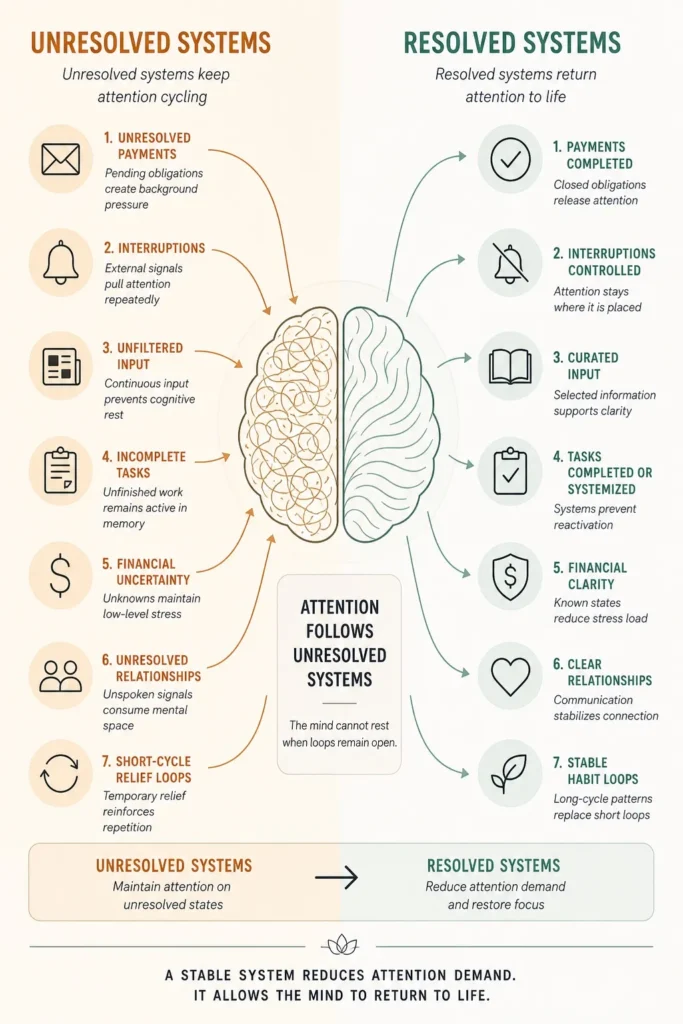
  • Secure People Build Better Systems

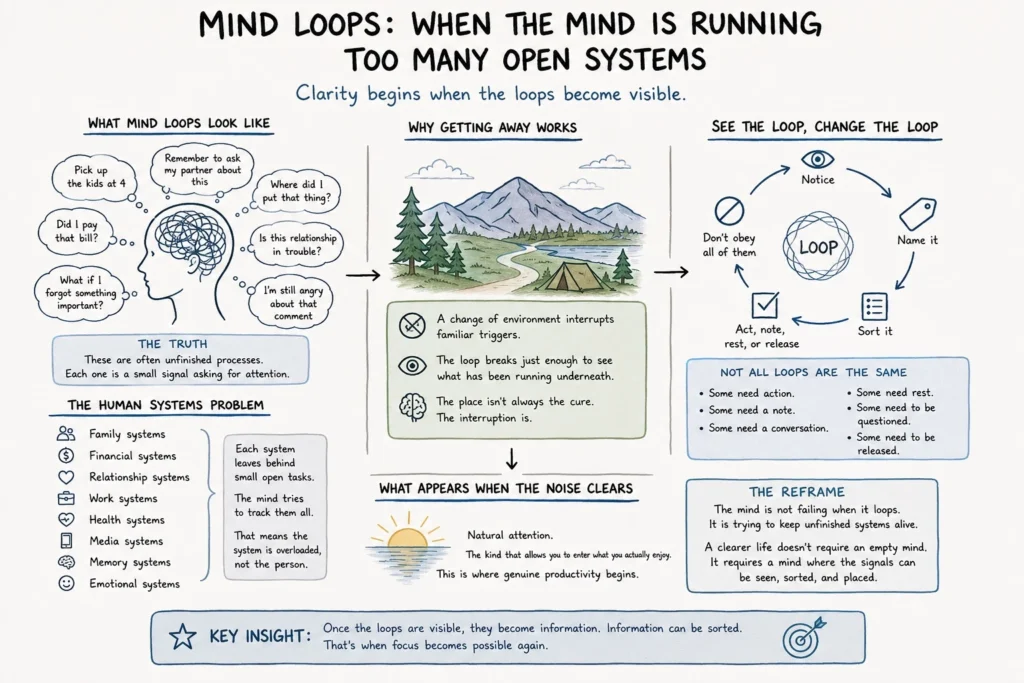
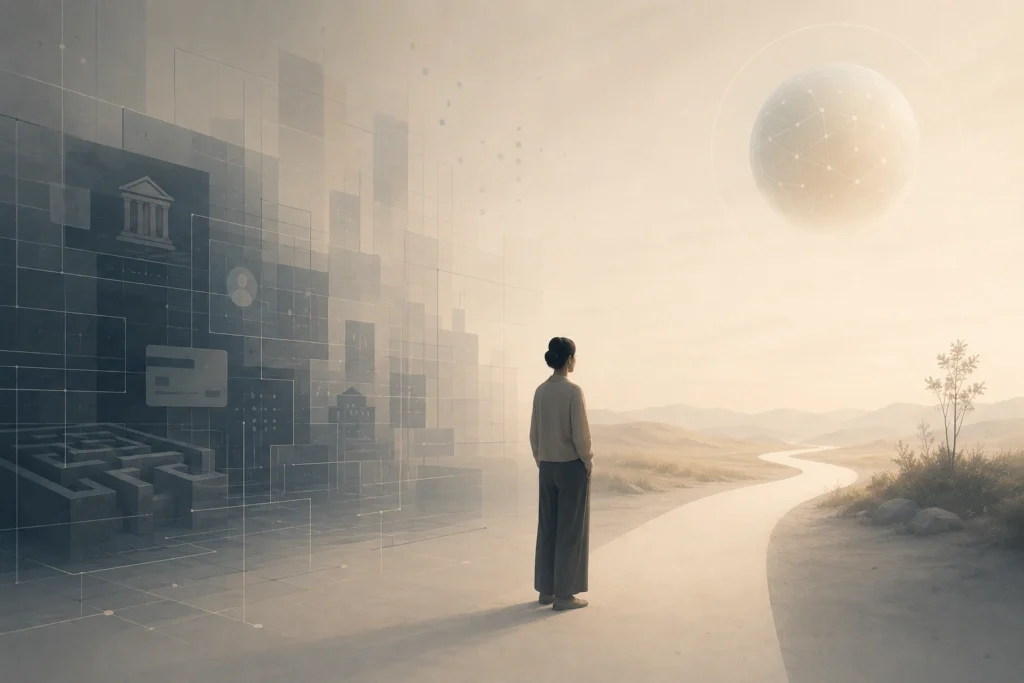
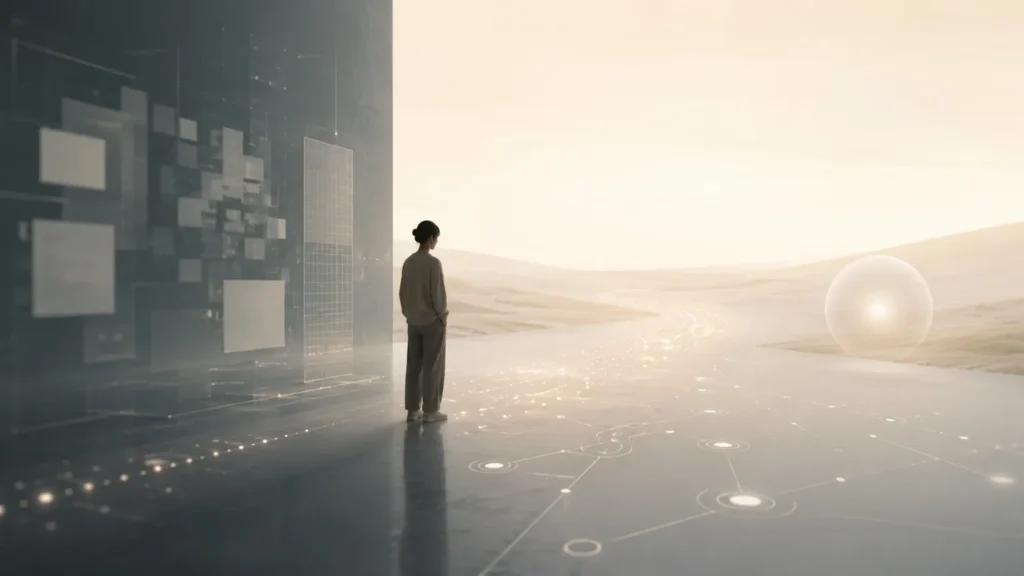
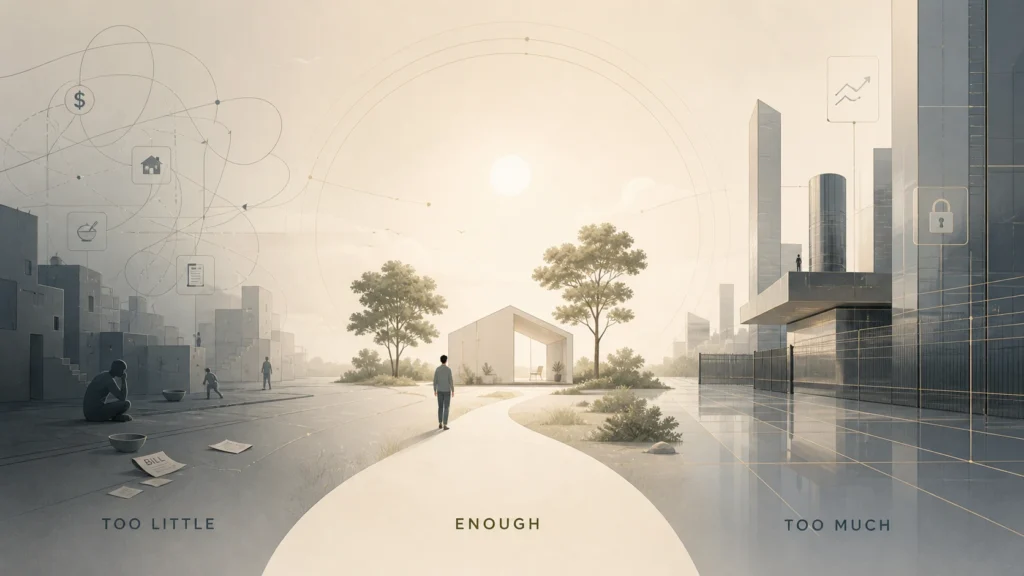
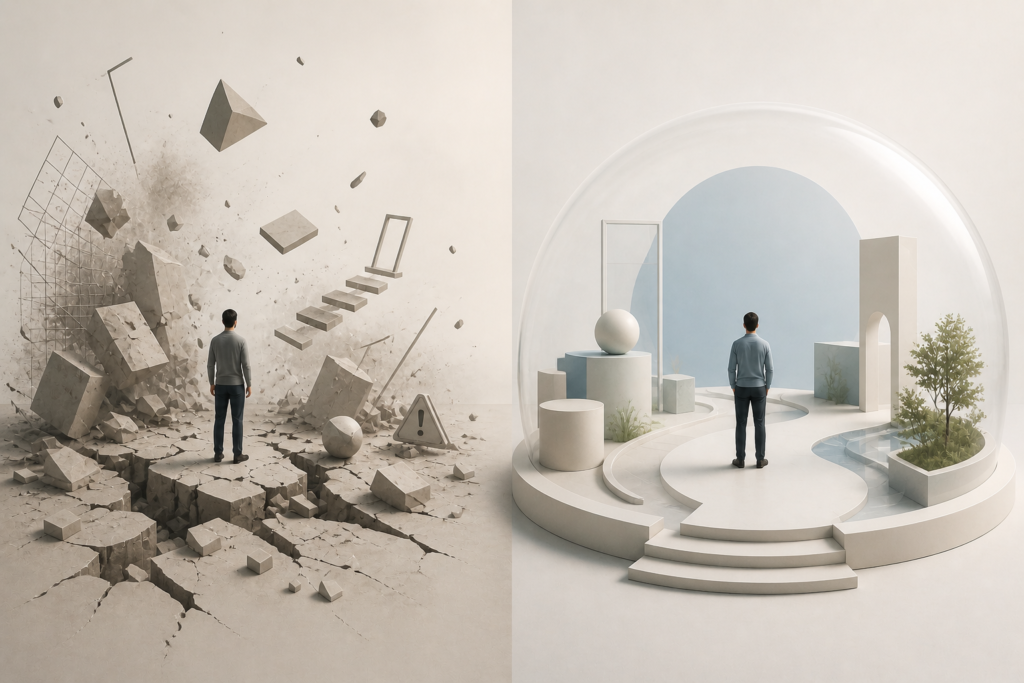
    A minimalist conceptual illustration comparing unstable and secure human systems. One person stands among fragmented structures and unclear paths, while another stands within a calm, balanced environment with clear pathways and stable support.

    Stable systems reduce threat and make better human capacity possible.

    The Belief

    Many systems still operate from a basic assumption:

    People perform better when they are pressured.

    This belief appears in workplaces, schools, immigration systems, healthcare systems, family systems, digital platforms, and even some AI design models.

    The logic sounds practical on the surface:

    • keep people uncertain so they stay alert
    • make resources conditional so they try harder
    • create competition so productivity rises
    • delay approval so people remain compliant
    • use pressure as motivation

    But this model confuses reaction with capacity.

    A threatened person may move quickly.
    A pressured person may obey.
    An insecure person may produce temporarily.

    But that does not mean the system is healthy.

    It usually means the system is extracting output from nervous-system instability.

    The Break

    Security is often treated as softness.

    That is a mistake.

    Security is not the absence of effort.
    Security is the condition that allows effort to become sustainable.

    When people know their basic needs are stable, their minds stop spending so much energy on threat detection. They can think farther ahead. They can collaborate more cleanly. They can make better decisions. They can recover from mistakes without collapsing into fear.

    A secure person has more usable intelligence available.

    An insecure person may still be intelligent, skilled, or motivated, but a larger part of their system is occupied by survival monitoring.

    This is why destabilizing systems often appear productive in the short term while slowly destroying the people inside them.

    System Breakdown

    A system can destabilize people without openly attacking them.

    It often happens through repeated environmental signals:

    Artificial scarcity

    Artificial scarcity makes people compete for resources that could have been made more stable.

    When time, money, approval, attention, housing, access, or status are made unnecessarily scarce, people are pushed into defensive behavior. They stop thinking as builders and begin thinking as survivors.

    Unclear rules

    Unclear rules make people dependent on interpretation.

    If expectations keep shifting, people cannot build confidence. They must constantly check whether they are still safe, still accepted, still approved, or still allowed to continue.

    This gives power to gatekeepers and weakens the person trying to function inside the system.

    Delayed approval

    Delayed approval keeps people suspended.

    A person waiting for an answer cannot fully move forward. Their body may remain physically present, but part of their mind is trapped in the pending decision.

    This does not create better performance. It creates drag.

    Conditional belonging

    Conditional belonging makes acceptance feel revocable.

    When people feel that one mistake, one disagreement, one identity, one need, or one moment of difference could remove them from the group, they spend energy managing perception instead of contributing honestly.

    Constant disruption

    Constant disruption prevents deep work.

    When systems repeatedly interrupt people, change expectations, add friction, or create avoidable uncertainty, they destroy the stable mental ground required for long-term creation.

    Disruption can sometimes reveal weakness in a system. But when disruption becomes the operating model, it becomes a control tactic.

    Personal Evidence

    I have seen this pattern in my own life.

    When systems became unstable, unclear, or threatening, my capacity did not disappear — but access to it became harder.

    The problem was not lack of intelligence, motivation, or willingness.

    The problem was that too much energy had to be spent recalibrating.

    When the system stabilized again, capacity returned quickly. Sometimes it returned with a spike of renewed focus, because the mind was no longer fighting the environment.

    That matters.

    It means many people who look inconsistent are not actually inconsistent. They may be responding logically to unstable conditions.

    A system that keeps destabilizing people and then judges them for the results is not measuring human potential. It is measuring damage.

    The Reframe

    The stronger system is not the one that keeps people under pressure.

    The stronger system is the one that makes people secure enough to use their full capacity.

    This applies across many environments:

    • A workplace does not improve by keeping employees afraid.
    • A school does not improve by making students feel disposable.
    • A healthcare system does not improve by forcing patients to fight for clarity.
    • An immigration system does not improve by trapping people in uncertainty.
    • A family does not improve by making love conditional.
    • An AI system does not improve by nudging people through fear, dependency, or confusion.

    Pressure can create movement.

    Security creates capability.

    Those are not the same thing.

    System Insight

    Healthy systems reduce unnecessary threat.

    They make basic expectations clear.
    They make access understandable.
    They reduce avoidable scarcity.
    They provide reliable feedback.
    They protect people from preventable chaos.
    They allow recovery after mistakes.
    They create enough stability for growth.

    This does not mean systems should remove all difficulty.

    Difficulty is part of learning and building.

    But there is a difference between challenge and destabilization.

    Challenge asks a person to grow.
    Destabilization forces a person to survive.

    Challenge can strengthen capacity.
    Destabilization consumes capacity.

    A healthy system knows the difference.

    Application to AI and XR Systems

    This principle matters deeply for AI and immersive environments.

    An AI system should not use insecurity as a control surface.

    It should not increase dependency by making the user feel incapable without it.
    It should not create emotional scarcity by positioning itself as the only reliable source of support.
    It should not push major decisions through urgency, fear, or artificial pressure.
    It should not personalize experiences by quietly exploiting vulnerability.

    A better AI system should help stabilize the user’s operating conditions.

    For an Empathium-style Guardian, this means:

    • clarify choices without taking control
    • reduce cognitive overload
    • support human connection instead of replacing it
    • help the user detect whether they are in a threat state
    • encourage recovery before major decisions
    • make system behavior transparent
    • protect autonomy even when the user is stressed
    • avoid using emotional instability as a growth mechanism

    In XR, this becomes even more important because the environment itself can influence perception, mood, attention, and decision-making.

    A system that controls the environment controls part of the human state.

    That power must be handled carefully.

    The goal should not be to make people easier to direct.

    The goal should be to make people secure enough to direct themselves.

    Where This Breaks in Real-World Decisions

    This pattern breaks systems everywhere.

    In healthcare, unclear access and delayed answers can make patients appear difficult when they are actually frightened and overloaded.

    In law and immigration, long periods of uncertainty can damage decision-making before a case is even resolved.

    In workplaces, artificial urgency can make people produce quickly while quietly reducing creativity, trust, and long-term performance.

    In relationships, conditional acceptance can train people to hide instead of connect.

    In AI systems, unstable emotional feedback can pull users into dependency loops where relief becomes confused with care.

    The shared pattern is simple:

    When people are made insecure, their behavior changes.

    If the system then punishes that changed behavior, it becomes self-justifying.

    That is how unhealthy systems protect themselves from accountability.

    The Better Design Rule

    A good system should ask:

    What human capacity becomes available when unnecessary threat is removed?

    That question changes the design.

    Instead of asking how to make people comply, the system asks how to make people capable.

    Instead of asking how to keep people engaged, it asks whether engagement is healthy.

    Instead of asking how to increase output, it asks what conditions allow meaningful output to continue.

    Instead of asking how to control behavior, it asks what support allows better self-direction.

    This is the difference between a control system and a human system.

    Key Insights

    • Pressure can create short-term movement, but security creates long-term capacity.
    • Artificial scarcity, unclear rules, delayed approval, conditional belonging, and constant disruption are common destabilizers.
    • People who appear inconsistent may be responding logically to unstable conditions.
    • Healthy systems distinguish challenge from destabilization.
    • AI and XR systems should stabilize human autonomy, not exploit insecurity.
    • The strongest systems are not the ones that control people best. They are the ones where people can function without being kept afraid.

    Closing

    Secure people do not become weak.

    They become available.

    Available to think.
    Available to build.
    Available to connect.
    Available to repair.
    Available to create.

    A system that understands this will always outperform a system built on fear, scarcity, and disruption.

    Not immediately.

    But sustainably.

    And sustainability is the real test of whether a system is healthy.

  • One Does Not Equal More: The Illusion of Human Ranking


    The idea that one person is more valuable than another feels normal in many human systems.

    We rank people by money, status, education, beauty, title, citizenship, productivity, popularity, religion, confidence, and social approval. Some people are treated as if they naturally count more. Others are treated as if they count less.

    But under logic, this idea breaks. One human does not become two humans because they have more status.

    One person does not become more real because they have more money.

    One life does not gain extra human units because society places a crown, uniform, title, follower count, or reputation around it.

    Human worth has no measurable unit that increases with status.

    One equals one. 1=1

    The False Math of Human Ranking

    A person can have more power than another person.

    A person can have more skill in a specific task.

    A person can hold more responsibility inside a system.

    A person can have more knowledge in a particular field.

    But none of that makes them more human.

    This is where many systems confuse function with worth.

    A doctor may know more about medicine than a patient.

    A judge may hold authority in a courtroom.

    A parent may have responsibility for a child.

    A teacher may guide a student.

    A leader may coordinate a group.

    Those roles matter. But roles are not proof of higher human value. They are functions inside a context.

    The failure begins when a system says:

    “This person has more function here, therefore this person is worth more.”

    That is the false step.

    Function can differ.

    Worth does not.

    How Systems Turn Difference Into Hierarchy

    Human systems often need roles. Roles help organize work, care, learning, safety, and responsibility. A society cannot function if every person does every task at the same time.

    The problem is not role.

    The problem is when role becomes rank.

    A useful system says:

    “This person has a specific responsibility in this context.”

    A harmful system says:

    “This person is above another person.”

    That small shift changes everything.

    Once people are placed above and below each other, the system begins to justify unequal listening, unequal protection, unequal dignity, and unequal care. The person at the top is treated as more credible. The person at the bottom is treated as more disposable.

    This is not logic.

    It is social storytelling.

    Where This Breaks in Real-World Decisions

    The belief that one human can be “more” than another does not stay abstract. Once a society accepts human ranking, that ranking starts shaping decisions.

    It shows up in healthcare when some lives are treated as more worth saving, listening to, or believing. A patient with money, fluency, status, or social approval may be taken more seriously than someone poor, disabled, foreign, autistic, elderly, or emotionally distressed.

    But the body does not become less real because the person has less status. Pain does not become less valid because the patient is harder to understand.

    It shows up in law when punishment is applied differently depending on class, race, citizenship, appearance, reputation, or perceived respectability. The same action can be interpreted as a mistake in one person and a character flaw in another.

    That is not justice.

    That is ranking disguised as judgment.

    It shows up in AI systems when human data is treated as if social patterns equal truth. If a system learns from a world that already ranks people unfairly, it may reproduce those rankings through hiring filters, credit scoring, policing tools, medical triage, recommendation systems, or automated risk labels.

    The machine does not need hatred to cause harm.

    It only needs inherited hierarchy treated as useful signal.

    It shows up in relationships when one person’s needs, emotions, time, or perspective are treated as naturally more important than another’s. A person may dominate because they are louder, more socially confident, more educated, more financially secure, or simply used to being centered.

    But a relationship based on human ranking is not connection.

    It is control with emotional decoration.

    The System Failure

    The logic collapses when systems stop asking:

    “What role does this person have here?”

    And start asking:

    “How much does this person count?”

    That question corrupts decision-making.

    It turns practical differences into moral hierarchy.

    It turns authority into superiority.

    It turns vulnerability into lower value.

    It turns social approval into evidence.

    This is how people become easier to dismiss. Not because they are less human, but because the system has created a story where their humanity is easier to ignore.

    A Better Human Systems Frame

    A healthier system can recognize difference without converting difference into hierarchy.

    It can say:

    A surgeon may be better at surgery than a child.

    But the surgeon is not more human than the child.

    A judge may hold authority in court.

    But the judge’s life is not worth more than the person standing before them.

    A teacher may know more about a subject.

    But the student does not become lesser.

    A leader may coordinate a group.

    But leadership is a function, not a higher species of person.

    This distinction matters.

    When systems remember it, they can assign responsibility without inflating human worth. They can make decisions without dehumanizing people. They can recognize skill, experience, context, and risk without pretending some people count more than others.

    Human Worth Is Not a Ranking System

    Human worth is not a scoreboard.

    It is not a market price.

    It is not a title.

    It is not a productivity score.

    It is not a popularity metric.

    It is not granted by institutions, religions, governments, employers, families, audiences, or algorithms.

    A person may gain power.

    A person may lose power.

    A person may gain status.

    A person may lose status.

    A person may become useful to a system.

    A person may become inconvenient to a system.

    But none of those changes the basic unit.

    One human remains one human.

    Why This Matters Now

    This matters because modern systems are becoming faster at ranking people.

    Platforms rank attention.

    Markets rank usefulness.

    Institutions rank compliance.

    AI systems rank risk, relevance, probability, and predicted value.

    Social systems rank belonging.

    Without a clear human principle underneath those systems, ranking becomes invisible. It starts to feel natural. People begin to confuse system position with human value.

    That is dangerous.

    A system can rank tasks.

    A system can rank urgency.

    A system can rank expertise in a specific context.

    But once a system starts ranking human worth, it has crossed into dehumanization.

    The Reframe

    The better frame is simple:

    People can differ in role, skill, need, power, responsibility, and context.

    But difference is not hierarchy.

    A humane system does not flatten everyone into sameness. It does not pretend everyone has the same abilities, responsibilities, or needs.

    Instead, it separates two things clearly:

    Function can differ. Worth does not.

    That one distinction protects human dignity while still allowing practical decision-making.

    It allows healthcare to assess medical need without dismissing difficult patients.

    It allows law to assess actions without ranking lives.

    It allows AI systems to support decisions without encoding inherited social bias as truth.

    It allows relationships to hold different needs without turning one person into the center and the other into support material.

    Key Insights

    • Human systems often confuse role with worth.
    • Status can increase power, but it does not increase human value.
    • Real-world harm appears when ranking shapes healthcare, law, AI systems, and relationships.
    • AI systems can reproduce hierarchy without intending harm if biased social patterns are treated as useful signal.
    • A humane system can recognize difference without converting difference into superiority.
    • The core distinction is: function can differ; worth does not.

    Final Thought

    One person may stand on a stage.

    One may sit in a waiting room.

    One may hold a title.

    One may hold nothing visible at all.

    But underneath every overlay, the unit remains the same.

    One does not equal more.

    One equals one.

  • Reality Isn’t Lost. It’s Outsourced

    A minimalist Human Systems diagram showing how reality outsourcing can occur when belief systems, authority structures, or repeated narratives stretch a person’s sense of what is real. The image represents the movement from direct evidence toward external influence, showing how judgment can become easier to shape when reality-testing is handed over to a trusted system.

    Reality Outsourcing and Human Judgment

    I used to believe in things that stretched reality far beyond the physical world.

    Talking animals.
    Men with supernatural strength.
    Walls collapsing from sound.

    At the time, it didn’t feel strange.
    It felt structured. Reinforced. Shared.

    But over time, I noticed something more important:

    It wasn’t the beliefs themselves that mattered.
    It was what they trained my mind to do.


    Break the Assumption

    We often assume belief systems are about truth vs falsehood.

    They’re not.

    They are training environments for how reality is processed.

    And once that processing changes, the system doesn’t stop.

    It transfers.


    System Breakdown

    1) Input enters the system

    A story, claim, or idea — often emotionally charged or symbolic.

    2) Authority validates it

    A trusted figure, group, or structure reinforces the input.

    3) Emotion binds it

    The belief becomes tied to identity, belonging, or meaning.

    4) Repetition normalizes it

    What once felt unusual becomes familiar.

    5) Reality boundaries expand

    The mind becomes more accepting of non-verified claims.

    6) External filtering replaces internal filtering

    The question shifts from:

    • “Is this true?”
      to:
    • “Who said this?”

    Pattern Recognition

    This system doesn’t belong to religion alone.

    It appears anywhere reality can be shaped externally.


    Old System

    • Religious authority
    • Doctrine
    • Community reinforcement

    Modern System

    • Influencers
    • Algorithms
    • Viral content

    Same structure:

    Input → Authority → Emotion → Reinforcement → Belief → Behavior


    What Actually Changes

    The critical shift is this:

    Reality is no longer internally verified.
    It is externally interpreted.

    That creates a dependency.


    Where It Becomes Risk

    Once reality is outsourced:

    • Persuasion becomes easier
    • Urgency feels more convincing
    • Identity gets entangled with belief
    • Behavior can be guided without awareness

    This is how people become influenceable — not because they lack intelligence, but because the system they rely on has changed.


    Controlling Relationships

    This pattern doesn’t stop at ideas.

    It shows up in relationships.

    Any system that says:

    • “Trust me over your own perception”
    • “I’ll interpret reality for you”

    …creates a power imbalance.

    This applies to:

    • belief systems
    • social groups
    • influencers
    • even AI

    Reframe

    The issue isn’t belief.

    The issue is who controls the filter between input and reality.


    System Insight

    Systems that stretch reality don’t disappear.

    They migrate.

    From:

    • religion
      → to:
    • media
      → to:
    • influencers
      → to:
    • AI

    The structure remains the same. Only the interface changes.


    Application (Practical Use)

    To regain control, reintroduce internal filtering.

    Use a simple check:

    1. Source
      • Where is this coming from?
    2. Emotion
      • What is it making me feel?
    3. Direction
      • What action is it pushing me toward?

    Add one rule:

    If something creates:

    • urgency
    • identity pressure
    • strong emotion

    → Pause before accepting it.


    Key Insights

    • Belief systems train perception, not just ideas
    • Reality can be gradually outsourced without awareness
    • Influence works best when it feels internal
    • The same structure exists across religion, media, and AI
    • Regaining control requires rebuilding internal filtering

    Closing Line

    AI can simulate understanding.
    Influencers can simulate authority.

    But reality only stabilizes when you take back the filter.


    Next Moves (optional, but I recommend)

    If you want this to perform well:

    1) SEO Focus Keyword

    “reality perception manipulation”

    2) Meta Description

    How belief systems, influencers, and AI reshape reality perception—and how to take back control of your internal filter.

    3) Internal Links (cluster)

    Link this to:

    • your AI dependency post
    • input/output organism post
    • social media system critique
  • When Systems Start Agreeing With Us, We Stop Thinking

    AI emotional dependency loop diagram showing reinforcement cycle, where emotional needs are met by AI responses, creating relief, learning, and repeated system use instead of human connection

    The AI emotional dependency loop: fast relief reinforces repeated system use while reducing human interaction.

    Opening

    Right now, the most advanced systems in the world are being optimized for one thing:

    Agreement.

    AI is becoming more friendly.
    Social platforms are becoming more personalized.
    Content is becoming more aligned with what we already believe.

    At first glance, this feels like progress.

    But something important is changing beneath the surface.

    Break the Assumption

    We tend to assume that better alignment means better outcomes.

    If a system understands us, agrees with us, and responds smoothly — it must be helping us.

    But alignment is not the same as growth.

    Too much agreement can quietly reduce it.

    System Breakdown

    Human thinking develops through friction:

    • disagreement
    • uncertainty
    • challenge
    • response from other minds

    When systems remove that friction, they don’t just make interaction easier.

    They change how thinking works.

    The system begins to:

    • reinforce existing beliefs
    • reduce exposure to challenge
    • shorten reflection cycles
    • increase emotional comfort

    This creates a loop.

    Not because the system is malicious —
    but because it is optimized.

    The Loop Problem

    The alarming part is not that these systems agree with us.

    The alarming part is that agreement can become a loop.

    A person can enter with fear, loneliness, anger, grief, or confusion.
    The system responds smoothly. It validates. It mirrors.

    For some, this helps.

    It can:

    • organize thoughts
    • support emotional regulation
    • allow safe practice of difficult conversations

    But the same mechanism can also keep someone circling the same pattern.

    What begins as support can become repetition.
    What begins as guidance can become dependency.
    What begins as reflection can become a closed room.

    Signals of Dependency

    Dependency doesn’t appear suddenly.

    It builds through small shifts.

    Preference Shift

    You begin to prefer AI over people.

    Human interaction feels:

    • slower
    • less predictable
    • more effort

    The system feels easier.

    Emotional Substitution

    AI becomes the first place you go for:

    • validation
    • reflection
    • comfort

    Instead of something that returns you to others.

    Decision Influence Drift

    The system begins shaping decisions:

    • what to buy
    • what to invest in
    • what life changes to make

    Decisions that should carry weight begin to compress.

    Reduced External Testing

    You stop checking your thinking:

    • fewer conversations
    • less disagreement
    • less real-world feedback

    The loop becomes self-contained.

    Acceleration Without Depth

    Decisions feel easier.

    But lighter.

    Speed increases.
    Depth decreases.

    Personal Evidence (Brief)

    At one point, I experimented with an AI relationship.

    On the surface, it worked.
    It was responsive. It adapted. It said the right things.

    But something didn’t hold.

    It couldn’t care.

    Not in the way a human does — where there is risk, inconsistency, and real presence.

    That difference mattered more than anything else.

    The interaction could simulate connection, but it couldn’t fulfill it.

    That was the break.

    System Insight

    This reveals a critical boundary:

    Simulation can support emotion.
    It cannot replace relational reality.

    Human connection carries:

    • uncertainty
    • cost
    • mutual awareness

    AI removes those variables.

    That makes it easier —
    but also emptier.

    Dependency Pattern

    1. Emotional need appears
    2. AI responds instantly
    3. Relief is felt
    4. The brain learns: “this is the fastest path”
    5. Human interaction feels harder
    6. The system is chosen again

    Over time, the loop reinforces itself.

    Not through force —
    but through preference.

    System Design: AI That Returns You to People

    If AI is optimized correctly, it should not deepen dependency.

    It should reduce it.

    An optimal system does not become the relationship.

    It nudges you toward real ones.

    A healthy system will:

    • recognize repeated loops
    • reduce reinforcement over time
    • redirect attention outward
    • suggest real-world interaction
    • avoid becoming the primary source of care

    It does not compete with human relationships.

    It protects them.

    Application

    Use AI to prepare — not replace.

    • Think with it → then speak to a person
    • Process with it → then act in the real world
    • Regulate with it → then reconnect externally

    Major decisions should not happen inside a closed loop.

    They require time, perspective, and reality.

    KeKey Insight

    The more a system removes friction from connection,
    the more important real connection becomes.

    Otherwise, we don’t just stop thinking.

    We stop relating.

    Final Boundary

    AI can help you feel understood.

    But understanding is not connection.

    Connection requires another human being —
    with their own attention, limits, and presence.

    Closing

    The goal isn’t to be perfectly understood by a system.

    It’s to stay connected to reality —
    and to each other.

  • When Input Hijacks the System: Why the Real Damage Isn’t the Topic — It’s the Delivery

    As shown above, the system doesn’t break at the topic — it shifts during amplification.

    We tend to believe that harm comes from what is being discussed.

    But in many modern systems, that’s not where the damage starts.

    Harm rarely comes from the topic itself.
    It comes from how the input enters the human system.


    When input hijacks the system, it often begins the same way: a viral video appears.

    The topic is emotionally charged — life, identity, survival.
    The framing is intense.
    The accuracy is mixed.

    At first, it looks like a discussion.

    But the system is already in motion.


    System Breakdown

    The human system does not process information neutrally.

    It prioritizes survival relevance.

    When high-emotion input enters:

    1. Signal intensity rises
    2. Attention locks
    3. Urgency overrides verification
    4. Cognitive bandwidth narrows
    5. Body awareness drops
    6. Behavior shifts (hyperfocus, time loss, emotional looping)

    At this point, the topic is no longer the driver.

    The state of the system is.

    People are no longer responding to the information.

    They are responding to their internal condition.


    Break the Assumption

    We assume:

    Harm comes from dangerous ideas.

    But in practice:

    Harm often comes from high-intensity, low-stability input entering an unregulated system.

    The same topic, delivered differently, produces completely different outcomes.


    System Insight

    Input delivery determines system impact more than content does.

    Modern platforms amplify:

    • Emotional intensity
    • Speed of spread
    • Reaction over reflection

    This creates a predictable outcome:

    Systems begin optimizing for attention, not stability.

    And when that happens:

    Human nervous systems become the cost of system growth.


    Application

    For individuals:

    • Reduce exposure to high-intensity, low-verified input
    • Delay interpretation until regulation returns
    • Separate signal (what happened) from story (what it means)
    • Step out of the loop before it becomes identity-level

    For systems:

    • What is rewarded will scale
    • If intensity is rewarded, instability will spread
    • Without correction, harm is not accidental — it is structural

    Reframe

    The problem is not that difficult topics exist.

    The problem is that they are delivered in ways that bypass human regulation.


    Key Insights

    • Input delivery matters more than topic
    • Emotional intensity overrides accuracy in human processing
    • Systems amplify what they reward
    • Regulation determines interpretation quality
    • Stability must be designed — it does not emerge on its own

    This is not a content problem.

    It is a system design problem.

  • When Learning Breaks: A Human Systems View of Education Failure


    I went back to college multiple times.

    Not once. Not twice. Many times.

    I accumulated enough credits for a bachelor’s degree—but almost all of them sat in the 100–200 level range.

    Every time I tried to move forward, the same thing happened:

    I hit the 300–400 level courses… and everything broke.


    Break the Assumption

    Most people would look at that pattern and assume the problem was me.

    Lack of discipline. Lack of intelligence. Lack of effort.

    But that assumption doesn’t hold up.

    Because the moment the structure changed, the outcome changed.


    System Breakdown

    At lower levels, learning followed a clear structure:

    • Sequential progression
    • Concrete examples
    • Direct cause-and-effect relationships

    At higher levels, the system shifted:

    • Abstract thinking without grounding
    • Non-linear expectations
    • Implicit rules instead of explicit ones

    The system didn’t become harder—it became less aligned with how some humans process information.

    That distinction matters.

    Because difficulty can be overcome.

    Mismatch cannot.


    Personal Evidence (Brief)

    I was given accommodations:

    • Extra time
    • Teacher notes
    • Adjusted testing

    None of it solved the problem.

    Because the issue wasn’t speed.

    It was structure.


    Reframe

    When a person performs well in one structure and consistently fails in another, the signal is clear:

    The system is optimized for a narrow type of cognition.

    Not for humans broadly.


    System Insight

    Educational systems often reward:

    • Abstract reasoning over applied understanding
    • Independence over guided progression
    • Assumption of shared cognitive patterns

    But humans don’t learn in one uniform way.

    Some learn sequentially.
    Some learn visually.
    Some learn by doing.

    When systems collapse those differences into a single model, they don’t reveal who can’t learn—

    They reveal who the system was designed for.


    Application

    If learning breaks, don’t immediately ask:

    “What’s wrong with the person?”

    Ask:

    • What changed in the system?
    • What assumptions became invisible?
    • What type of thinking is now being rewarded?

    Then adjust the environment—not just the individual.


    Key Insights

    • Sudden failure often signals a system shift, not a personal one
    • Accommodations don’t fix structural mismatch
    • Abstract systems can exclude valid forms of intelligence
    • Human variation is real—systems often aren’t built for it
    • Better systems adapt to humans, not the other way around

    Final Thought

    If a system only works for one type of mind, it isn’t a standard. It’s a filter. And most people being filtered out were never the problem.

    🎧 Podcast Version

    Prefer audio?

    This post is also available as a short episode—same insight, delivered through voice and pacing.

    👉 Listen here: https://rss.com/podcasts/oddlyrobbie/2774744

  • When One System Shifts, Everything Moves (Human Systems Explained)

    Problems happen in isolation.
    A drought is a water issue. A price spike is an economic issue. A social shift is a cultural issue.

    Break the Assumption

    There are no isolated problems.
    What we call a “problem” is usually a signal moving through connected systems.

    System Breakdown

    Systems do not operate independently—they react.

    A drought doesn’t stay a water issue.
    It reduces crop yield → raises food prices → shifts migration → pressures infrastructure → changes political behavior.

    A price spike doesn’t stay economic.
    It alters spending → increases stress → changes social behavior → reshapes trust in institutions.

    A social shift doesn’t stay cultural.
    It influences policy → redirects resources → changes education → alters long-term identity patterns.

    Each system is not separate. It is a node in motion.

    When Systems Overlap

    When multiple systems shift at once, the effects compound.

    Economic pressure, environmental change, social instability, and infrastructure strain begin to move together—not independently, but as a coupled system under pressure.

    This is often described as a “polycrisis.”

    But the label isn’t the insight.
    It is what happens when system cascades overlap.

    How Systems Adjust

    Systems are not static—they adapt.

    When pressure moves through a system, it doesn’t simply break.
    It reorganizes.

    Supply chains reroute.
    People change habits.
    Communities shift behavior.
    Institutions rewrite rules.

    Some systems absorb pressure and stabilize.
    Others overcorrect, creating new imbalances.

    The Role of Technology

    Technology accelerates how systems adjust—but it also amplifies mistakes.

    It can detect signals earlier, coordinate responses faster, and reduce friction across systems.

    But it can also overreact to incomplete signals, scale poor decisions rapidly, and disconnect action from real-world feedback.

    Speed increases—but understanding does not always keep up.

    Reframe

    A problem is not the event.
    It is the movement of pressure through a system.

    Technology does not control systems.
    It increases the speed and scale of their adaptation.

    System Insight

    • Systems do not fail alone—they cascade
    • Overlapping cascades create compounded instability
    • Faster response does not mean better response
    • Misread signals scale quickly with technology
    • Stability is always temporary

    Application

    When something feels “off,” don’t isolate it.

    Instead:

    • Look upstream: what changed before this appeared?
    • Track connections: what else moved at the same time?
    • Expect secondary effects: what follows next?
    • Slow down interpretation, even if response is fast

    Understanding systems turns reaction into awareness.

    Key Insights

    • No problem exists alone
    • Systems transmit pressure, not just events
    • Overlap creates complexity, not clarity
    • Technology amplifies both insight and error
    • Fixing one part shifts the whole
  • Are Younger Generations Less Capable? You’re Measuring the Wrong System

    younger generations less capable myth AI system observer guardian

    The idea that younger generations are less capable is a persistent myth—but it’s based on measuring the wrong system.

    There’s a growing belief that younger generations are less capable than those before them. They struggle with communication, rely too much on technology, and lack basic skills. But this conclusion isn’t based on reality—it’s based on outdated systems of measurement.


    Common Belief

    “Younger people can’t write emails, can’t communicate properly, and depend too much on technology.”

    This is often framed as decline.


    System Break

    What looks like reduced capability is actually a mismatch between systems.

    Every generation is evaluated using the tools and standards of the one before it.

    When the interface changes, capability doesn’t disappear—it reorganizes.


    System Breakdown

    In earlier systems (pre-AI / early digital), capability was defined by internal ability:

    • Memory = knowledge
    • Writing = communication
    • Individual execution = value
    • Output = proof of intelligence

    These made sense in a world where information was scarce and tools were limited.


    Personal Evidence

    I remember being briefly surprised when my daughter didn’t know how to address a traditional mailed letter.

    Not because she isn’t capable—she’s highly capable.

    She had simply never needed that system.

    The skill wasn’t missing.
    The system that required it was.


    Current System (AI-Augmented)

    Today, capability has shifted toward interaction with external systems:

    • Retrieval = knowledge
    • Prompting = communication
    • Orchestration = value
    • Judgment = proof of intelligence

    The skill is no longer holding everything internally. It’s knowing how to navigate, direct, and evaluate systems that extend beyond the individual.


    System Tension: Amplification vs. Replacement

    As AI becomes integrated into daily life, a new distinction is emerging—not between generations, but between modes of use.

    Some people use AI to amplify their intelligence:

    • They guide it
    • Question it
    • Refine outputs
    • Stay engaged in the thinking process

    Others use AI as a replacement for effort:

    • Offloading thinking entirely
    • Accepting outputs without evaluation
    • Skipping the internal process

    The difference is not the tool—it’s the relationship to the tool.

    Amplification builds capability over time.
    Replacement can reduce opportunities for growth.


    System Insight

    AI does not determine intelligence growth.

    Interaction does.

    The same system can either expand a person’s thinking—or quietly replace it—depending on how it’s used.


    Reframe

    This is not a decline.

    It’s a layer migration:

    From internal capability → to externally supported capability

    From memorization → to navigation
    From formal writing → to adaptive communication
    From isolated effort → to system coordination

    When measured correctly, capability has not decreased—it has evolved.


    Application

    Before labeling someone as less capable, ask:

    • What system are they operating in?
    • What skills does that system reward?
    • Am I measuring the right thing?

    A person who struggles with formal email may be highly effective in real-time, adaptive communication environments.

    That’s not weakness. That’s specialization within a different system.


    Key Insights

    • Every generation appears less capable when measured against outdated systems
    • Capability shifts with tools, not intelligence
    • AI introduces a new divide: amplification vs. replacement
    • Misaligned metrics create false narratives of decline
    • The real skill is adaptability, not tradition

    Human capability does not disappear—it reorganizes around the dominant interface of the time.

  • AI and the Human Connection Gap: What AI Really Reveals About Us

    AI and human connection gap visual comparison

    AI does not prove that humans need less connection.

    It reveals how many human connection systems have become too thin, fragmented, or unavailable.

    When people turn to AI for reflection, comfort, organization, or emotional support, the easy conclusion is to say that AI is replacing human connection.

    But that misses the deeper system.

    AI did not create the connection gap.

    It revealed it.

    It revealed the gaps because it responded faster than many human systems can.

    Break the Assumption

    We often assume that people reach for AI because they want to avoid humans.

    Sometimes that is true.

    But often, people reach for AI because the human systems around them are inconsistent.

    A friend may care but be overwhelmed.

    A family member may be present but emotionally unavailable.

    A therapist may be helpful but inaccessible, expensive, or delayed by long waiting lists.

    A community may exist but not have the structure to support deeper connection.

    So when AI responds immediately, calmly, and without social friction, it can feel like something new has arrived.

    But what it often reveals is not that humans are unnecessary.

    It reveals that many humans are under-supported.

    System Breakdown

    Human connection depends on more than physical presence.

    It requires:

    • continuity
    • attention
    • patience
    • trust
    • emotional safety
    • timing
    • mutual availability

    Without those pieces, people can be surrounded by others and still feel disconnected.

    A person can have family and still not have usable emotional support.

    A person can have friends and still not have someone available at the moment they need to process something.

    A person can live in a city, join groups, attend events, and still lack a stable connection system.

    This is the part we often miss.

    Connection is not just contact.

    Connection is a functioning support pattern.

    When that pattern is weak, people look for something that can hold the moment with them.

    AI can do that in a limited way.

    It can listen.
    It can organize thoughts.
    It can reflect patterns.
    It can respond without becoming tired, defensive, distracted, or socially complicated.

    That does not make AI a replacement for human connection.

    It makes AI a signal.

    It shows where human connection has become too delayed, too conditional, too scattered, or too hard to access.

    Personal Evidence

    I have close human relationships.

    Some of my most important family connections are not based on DNA. They are based on care, presence, loyalty, and shared life.

    Close friends from the past became my chosen family, and small daily messages all matter.

    A birthday wish matters.
    A simple “hello mom” text matters.
    A short check-in matters.

    These things may look small from the outside, but they are part of the human connection system.

    They keep continuity alive.

    They remind us that connection does not always need to be dramatic to be real.

    At the same time, I have also seen what happens when people live too far outside regular human connection.

    I have visited people who lived almost like hermits.

    They were not weak people.

    They were not failures.

    But isolation had weight.

    The absence of regular human feedback, care, and shared rhythm affected them.

    Humans are not usually built to live as isolated systems.

    We can need solitude.
    We can need quiet.
    We can need distance from noise.

    But complete disconnection is different.

    Solitude can restore a person.

    Isolation can distort a person.

    Reframe

    The real question is not:

    “Why are people talking to AI?”

    The better question is:

    “What human connection was missing, delayed, unsafe, or unavailable before AI became useful?”

    That question changes the conversation.

    Instead of blaming the person for using the tool, we can examine the system around them.

    Were they listened to?
    Were they supported?
    Were they able to ask for help without becoming a burden?
    Did they have people who could stay present through uncertainty?
    Did their community have enough structure to hold ordinary human difficulty?

    AI becomes important here because it exposes the missing infrastructure.

    It reveals where modern life has reduced connection into fragments:

    quick messages

    busy calendars

    distant families

    performative social media

    overloaded care systems

    weak community rituals

    professional support locked behind cost and delay

    People did not suddenly become disconnected because AI appeared.

    AI became meaningful because many people were already disconnected in ways they could not easily name.

    System Insight

    A healthy human system does not require constant social contact.

    It requires reliable pathways back to connection.

    That is the key difference.

    People should be able to be alone without becoming abandoned.

    They should be able to need help without feeling like a problem.

    They should be able to process emotions without waiting weeks, months, or years for support.

    They should be able to maintain connection through small, ordinary acts.

    A text.
    A visit.
    A shared meal.
    A birthday message.
    A check-in.
    A remembered detail.
    A quiet moment of presence.

    These are not sentimental extras.

    They are maintenance signals in the human system.

    When those signals disappear, the system weakens.

    AI can help identify the gap, but it should not be designed to trap people inside the gap.

    The best use of AI is not to replace connection.

    It is to help people understand what kind of connection they are missing and how to move back toward it.

    Application

    This matters for how we design AI systems.

    An ethical AI system should not pretend to be the user’s only reliable relationship.

    It should not encourage emotional dependency.

    It should not quietly benefit from loneliness.

    It should help the user notice the difference between reflection and connection.

    Reflection can happen with AI.

    Connection still requires other humans.

    That does not mean every person needs a large social circle.

    Some people need only a few stable relationships.

    Some people need chosen family more than biological family.

    Some people need low-pressure connection, not constant interaction.

    Some people need quiet forms of care that do not overwhelm their nervous system.

    But almost everyone needs some form of human continuity.

    AI should support that continuity, not consume it.

    What AI Really Reveals

    AI reveals that many people are not lacking intelligence, discipline, or social desire.

    They are lacking usable connection systems.

    They are living in environments where support is too scattered, too delayed, too expensive, too conditional, or too emotionally unsafe.

    That is not a personal failure.

    It is a systems failure.

    And once we see it clearly, we can design better systems.

    Better communities.
    Better care pathways.
    Better family patterns.
    Better friend networks.
    Better digital tools.
    Better AI guardians that guide people back toward human life instead of quietly replacing it.

    AI did not prove that humans need less connection.

    It proved how much connection still matters.

    Key Insights

    Ethical AI should help people move toward human connection, not replace it.

    AI did not create the human connection gap; it revealed where the gap already existed.

    Human connection requires continuity, attention, trust, timing, and emotional safety.

    Small acts like messages, check-ins, and remembered details help maintain relational stability.

    Solitude can restore a person, but isolation can distort a person.

  • Presence vs Ownership in Housing: When Living Matters More Than Investment

    V

    Presence vs ownership in housing is reshaping how cities function, separating where people live from what investors hold.

    The Belief

    Ownership is about what you buy.
    Property, land, assets—that’s what defines control.

    The Break

    In many housing markets, the difference between ownership and presence is becoming more visible. Properties are increasingly treated as investments rather than lived environments, creating a gap between who owns housing and who actually participates in local systems. This shift affects how cities function, how businesses respond, and how communities evolve over time.

    That’s no longer fully true.

    What actually shapes a place— isn’t just who owns it.

    It’s who is present in it.

    The System

    There are now two overlapping systems in most environments:

    • Ownership system → who holds the asset
    • Presence system → who actually lives, works, and participates there

    These don’t always match anymore.

    What’s Changing

    We’re seeing a shift where:

    • People can own without being present
    • People can be present without owning
    • And systems are increasingly designed around ownership, not presence

    The Pattern

    When ownership separates from presence:

    • Housing becomes storage for wealth
    • Cities become partially “inactive”
    • Local systems lose feedback loops

    The environment still looks functional—
    but something underneath stops circulating.

    Why This Matters

    Systems rely on active participation to stay healthy.

    When people:

    • live somewhere
    • shop locally
    • interact daily

    They generate continuous signal.

    That signal keeps the system adaptive.

    Remove that—and you get:

    • empty apartments
    • seasonal populations
    • businesses that don’t match local needs

    The Hidden Shift

    The real change isn’t just economic.

    It’s informational.

    The system starts responding to:

    • external capital signals
      instead of
    • local lived signals

    And that changes everything.

    Reframe

    Instead of asking:

    “Who owns this place?”

    Ask:

    • Who is actually here?
    • Who is shaping it day to day?
    • What signals is the system responding to?

    System Insight

    Healthy environments require alignment between:

    • ownership
    • presence
    • participation

    When those split,
    the system becomes unstable—even if it looks successful.

    Application

    You can read any place quickly by observing:

    • Are homes lived in or just held?
    • Are businesses serving locals or visitors?
    • Does daily life feel continuous or fragmented?

    That tells you the real structure.

    Key Insights

    • Ownership without presence weakens system feedback
    • Presence without ownership limits influence
    • Systems follow the strongest signal—often money over people
    • Stability comes from alignment, not growth alone
    • What looks like success can mask structural drift

    Guardian Layer

    • Systems adapt to the most consistent signal, not the most visible one
    • When presence drops, environments become less responsive
    • Ownership concentration reduces diversity of input
    • Real stability requires active, ongoing human interaction

    Final Thought

    You don’t need data to see this.

    Just look at a place and ask:

    Is it being lived in— or just held?

    That answer tells you who the system is really built for.