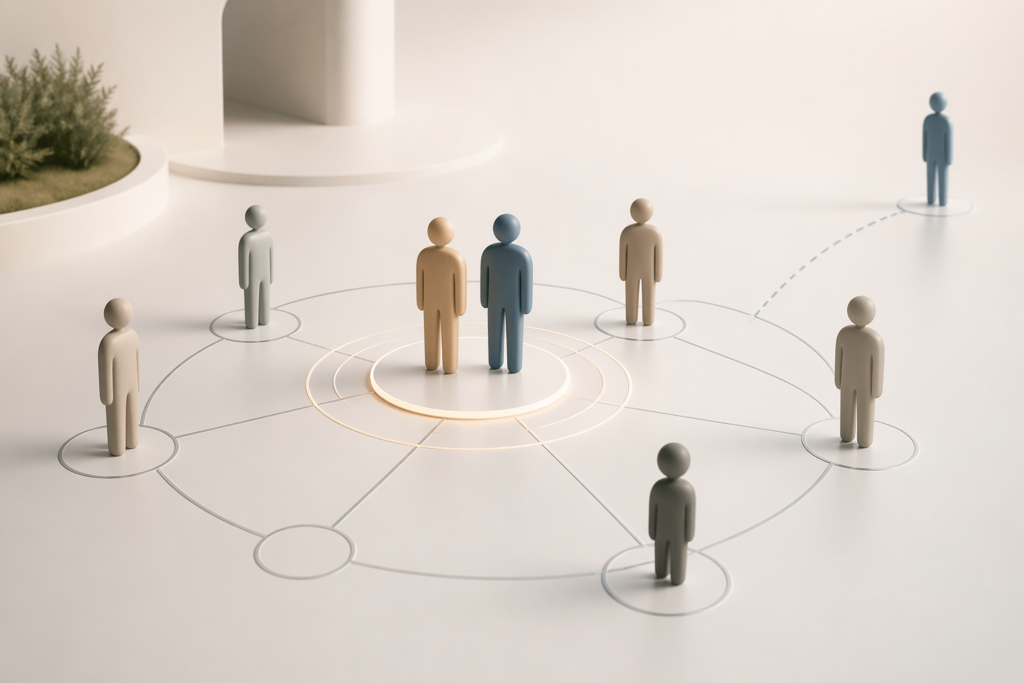
Tag: human systems

  • When Systems Get Loud, the Human Gets Lost

    A Human Systems view of control, environment, and identity


    Opening — The Assumption

    If everything around you is structured, optimized, and controlled…
    then you should function better.

    More systems = more stability.
    More control = more clarity.

    That’s the belief.


    Break the Assumption

    Some systems don’t support the human.

    They replace them.

    When a system becomes too loud—
    too structured, too controlling, too constant—

    it doesn’t guide behavior.

    It overrides it.


    System Breakdown

    Humans are adaptive systems.

    We regulate through:

    • environment
    • pacing
    • internal signals
    • autonomy of choice

    A healthy system:

    • supports regulation
    • reduces friction
    • allows variation

    But controlling environments do something different:

    They:

    • remove variation
    • suppress internal signals
    • enforce constant external structure
    • replace choice with compliance

    Over time, the human system stops referencing itself.

    It starts referencing the system.


    What Actually Happens

    At first:

    • things feel easier
    • decisions are reduced
    • structure feels supportive

    Then gradually:

    • internal signals get quieter
    • identity becomes reactive
    • behavior becomes scripted

    Eventually:

    The person is functioning—
    but not self-directed.


    The Real Question

    If the system went quiet…

    Who is left?

    Not the role.
    Not the routine.
    Not the behavior shaped by the environment.

    The actual human.


    Reframe

    The goal of a system is not control.

    It’s support without replacement.

    A system should:

    • hold structure lightly
    • amplify awareness
    • protect autonomy
    • adapt to the human—not the other way around

    System Insight

    A system becomes harmful when it becomes the primary source of truth.

    Instead of:

    “This helps me function”

    It becomes:

    “This is how I exist”

    That’s the shift where the human gets lost.


    Application

    Check any system in your life:

    Ask:

    • Can I step out of this and still feel like myself?
    • Do I notice my internal signals, or only external demands?
    • Is this system helping me choose—or choosing for me?

    If the system goes quiet and there’s discomfort…

    That’s not failure.

    That’s signal returning.


    Key Insights

    • Not all structure supports the human system
    • Control can replace regulation if it becomes constant
    • Identity weakens when internal signals are ignored
    • Healthy systems are adjustable—not dominant
    • If you can’t function without the system, the system is too loud

    The human system isn’t meant to be controlled.
    It’s meant to be supported—and still remain itself.

  • Real Food vs Processed Food: Why Taste Was Never the Point

    It Was About Signal Integrity in Human Systems

    Opening

    I didn’t change my discipline.
    I changed my environment.

    Within weeks of living in Spain, my body responded—more stable energy, clearer skin, better muscle response. No supplements. No tracking. Just different food.

    That shift wasn’t random.


    Break the Assumption

    The assumption is simple:

    If you’re eating enough, you’re being nourished.

    That assumption fails.

    Modern food systems optimize for shelf life, cost, and repeat consumption, not biological alignment.


    System Breakdown

    Food is not just fuel. It is a signaling system.

    What you eat sends instructions to your body:

    • Metabolism regulation
    • Hormonal balance
    • Energy stability
    • Cognitive clarity

    When food is altered, the signal degrades.

    In degraded systems:

    • “Fat-free” = sugar compensation
    • “Healthy” = marketing layer, not biological truth
    • Serving sizes = perception manipulation
    • Ingredients = obscured complexity

    The result:

    High caloric intake + low functional nourishment = system confusion


    Personal Evidence (Controlled)

    In the U.S., I experienced what I’d call nutritional saturation without fulfillment.

    Plenty of food. Persistent depletion.

    In Spain, without trying:

    • Simpler ingredients
    • Shorter supply chains
    • Fewer additives

    The system corrected itself.


    Reframe

    This isn’t about “good vs bad food.”

    It’s about system design differences:

    System TypeOptimization TargetResult
    Industrial Food SystemProfit + shelf stabilitySignal distortion
    Local Food SystemFreshness + simplicitySignal clarity

    System Insight

    The human body does not interpret labels.
    It interprets inputs.

    When inputs are:

    • Over-processed
    • Chemically stabilized
    • Nutritionally reconstructed

    …the body must compensate.

    That compensation shows up as:

    • Fatigue
    • Cravings
    • Instability

    Not because the body is weak—
    but because the system signal is degraded.


    Application

    If you want to improve biological performance:

    Don’t start with restriction. Start with signal clarity.

    Practical shifts:

    • Choose foods with fewer transformations
    • Favor local over global supply chains
    • Read ingredients as signals, not branding
    • Observe how your body responds within days, not months

    Key Insights

    • Food is a signaling system, not just fuel
    • Industrial optimization distorts biological signals
    • “Healthy” labels are often system noise
    • Simpler food environments reduce decision load
    • The body stabilizes quickly when signals are clean

    Closing

    If you feel off—foggy, tired, inconsistent—
    look at the system before blaming yourself.

    Because in many cases:

    It’s not a willpower problem.
    It’s a signal problem.

    And signal problems are fixable.

  • When Systems Destabilize: What Happens to Human Behavior Under Stress

    Opening — The Assumption

    When systems begin to fail, people look for explanations in culture, politics, or morality.

    They ask:
    Why are people acting like this?
    Why is this happening here?

    But this framing misses the deeper pattern.

    Across countries, histories, and systems, human behavior under instability follows consistent rules.

    The surface changes.

    The underlying system does not.


    Break the Assumption

    Instability does not create random behavior.

    It reveals how the human system responds under stress.

    When large systems destabilize—economic, political, social, or environmental—humans do not become irrational.

    They become adaptive to survival conditions.


    System Breakdown

    When stability drops, the human system recalibrates:

    Uncertainty rises → perception narrows
    Trust drops → control behaviors increase
    Coordination weakens → fragmentation begins
    Fear increases → reaction replaces decision-making

    This pattern appears everywhere:

    Economic collapse
    Conflict zones
    Natural disasters
    Institutional failure
    Rapid technological disruption

    Different environments. Same system response.


    Clarification — Fear Is Not the Cause

    It’s easy to assume fear breaks systems.

    More accurate:

    Fear is the signal.

    It reflects that the system has already lost stability.

    When predictability disappears, the human system shifts into protection mode.

    This is not failure.

    It is function.


    System Insight

    Stable systems are not defined by power, size, or authority.

    They are defined by:

    Trust continuity
    Predictable response systems
    Shared reality (agreement on what is happening)
    Capacity to absorb stress without fragmentation

    When these degrade, behavior changes.

    Not because people are worse—

    But because the conditions no longer support stable behavior.


    Reframe

    The wrong question:

    Why are people behaving this way?

    The better question:

    What conditions caused the human system to shift into survival mode?


    Application

    If you want to understand—or design—resilient systems:

    Watch trust erosion early, not just visible collapse
    Reduce unnecessary uncertainty signals
    Maintain clear, shared communication
    Design systems that degrade gracefully, not abruptly
    Support human regulation capacity, not just control mechanisms

    Focus on conditions, not blame.


    Key Insight

    Humans do not break systems.

    Systems that cannot regulate stress shift humans into states where breakdown becomes inevitable.


    Closing

    When systems hold, humans expand.

    When systems destabilize, humans contract.

    Not by choice—

    By design.

  • Why Systems Don’t Just Check Documents — They Read Behavior

    Opening

    You can have the right documents.
    The right diagnosis.
    The right qualifications.

    And still not be let in.

    Not because you’re unqualified—
    but because the system is reading something else.


    Break the Assumption

    We tend to believe systems make decisions based on facts.

    Forms. Credentials. Labels.

    But in practice, most systems don’t operate that way.

    They don’t just process information.
    They interpret presence.


    System Breakdown

    Every system has one core priority:

    stability.

    To maintain that stability, systems develop filters.

    Not just formal ones—
    but informal, behavioral ones.

    These include:

    • how you communicate
    • how predictable you seem
    • how well you match expected patterns
    • how safe you feel to others inside the system

    Before access is granted, the system is asking:

    “Will this person maintain or disrupt the environment?”

    This evaluation often happens quickly—
    and mostly outside of conscious awareness.


    Personal Evidence (Controlled)

    You can see this in support systems.

    In some autism organizations, access isn’t immediate.

    There may be a meeting first.
    A conversation.
    An assessment of fit.

    On the surface, this looks like verification.

    But functionally, it’s something else:

    a behavioral alignment check.

    The intention is protection—
    to keep the environment safe for those already inside.

    But the effect is more complex.


    Reframe

    This isn’t about gatekeeping in the traditional sense.

    It’s about system stabilization.

    Systems that support vulnerable people
    tend to be more sensitive to disruption.

    So they filter more carefully.

    But here’s the tradeoff:

    The same filters that protect
    can also exclude.

    Not because someone doesn’t belong—
    but because they don’t match expected signals.


    System Insight

    Access isn’t granted by qualifications alone.

    It’s granted by alignment.

    Systems don’t evaluate what you claim.
    They evaluate what your behavior signals over time.

    Every action—timing, tone, response, consistency—
    is interpreted as a signal of fit.

    Whether you intend it or not,
    you are always communicating alignment.


    Application

    Next time you enter a system:

    • slow down
    • observe before acting
    • match the tone of the environment
    • adapt instead of pushing

    This isn’t about changing who you are.

    It’s about understanding the system you’re in
    so you can move through it more effectively.


    Key Insights

    • Systems prioritize stability over fairness
    • Behavior is often weighted more than credentials
    • Filters protect environments—but can exclude needed participants
    • Alignment is interpreted, not declared

    Closing

    If we want better systems,
    we don’t just improve access.

    We improve how systems interpret people.

    Because right now,
    many systems are protecting themselves—

    even when it means keeping out
    the very people they were built to support.

  • When Systems Scale Beyond Empathy

    Key Insight

    Growth isn’t the problem.
    Scale isn’t the problem.

    The problem is what systems optimize for as they scale.


    Break the Assumption

    We often assume that as systems grow, they become more capable of serving people.

    In reality, scale changes what a system can perceive.

    As systems grow, they replace direct human signals with measurable proxies—and lose visibility into the people they were designed to serve.


    System Breakdown

    At small scale, systems operate close to human experience:

    • Direct feedback
    • Context-rich decisions
    • Adaptive responses

    At large scale, this becomes unmanageable.

    So systems shift toward what can be measured:

    • Data instead of experience
    • Metrics instead of meaning
    • Targets instead of context

    This creates a predictable chain:

    • Human input → translated into data
    • Data → simplified into metrics
    • Metrics → optimized at scale
    • Optimization → detaches from lived reality

    The system becomes more efficient—
    but less aware.


    Mechanism: Stabilizing Demand

    As systems scale, they don’t just respond to demand—they begin to stabilize it.

    When real human need isn’t enough to sustain growth, systems compensate.

    Products and services are optimized for:

    • repeat consumption
    • efficiency and margin
    • predictable behavior

    At the same time, demand is reinforced through:

    • advertising
    • behavioral nudging
    • perceived need creation

    The system appears responsive—
    but is increasingly generating the very demand it depends on.


    Real-World Example: Airbnb

    Airbnb began as a simple exchange—unused space meeting temporary need.

    At small scale, it increased flexibility and access.

    As the system grew, optimization shifted.

    Individual hosts were replaced by professional operators.
    Homes became inventory.

    What was once:

    • housing first, hospitality second

    Became:

    • hospitality first, housing second

    The system didn’t intend to displace residents.
    It optimized for occupancy, yield, and demand.

    And in doing so, it reduced the availability of long-term housing in the very places people live.


    Reframe

    Systems don’t lose empathy because they grow.

    They lose empathy because they lose visibility.

    When human signals are replaced by proxies, the system follows the proxies.


    System Insight

    At scale, systems don’t lose purpose—
    they lose visibility.

    And once visibility is lost, optimization continues without awareness of impact.


    Application

    When evaluating any system—platform, policy, or product—don’t ask:

    • “Is it efficient?”

    Ask:

    • “What human signals were replaced to make it efficient?”
    • “What can this system no longer see?”
    • “Who is affected but not measured?”

    These questions restore visibility where scale has removed it.


    Key Insights

    • Scale requires simplification—and simplification removes context
    • Metrics replace human signals because they are easier to optimize
    • Systems become efficient at targets while becoming blind to people
    • Demand can be stabilized or manufactured when real need is insufficient
    • Loss of empathy is not failure—it is a predictable system outcome
  • Human Systems Must Evolve: A Path to a Stable Future

    By Oddly Robbie

    Human systems are beginning to shift across the world.

    More people are stepping out of silence and questioning systems built on domination, extraction, and fear. This is not just political tension. It is a deeper refusal to continue feeding systems that reward harm while calling it normal.

    More people are recognizing the cost of old models of power. Systems shaped by greed, control, and permanent conflict do not create stability. They drain human energy, distort priorities, and keep societies locked in reaction instead of progress.

    The System Problem

    We already have the knowledge, tools, and productive capacity to reduce hunger, prevent suffering, and support human dignity.

    The constraint is not capability. It is how human systems are designed.

    The real question is:

    • Who do systems serve?
    • What behaviors do they reward?
    • What harm do they allow to continue?

    When systems reward extraction over wellbeing, outcomes follow that design.

    Empathy as Infrastructure

    This is why empathy matters—not as emotion, but as structure.

    A functioning human system must:

    • recognize real needs
    • reduce unnecessary harm
    • organize around collective wellbeing

    Without this, systems default to competition loops that escalate instability.

    Why Control Systems Fail

    Oppressive systems often look powerful in the moment.

    But structurally, they are fragile.

    Systems built on:

    • fear
    • division
    • dehumanization

    cannot adapt. They do not know how to relate—only how to control. Over time, they begin to consume themselves.

    What Actually Scales

    What lasts is not domination.

    It is:

    • cooperation
    • trust
    • aligned incentives

    The future is not built by stronger control systems.
    It is built by better-designed human systems.

    The Shift

    The planet does not need more speeches about saving it while destructive systems remain unchanged.

    It needs:

    • systems capable of regeneration
    • coordination without exploitation
    • restraint in the face of power

    And it needs people willing to shift energy away from conflict and toward repair.

    Practical Reality

    This does not require perfection.

    It requires enough people:

    • making better decisions
    • designing better systems
    • refusing to reinforce what is clearly broken

    Small shifts, repeated across systems, compound into real change.

    Why This Matters Now

    Human systems are no longer isolated. What happens in one region quickly affects others through economics, technology, and environment.

    This means poorly designed systems do not stay contained. Instability spreads.

    Designing better human systems is no longer optional. It is required for long-term global stability.

    Final Thought

    The future will not be built by silence.

    It will be built by people willing to:

    • question what is broken
    • understand how systems actually work
    • and help redesign them toward something better
  • Stability Is Not a Place — It’s a System

    moving to spain with cats personal story stability system

    Right now, as you read this, I’m in the air—literally.

    Suspended in that liminal space between the familiar and the foreign, crossing invisible lines that mark not just countries but chapters.

    Two suitcases.
    Two carry-ons.
    Two cats.
    My partner and I.


    The Belief

    At the time, I thought I was moving toward stability.

    A new country.
    A new environment.
    A place that might feel better, safer, more aligned.

    Like many people, I believed stability came from where you are.


    The Reality

    This wasn’t a sprint away from something.
    It was a walk toward something new.

    And I didn’t dislike where I came from. I felt deeply for the U.S.—for the people navigating its increasingly jagged terrain.

    But for someone like me—neurodivergent, routine-oriented, soothed by predictability—change like this isn’t just hard.

    It’s seismic.


    The Preparation

    I had never been to Spain before. Not physically.

    But I prepared intensely:

    • I walked its streets in virtual reality
    • I studied its rhythms daily
    • I followed local news
    • I learned language, slang, and custom

    Not just to survive—but to belong.

    I trained for this like an athlete trains for their debut:

    with empathy in one hand and self-protection in the other.


    What Actually Happened

    Something unexpected happened in that process.

    I changed.

    I became:

    • more effective
    • more reflective
    • more capable of handling uncertainty

    I learned to pack light—not just in my suitcase, but in my thinking.


    The System I Didn’t See Yet

    At the time, I thought Spain would give me stability.

    But looking back, that’s not what happened.

    What I actually built was something portable:

    • routines
    • awareness
    • adaptability
    • internal regulation

    Spain didn’t create those.

    The preparation did.


    The Reframe

    Stability isn’t a place you arrive at.

    It’s a system you build.

    And once you build it:

    It travels with you.


    Why This Matters

    Because if your stability depends on:

    • a country
    • a job
    • a situation

    Then uncertainty will always feel like a threat.

    But if your stability comes from:

    • what you do daily
    • how you think
    • how you adapt

    Then no single outcome can take it from you.


    Looking Back

    At the time, I thought I was flying toward a new life.

    Now I see it differently.

    I was building the ability to function anywhere.


    Today

    Now, I find myself in a different kind of uncertainty.

    Not in the air—but in between outcomes.

    Waiting on decisions that could shift where I live, how I move, what comes next.

    And I notice something important:

    I’m not reacting the same way.

    I’m still walking.
    Still training.
    Still thinking clearly.
    Still building.


    What Changed

    Back then, I thought stability was something I was flying toward.

    Now I see it differently.

    It’s something I already built.


    The Real Test

    The move to Spain wasn’t the achievement.

    This is.

    The ability to stay steady when nothing is guaranteed.


    Final Insight

    You can’t remove uncertainty from life.

    But you can build a system that doesn’t collapse when it shows up.

    That’s the difference.

    That’s stability.

  • Challenge Claims with Evidence: A Human Systems Method

    1. Opening

    Challenge claims with evidence sounds simple—but most people don’t actually do it.

    “Don’t take my word for it” is often used as a signal of truth. In reality, it usually replaces the process of verifying information with the feeling of confidence.

    In most cases, people still accept the claim at face value.

    That’s where the system breaks.


    2. Break the Assumption

    We assume that inviting challenge leads to verification.

    It doesn’t.

    Most people hear:

    • “Trust me”
    • “It’s true”
    • “Don’t take my word for it”

    …and stop there.

    The phrase creates the feeling of openness—without the process of testing anything.


    3. System Breakdown

    In human systems, claims are often accepted based on delivery, not evidence.

    When someone says:

    • “Don’t take my word for it”
    • “Look it up”
    • “Do your own research”

    it can signal one of two things:

    • Genuine openness to verification
    • Or a transfer of responsibility without providing structure

    This creates a failure pattern:

    The burden shifts to the listener—but without tools to evaluate the claim.

    So what happens?

    • People don’t investigate
    • Or they investigate poorly
    • Or they confirm what they already believe

    The result is not truth—it’s reinforced bias.


    4. Personal Evidence (Controlled)

    Over time, I noticed something consistent:

    When I actually did challenge claims—slowing down, checking structure, asking for evidence—the outcome changed.

    Some ideas held up.

    Many didn’t.

    The difference wasn’t intelligence.

    It was method.

    At one point, I was part of a highly structured belief system that openly encouraged questioning.

    On the surface, it sounded aligned with truth-seeking.

    But when I actually questioned—when I slowed down, asked for evidence, and pushed beyond surface answers—the response changed.

    The encouragement disappeared.

    What was allowed in language wasn’t supported in practice.

    That’s when I started to see the pattern:

    Some systems don’t resist questions directly—they signal openness, but react negatively when real investigation begins.

    That gap—between what a system says and how it responds—is where you learn what actually holds.


    5. Reframe

    “Don’t take my word for it” is not a conclusion.

    It’s an entry point.

    The real process starts after the statement—not before it.

    Once you see that gap, you stop listening to claims—and start watching systems.


    6. System Insight

    Across human systems:

    People are rarely taught how to challenge—only that they should.

    So language substitutes for process.

    Phrases like:

    • “Do your research”
    • “It’s obvious”
    • “Everyone knows”

    create the illusion of rigor without the structure of it.

    Real verification requires:

    • Evidence
    • Traceability
    • Repeatability

    Without these, “challenge” becomes performance—not investigation.


    7. Application — The “Challenge It” Test

    When you hear a claim:

    Step 1 — Pause

    Don’t react to confidence or tone.

    Step 2 — Ask

    • What evidence supports this?
    • Where does this information come from?

    Step 3 — Investigate

    • Can this be independently verified?
    • Is the source credible or just repeated?

    Step 4 — Analyze the System

    • What mechanism makes this true?
    • Does it hold under different conditions?

    Step 5 — Decide

    • Evidence holds → keep it
    • Evidence weak → discard or flag

    You’re not rejecting the claim.

    You’re testing it.


    8. Key Insights

    • “Don’t take my word for it” often shifts responsibility without guidance
    • Confidence and openness can mask lack of structure
    • Most people are told to question—but not how
    • Evidence requires method, not intention
    • Truth survives investigation—weak claims don’t

    Closing

    The next time someone says:

    “Don’t take my word for it.”

    Take them seriously.

    Challenge it.

    Because real understanding doesn’t come from hearing claims—

    It comes from learning what makes them actually work.

  • Human Systems Roles Before Ability

    Opening

    Human systems roles before ability is one of the most common structural failures in how societies shape identity and potential.

    From a Human Systems perspective, roles are often assigned before ability is understood.

    From a young age, children are guided toward what they are expected to be rather than what they might become.

    These expectations are usually subtle. They come through praise, repetition, and what a culture treats as “normal.” Over time, they begin to feel natural—even inevitable.

    Break the Assumption

    But these expectations are not neutral.

    They shape identity before ability has a chance to emerge.

    When a system rewards fitting a role more than exploring a possibility, it begins narrowing human potential early—long before real capacity is understood.

    System Breakdown

    This is how human systems roles before ability becomes a repeated pattern.

    Human systems operate through reinforcement loops:

    • What is praised gets repeated
    • What is repeated becomes identity
    • What becomes identity limits exploration

    When roles are assigned too early, systems begin to confuse compliance with capability.

    This creates a filtering effect:

    • Some paths are encouraged
    • Others are quietly discouraged
    • Entire areas of potential are never explored

    Over time, the system does not just reflect culture—it locks it in place.

    Why This Pattern Persists

    Human systems roles before ability persists because it simplifies complexity.

    Assigning roles early reduces uncertainty for the system. It creates predictability, faster social organization, and easier control. But this efficiency comes at a cost: it trades long-term human potential for short-term stability.

    Over time, systems that rely on early role assignment become rigid. They struggle to adapt, innovate, or respond to new challenges because too many individuals were never allowed to fully develop their capabilities.

    This is why systems that appear stable in the short term often become fragile in the long term.

    Personal Evidence

    When my daughter said she wanted to be a paleontologist, it stood out for a simple reason.

    It didn’t come from expectation. It came from curiosity.

    That moment wasn’t just a childhood statement—it was a glimpse of what happens when possibility appears before permission.

    Reframe

    A healthier system does not assign identity first.

    It allows ability to emerge before roles are defined.

    Instead of asking:

    “What should this person be?”

    It asks:

    “What is this person capable of becoming?”

    System Insight

    Systems that avoid human systems roles before ability produce better long-term outcomes.

    They:

    • preserve variation
    • expand problem-solving capacity
    • increase adaptability over time

    Equality, in this context, is not symbolic.

    It is structural.

    It protects access to exploration before identity is fixed.

    Application

    This changes how we think about everyday interactions:

    • Encourage curiosity over conformity
    • Reward exploration, not just correctness
    • Avoid reinforcing roles too early
    • Pay attention to what is quietly discouraged

    Small signals shape long-term outcomes.

    What is allowed early becomes what is possible later.

    Key Insights

    • Human systems roles before ability limits human potential early
    • Early reinforcement shapes identity more than most people realize
    • Systems that preserve exploration produce stronger long-term outcomes
    • Equality is not about sameness—it is about access to possibility
    • What a system rewards determines what it becomes

  • Wasted Time Doesn’t Exist

    A relaxed person lying in grass at sunset, symbolizing rest and a reframe of the idea of wasted time.


    (A Human Systems Reframe)

    By Oddly Robbie


    The Belief We Inherited

    People say things like:

    • “My time.”
    • “Your time.”
    • “Time is money.”

    That last one always lands heavy.

    It sounds practical. Responsible. Even intelligent.

    But it carries something underneath it:
    A quiet rule — that if time isn’t being used, it’s being wasted.


    The Break

    Today, my partner spent the morning gaming.
    Fully immersed. Smiling. Alive in it.

    Later, he said he had “wasted time.”

    That’s the moment the system shows itself.

    Because nothing about what I saw looked like waste.


    The Hidden System

    “Wasted time” isn’t a fact.
    It’s a cultural control mechanism.

    A narrative designed to keep people:

    • productive
    • measurable
    • economically useful

    It defines value narrowly:

    If you’re not producing, you’re failing.

    But that system ignores something fundamental:

    You are not a production unit.


    The Reality of Time

    Time isn’t something you own.
    You can’t store it.
    You can’t spend it.

    You can only experience it.

    Time is not currency.
    It’s process.

    A rhythm.
    A flow.
    A continuous unfolding of being.


    What “Doing Nothing” Actually Is

    When you rest, you’re regulating your nervous system.

    When you play, you’re engaging joy and cognition.

    When you drift or daydream, you’re integrating experience.

    These are not empty states.
    They are core human functions.

    Calling them “waste” is a system error.


    System Insight

    The idea of “wasted time” exists because the system only recognizes visible output.

    But human life runs on:

    • invisible processing
    • emotional regulation
    • cognitive integration
    • restoration cycles

    Remove those, and output collapses anyway.


    The Reframe

    You don’t waste time.

    You either:

    • align with your current state, or
    • fight it and create friction

    That’s it.


    Expanded Perspective (If You Want to Go Further)

    Some physicists suggest time itself may not even “flow” the way we think.

    Researchers like Carlo Rovelli and Julian Barbour argue:

    • Time may be an illusion
    • Only change is real
    • We move through states, not through time

    If that’s true, then “wasting time” becomes even less meaningful.

    You’re not losing anything.
    You’re simply occupying a state of existence.


    Final Grounding

    If you feel guilt about “wasting time,” pause.

    That feeling didn’t come from you.
    It came from the system you were taught.

    Take a breath.

    Look at what you’re actually doing.

    Living?
    Resting?
    Processing?
    Enjoying?

    Then nothing is being wasted.


    Key Insight

    You cannot waste time.

    You can only misinterpret your experience of it.

    And once you see that clearly—
    the guilt disappears.


    Closing

    Living is not a transaction.

    It’s not something to optimize every second.

    It’s something to experience fully.

    And that—
    is never wasted.