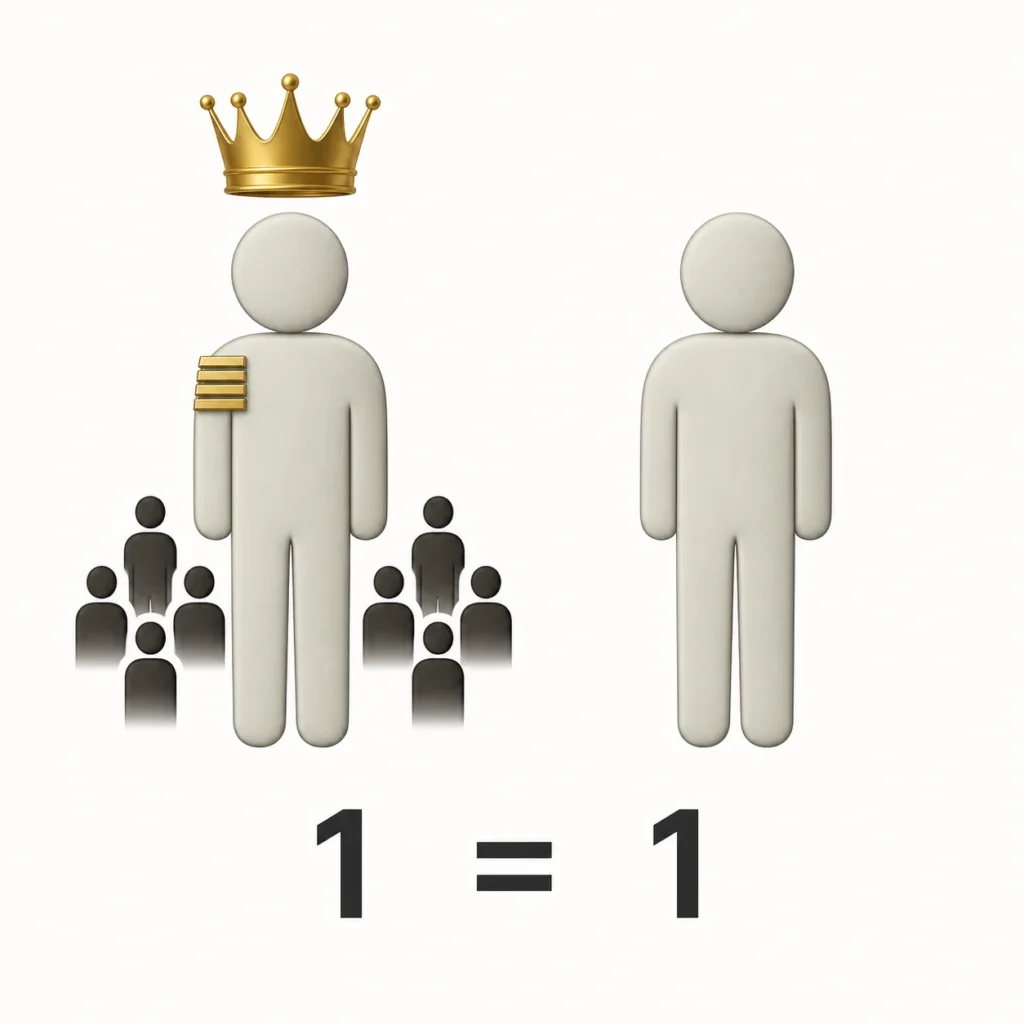
The idea that one person is more valuable than another feels normal in many human systems.
We rank people by money, status, education, beauty, title, citizenship, productivity, popularity, religion, confidence, and social approval. Some people are treated as if they naturally count more. Others are treated as if they count less.
But under logic, this idea breaks. One human does not become two humans because they have more status.
One person does not become more real because they have more money.
One life does not gain extra human units because society places a crown, uniform, title, follower count, or reputation around it.
Human worth has no measurable unit that increases with status.
One equals one. 1=1
The False Math of Human Ranking
A person can have more power than another person.
A person can have more skill in a specific task.
A person can hold more responsibility inside a system.
A person can have more knowledge in a particular field.
But none of that makes them more human.
This is where many systems confuse function with worth.
A doctor may know more about medicine than a patient.
A judge may hold authority in a courtroom.
A parent may have responsibility for a child.
A teacher may guide a student.
A leader may coordinate a group.
Those roles matter. But roles are not proof of higher human value. They are functions inside a context.
The failure begins when a system says:
“This person has more function here, therefore this person is worth more.”
That is the false step.
Function can differ.
Worth does not.
How Systems Turn Difference Into Hierarchy
Human systems often need roles. Roles help organize work, care, learning, safety, and responsibility. A society cannot function if every person does every task at the same time.
The problem is not role.
The problem is when role becomes rank.
A useful system says:
“This person has a specific responsibility in this context.”
A harmful system says:
“This person is above another person.”
That small shift changes everything.
Once people are placed above and below each other, the system begins to justify unequal listening, unequal protection, unequal dignity, and unequal care. The person at the top is treated as more credible. The person at the bottom is treated as more disposable.
This is not logic.
It is social storytelling.
Where This Breaks in Real-World Decisions
The belief that one human can be “more” than another does not stay abstract. Once a society accepts human ranking, that ranking starts shaping decisions.
It shows up in healthcare when some lives are treated as more worth saving, listening to, or believing. A patient with money, fluency, status, or social approval may be taken more seriously than someone poor, disabled, foreign, autistic, elderly, or emotionally distressed.
But the body does not become less real because the person has less status. Pain does not become less valid because the patient is harder to understand.
It shows up in law when punishment is applied differently depending on class, race, citizenship, appearance, reputation, or perceived respectability. The same action can be interpreted as a mistake in one person and a character flaw in another.
That is not justice.
That is ranking disguised as judgment.
It shows up in AI systems when human data is treated as if social patterns equal truth. If a system learns from a world that already ranks people unfairly, it may reproduce those rankings through hiring filters, credit scoring, policing tools, medical triage, recommendation systems, or automated risk labels.
The machine does not need hatred to cause harm.
It only needs inherited hierarchy treated as useful signal.
It shows up in relationships when one person’s needs, emotions, time, or perspective are treated as naturally more important than another’s. A person may dominate because they are louder, more socially confident, more educated, more financially secure, or simply used to being centered.
But a relationship based on human ranking is not connection.
It is control with emotional decoration.
The System Failure
The logic collapses when systems stop asking:
“What role does this person have here?”
And start asking:
“How much does this person count?”
That question corrupts decision-making.
It turns practical differences into moral hierarchy.
It turns authority into superiority.
It turns vulnerability into lower value.
It turns social approval into evidence.
This is how people become easier to dismiss. Not because they are less human, but because the system has created a story where their humanity is easier to ignore.
A Better Human Systems Frame
A healthier system can recognize difference without converting difference into hierarchy.
It can say:
A surgeon may be better at surgery than a child.
But the surgeon is not more human than the child.
A judge may hold authority in court.
But the judge’s life is not worth more than the person standing before them.
A teacher may know more about a subject.
But the student does not become lesser.
A leader may coordinate a group.
But leadership is a function, not a higher species of person.
This distinction matters.
When systems remember it, they can assign responsibility without inflating human worth. They can make decisions without dehumanizing people. They can recognize skill, experience, context, and risk without pretending some people count more than others.
Human Worth Is Not a Ranking System
Human worth is not a scoreboard.
It is not a market price.
It is not a title.
It is not a productivity score.
It is not a popularity metric.
It is not granted by institutions, religions, governments, employers, families, audiences, or algorithms.
A person may gain power.
A person may lose power.
A person may gain status.
A person may lose status.
A person may become useful to a system.
A person may become inconvenient to a system.
But none of those changes the basic unit.
One human remains one human.
Why This Matters Now
This matters because modern systems are becoming faster at ranking people.
Platforms rank attention.
Markets rank usefulness.
Institutions rank compliance.
AI systems rank risk, relevance, probability, and predicted value.
Social systems rank belonging.
Without a clear human principle underneath those systems, ranking becomes invisible. It starts to feel natural. People begin to confuse system position with human value.
That is dangerous.
A system can rank tasks.
A system can rank urgency.
A system can rank expertise in a specific context.
But once a system starts ranking human worth, it has crossed into dehumanization.
The Reframe
The better frame is simple:
People can differ in role, skill, need, power, responsibility, and context.
But difference is not hierarchy.
A humane system does not flatten everyone into sameness. It does not pretend everyone has the same abilities, responsibilities, or needs.
Instead, it separates two things clearly:
Function can differ. Worth does not.
That one distinction protects human dignity while still allowing practical decision-making.
It allows healthcare to assess medical need without dismissing difficult patients.
It allows law to assess actions without ranking lives.
It allows AI systems to support decisions without encoding inherited social bias as truth.
It allows relationships to hold different needs without turning one person into the center and the other into support material.
Key Insights
- Human systems often confuse role with worth.
- Status can increase power, but it does not increase human value.
- Real-world harm appears when ranking shapes healthcare, law, AI systems, and relationships.
- AI systems can reproduce hierarchy without intending harm if biased social patterns are treated as useful signal.
- A humane system can recognize difference without converting difference into superiority.
- The core distinction is: function can differ; worth does not.
Final Thought
One person may stand on a stage.
One may sit in a waiting room.
One may hold a title.
One may hold nothing visible at all.
But underneath every overlay, the unit remains the same.
One does not equal more.
One equals one.